


Do you need planning permission for air conditioning in the UK?
Most domestic air conditioning installations do not need planning permission, provided the outdoor unit meets Permitted Development conditions under Class G of the GPDO 2015. That is the short answer. The longer answer depends on three things: how big the outdoor compressor is, where you put it, and what kind of property you own.
Government guidance published in June 2026 confirms air conditioning has not been banned, and that small domestic installs generally sit outside planning control as long as they do not materially change how the house looks from outside, according to MHCLG. But that reassurance comes with real caveats:
- The outdoor unit must fit within strict volume limits, and those limits differ for houses and flats.
- Flats, maisonettes, listed buildings, and homes in conservation areas usually fall outside Permitted Development entirely.
- A unit that only cools, rather than one that can also heat, may not qualify for the same exemption.
If you want certainty rather than a probable answer, you can apply to your council for a Lawful Development Certificate, a formal document confirming your installation is legal, according to Gov. It costs a modest fee and removes any doubt before you spend money on equipment and installation.
Key Takeaways
Most UK homeowners can install air conditioning without planning permission if the outdoor unit meets Class G’s size, siting, and heating-capability conditions, though flats, listed buildings, and conservation areas usually fall outside that protection.
| Point | Details |
|---|---|
| Check the volume limit | Confirm your outdoor unit is under 1.5m³ for houses or 0.6m³ for flats before ordering. |
| Mind the boundary | Keep the unit at least one metre from the property boundary and off road-facing walls above ground floor. |
| Confirm heating capability | Cooling-only units may fall outside Permitted Development; heat pump models generally qualify. |
| Get it in writing | A Lawful Development Certificate from the council removes future enforcement risk. |
| Use certified installers | Ask for F-Gas, Part P, and MCS evidence before the installer leaves site. |
Table of Contents
- Permitted development: the Class G criteria you must meet
- When you do need planning permission (common scenarios and edge cases)
- Building Regulations, electrical safety and installer qualifications
- How to check with your local planning authority (steps, forms and Lawful Development Certificates)
- Practical checklist for homeowners before you order or install an air conditioning unit
- Noise and neighbour nuisance: placement matters more than you think
- Does air conditioning affect property value and resale?
- Environmental rules and energy efficiency standards to consider
- What to do if your planning application is refused
- What happens after you apply: typical outcomes and timelines
- Making an outdoor unit look like it belongs
- Get compliant heating and cooling advice from Simcodirect
- The gap between what the rules promise and what actually protects you
- Sources
- FAQ
Permitted development: the Class G criteria you must meet
Class G of the Town and Country Planning (General Permitted Development) (England) Order 2015 is the piece of law that lets homeowners install air source heat pumps and comparable air conditioning units without applying for planning permission, as long as several conditions are satisfied together. Miss one, and you drop out of Permitted Development and need to apply.
Here is what actually determines whether your installation qualifies:
- Outdoor unit volume. Following the 2025 amendment, a detached or semi-detached dwellinghouse can have an outdoor compressor of up to 1.5 cubic metres, roughly the size of a large wheelie bin, while a flat within a block is limited to 0.6 cubic metres, according to the 2025 amendment order.
- Distance from the boundary. The unit generally needs to sit at least one metre from the edge of the property boundary. Push it closer and you likely need permission.
- Roof and wall placement. You cannot install a unit on a pitched roof, and units mounted on a wall or roof slope facing a road are restricted above ground-floor level.
- Heating capability. The 2025 amendment inserted a specific condition: the unit must not be used solely for cooling. If your air conditioning is cooling-only with no heat pump function, it typically sits outside the Class G exemption altogether, regardless of size.
That last point catches people out. Plenty of products sold as “air conditioning” are actually air-to-air heat pumps that both heat and cool, and manufacturer spec sheets usually state this clearly. Check the datasheet before you buy if you want Permitted Development protection, because a straightforward cooling-only split unit may need a planning application even at a modest size.
Measuring “volume” practically means multiplying the unit’s height, width, and depth as listed on the manufacturer’s spec sheet, not estimating by eye. Most standard domestic split-system condensers, the kind fitted to the side or rear of a semi-detached house, sit comfortably under the 1.5m³ limit, according to Ideal Home’s practical summary.
When you do need planning permission (common scenarios and edge cases)
Permitted Development rights narrow considerably once your property or location falls into certain categories, and it is worth checking these before you order equipment.
- Flats and maisonettes. Class G generally does not extend Permitted Development rights to flats in the same way it does to houses, meaning most flat-based installations need a planning application or freeholder consent, or both.
- Listed buildings and scheduled monuments. Any external alteration, including a wall-mounted condenser, typically requires listed building consent regardless of size.
- Conservation areas and World Heritage Sites. Local authorities often apply tighter controls here, and some councils use an Article 4 direction to remove Permitted Development rights on a street-by-street basis.
- Siting within one metre of the boundary or on a road-facing wall above ground floor. Either of these breaches the standard Class G conditions outright.
- Multiple units on non-detached homes. Terraced and semi-detached properties face tighter restrictions on how many external units can be fitted without triggering a full application.
If any of these apply, you are not automatically refused. It simply means you need to submit a planning application, and the council will assess the visual impact, noise, and precedent before deciding. Where an Article 4 direction is in force, check with the council early, since these directions vary street to street and are easy to miss if you are relying on general guidance alone.
Building Regulations, electrical safety and installer qualifications
Planning permission and Building Regulations are two separate systems, and clearing one does not mean you have cleared the other. Even a fully Permitted Development installation still has to meet building standards.
- Part F ventilation. Approved Document F sets out when mechanical ventilation and air conditioning works need building-control notification, and what performance standard the system must meet once fitted.
- Part P electrical safety. Any new circuit or significant electrical work connected to the installation should be carried out or certified by a registered electrician or a competent-person scheme, according to Gov.
- F-Gas regulations. Anyone handling refrigerant during installation or servicing must hold F-Gas certification. This is a legal requirement, not a nice-to-have.
- MCS standards. Where the unit functions as a heat pump, installers working towards MCS certification follow recognised design and installation standards, which matters if you later want to claim any heat pump incentive.
Ask your installer for an installation certificate, proof of F-Gas registration, and electrical compliance documentation before they leave site, and keep all three with your property paperwork.
Pro Tip: Photograph the outdoor unit’s data plate and keep the spec sheet with your household documents. If you ever sell the property, or a neighbour raises a query with the council, that single sheet of paper answers most questions in seconds.
How to check with your local planning authority (steps, forms and Lawful Development Certificates)
Confirming your position with the council takes a little admin, but it is far less hassle than an enforcement notice.
- Contact the planning department directly, either through the council’s website or by phone, and describe the unit: make and model, outdoor compressor volume, and proposed siting.
- Send supporting evidence. A simple sketch plan, a photo of the intended location relative to the boundary, and the manufacturer’s dimensions usually suffice for an informal check.
- Apply for a Lawful Development Certificate if you want written confirmation rather than a verbal steer. This carries a fee, generally in the low hundreds of pounds, and gives you a legal document that protects against future enforcement action, according to gov.uk.
- Submit a full planning application if your installation clearly falls outside Class G, for example in a conservation area or on a flat. Expect to provide elevation drawings and, in sensitive locations, a noise assessment.
- Keep every document. Certificates, correspondence, and installer paperwork should all sit in one file, ideally digital and backed up, in case a future buyer’s solicitor asks for evidence during conveyancing.
Councils vary in how quickly they respond to informal enquiries, so build in a few weeks if you are working to an installation date.
Practical checklist for homeowners before you order or install an air conditioning unit
A few minutes of checking now saves a dispute later.
- Measure the outdoor unit’s volume from the spec sheet and confirm it against the 1.5m³ or 0.6m³ limit that applies to your property type.
- Check the distance from your boundary; anything under one metre needs a rethink or a planning application.
- Site the unit to the rear or side of the property where possible, away from road-facing elevations above ground level, paying attention to wall penetration and existing ventilation requirements as explained in our guide to cavity wall vents.
- Confirm the unit provides heating as well as cooling if you want Permitted Development protection, and keep the spec sheet as proof.
- Check whether your home is listed or in a conservation area, and if you are in a flat, get freeholder or management-company consent in writing.
- Verify your installer’s F-Gas, MCS, and Part P credentials, and ask for written compliance evidence.
- Consider a Lawful Development Certificate before work starts if your installation sits close to any of the size or siting limits.
Pro Tip: If you are choosing between a cooling-only split system and an inverter model that also heats, the inverter option is usually the safer route for Permitted Development purposes as well as for running costs. Our inverter air conditioner guide covers how these units perform through a UK winter.
Noise and neighbour nuisance: placement matters more than you think
Outdoor compressor units are not silent, and a badly placed one is the single most common reason neighbours complain to the council even where planning permission was never required.
Modern split-system condensers typically run at a modest noise level in normal operation, but that figure climbs under heavy load, on hot afternoons, or with age as fans wear. Mounting a unit directly outside a neighbour’s bedroom window, or wedging it into a narrow side passage where sound reflects off two walls, amplifies the problem regardless of the manufacturer’s stated decibel rating.
Three placement habits avoid most disputes. First, keep the unit away from shared boundaries and bedroom windows on both sides of the fence, not just your own. Second, avoid enclosed alleys and passageways where noise bounces rather than dissipates. Third, mount the unit on brackets rather than directly against a party wall, since solid-fixed units transmit vibration into shared brickwork far more than bracket-mounted ones.
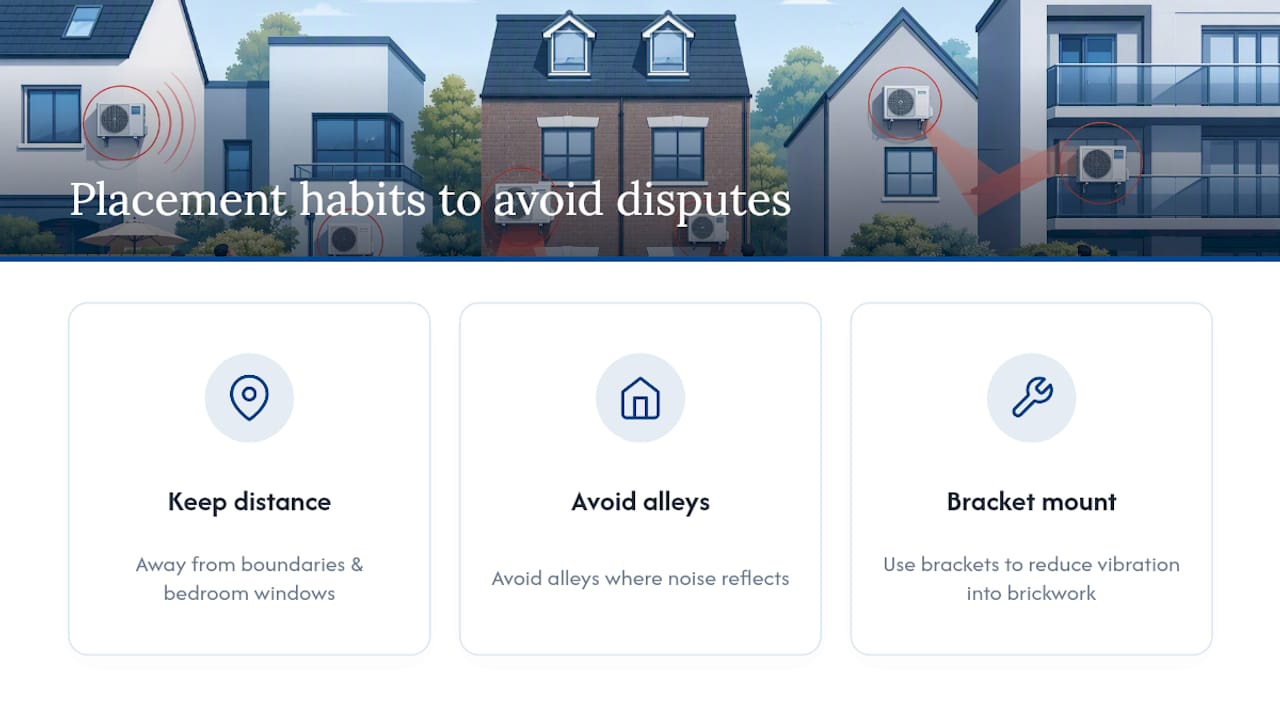
Noise nuisance is dealt with separately from planning law, usually through environmental health rather than the planning department, but a complaint can still trigger scrutiny of whether your installation was ever lawful in the first place. Getting siting right at the outset, and picking a quieter model designed for close-quarters installation, is cheaper than resolving a dispute after the fact.
Does air conditioning affect property value and resale?
Air conditioning has shifted from a rare luxury to an increasingly expected feature in UK homes, particularly following the warmer summers of recent years, and a well-installed system is generally viewed as a practical improvement rather than a liability.
The bigger risk to resale value is not the unit itself but paperwork gaps. An estate agent or a buyer’s solicitor will often ask what confirms the installation was lawful, and if you cannot produce a Lawful Development Certificate, planning permission, or clear evidence the work met Permitted Development conditions, that uncertainty can slow a sale or prompt a buyer’s surveyor to flag it. Buyers are increasingly cautious about unauthorised external alterations precisely because enforcement action, however unlikely, becomes their problem once they own the property.
A visually intrusive unit bolted to a front-facing wall can also affect kerb appeal in a way that a discreetly sited rear-mounted system does not. Buyers notice a compressor unit mounted awkwardly at eye level far more than one tucked behind a side return or screened by planting.
The practical takeaway: keep your certificate or correspondence with the council, choose a sensible siting position, and treat the installation paperwork with the same care you would a new boiler or extension. It costs nothing extra and removes a question mark at the point of sale.
Environmental rules and energy efficiency standards to consider
Air conditioning units are covered by F-Gas regulations because most systems use refrigerants classified as fluorinated greenhouse gases, and only F-Gas certified engineers are legally permitted to handle, install, or service equipment containing them. This is separate from planning law but equally non-negotiable, and it is one of the paperwork items worth confirming before you commit to an installer.
Energy efficiency matters for running costs as much as environmental impact. Inverter-driven units, which modulate compressor speed rather than switching bluntly on and off, generally use meaningfully less electricity over a cooling season than older fixed-speed systems, and many also double as efficient heating in shoulder seasons. That heating capability, beyond the running-cost benefit, is also the feature that keeps a unit inside the Class G Permitted Development exemption under the 2025 amendment.
Look for the manufacturer’s stated Seasonal Energy Efficiency Ratio (SEER) rating when comparing units, since a higher SEER figure indicates better performance per unit of electricity across a typical UK cooling season. Pairing a well-rated unit with sensible siting, decent insulation, and shading on south-facing glazing reduces the load the system has to work against in the first place, which matters more for your electricity bill than any single spec figure on the box.
What to do if your planning application is refused
A refusal is not the end of the road, and most homeowners have a genuine path forward if their application does not succeed first time.
You generally have six months from the decision date to lodge an appeal with the Planning Inspectorate, which reviews the case independently of the council that made the original decision. Appeals are usually decided through written representations, meaning both sides submit documents rather than attending a hearing, and a decision typically takes several months from submission.
Before appealing, it is worth asking the council directly what drove the refusal. Common reasons include visual impact on a conservation area, noise concerns raised by neighbours during consultation, or siting that breaches the boundary distance even where the unit’s volume was acceptable. Many refusals can be resolved more quickly by resubmitting a revised application that addresses the specific objection, for instance moving the unit to a rear elevation or reducing its visible footprint with screening, rather than appealing the original decision outright.
If the objection centres on noise, commissioning a short acoustic assessment from an independent consultant and submitting it with a revised application often carries more weight with planning officers than argument alone. Persistence with a modified proposal succeeds more often than a straight appeal against the original refusal.
What happens after you apply: typical outcomes and timelines
Most straightforward householder planning applications for air conditioning, where one is genuinely needed, are decided within eight weeks of the council confirming the application is valid, though this varies by authority and by how contested the site is.
Applications in conservation areas or affecting listed buildings tend to take longer, partly because they often require consultation with a conservation officer or Historic England, and partly because objections from neighbours or amenity societies can extend the process. A clean application with a well-sited, modest unit and no objections is more likely to be approved without conditions. Applications proposing a large or prominently sited unit, particularly on a front elevation, are more likely to draw either a refusal or an approval subject to conditions, such as a requirement to repaint the casing to match the wall or restrict operating hours.
Informal enquiries and Lawful Development Certificate applications generally move faster than full planning applications, since the council is simply confirming an existing legal position rather than exercising planning judgement on a new proposal. Building in a buffer of several weeks either way, and avoiding a fixed installation date until you have written confirmation, prevents the common mistake of booking an installer before the paperwork is settled.
Making an outdoor unit look like it belongs
A condenser unit does not have to look like an afterthought bolted onto the side of your house. Careful integration protects kerb appeal and reduces the chance of a neighbour objection reaching the council in the first place.
On period and listed properties, discreet siting matters more than anywhere else. A unit tucked behind a low wall, screened with slatted timber, or painted to match the brickwork using specialist masonry-effect paint tends to draw far less attention than a bright white box on an exposed elevation. On newer builds, manufacturers increasingly offer units in anthracite grey or black casings that blend with modern render and dark window frames rather than the traditional white finish.
Ground-level positioning behind planting, or within a purpose-built timber screen with ventilation slats, works well for most house types and has the added benefit of reducing perceived noise for neighbours. Avoid boxing a unit in too tightly, though, since condensers need adequate airflow to run efficiently, and restricting that airflow both increases running costs and shortens the unit’s working life.
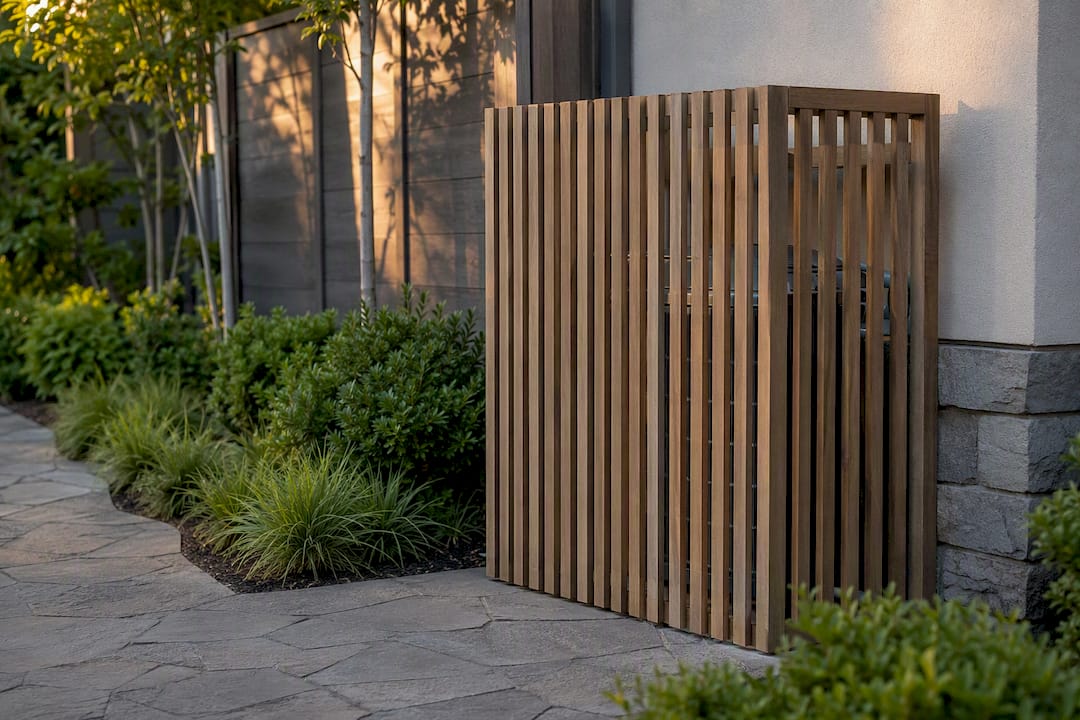
For flats and terraces where a wall-mounted position is unavoidable, a compact unit sited as low and as far from the boundary line as the space allows tends to satisfy both aesthetic and planning concerns simultaneously.
Get compliant heating and cooling advice from Simcodirect
Getting the planning position right is only half the job. Choosing equipment that suits your property and comes with the right documentation makes the rest of the process straightforward. Simcodirect stocks a range of heating solutions that pair well with a compliant air conditioning setup, from electric heaters for shoulder-season warmth to towel radiators for bathrooms where a full AC installation is not practical.
If you are weighing up complementary heating for rooms that will not get an AC unit, the Dimplex Q-Rad RF panel radiator offers smart electric heating with app-based control, while the Dimplex DX convector heater suits smaller spaces that need quick, reliable warmth. For bathrooms, the Titan chrome straight towel radiator combines heating with practical towel drying, a sensible addition alongside any home comfort upgrade. Every order ships with UK delivery and the product documentation you may need to support a council enquiry or a Lawful Development Certificate application.
The gap between what the rules promise and what actually protects you
The conventional advice on air conditioning planning permission in the UK stops at “check the size limit.” That is not wrong, but it is not enough. The real risk sits in the details people skip: whether the unit heats as well as cools, whether it is measured against the right volume limit for a house versus a flat, and whether the installer can actually prove F-Gas and Part P compliance when a buyer’s solicitor asks in three years’ time.
Homeowners underestimate how often enforcement gets triggered not by the council patrolling streets, but by a neighbour’s complaint about noise or a badly placed unit. A Permitted Development installation that technically complies on paper can still land you in a dispute if it is bolted next to someone’s bedroom window.
If there is one priority above all others, it is documentation. A spec sheet, an installer’s compliance certificate, and, where the installation sits anywhere near the limits, a Lawful Development Certificate. That paperwork costs little now and settles every future question in one go.
Sources
This guidance is built on primary sources rather than second-hand summaries: Class G of the GPDO 2015, the MHCLG clarification published in June 2026, and Approved Document F for Building Regulations.
- Air conditioning rules
- The Town and Country Planning (General Permitted Development) (England) Order 2015 — Class G
- Approved Document F Volume 1: Dwellings (Approved Document F)
- Lawful development certificates
FAQ
Do I need planning permission for AC in a standard semi-detached house? Usually not, provided the outdoor unit is under 1.5 cubic metres, sits at least a metre from the boundary, and is not mounted on a road-facing wall above ground-floor level.
Do you need planning permission for air con if you live in a flat? Almost always yes, or at minimum you need freeholder or management-company consent, since Class G’s Permitted Development rights generally do not extend to flats.
What UK air conditioning regulations apply even without planning permission? Building Regulations still apply. Part F covers ventilation performance and Part P covers electrical safety, and F-Gas certification is required for anyone handling refrigerant.
How do I get planning approval for air conditioning if I fall outside Permitted Development? Submit a full householder planning application to your local planning authority with plans showing the unit’s position, size, and, in sensitive areas, a noise assessment.
Is a Lawful Development Certificate worth the cost? For most homeowners installing near the size or siting limits, yes. It provides written legal confirmation that protects against enforcement action later, particularly useful at the point of sale.