


Air purifier CADR explained: a UK buyer's guide
CADR stands for Clean Air Delivery Rate. It measures the volume of filtered air an air purifier delivers per unit of time, expressed in cubic feet per minute (CFM) or cubic metres per hour (m³/h). The practical rule for UK buyers: your purifier’s smoke CADR (in m³/h) should match or exceed your room volume multiplied by your target air changes per hour, divided by 60. For most living spaces, that means targeting 3–5 air changes per hour. Every air purifier carries three separate CADR figures: one each for smoke, dust, and pollen. When comparing models, look for the AHAM Verifide seal, which confirms those numbers were independently tested rather than self-reported.
Key takeaways
Choosing an air purifier comes down to one calculation: match the unit’s smoke CADR (in m³/h) to your room volume multiplied by your target ACH, then verify the figures are independently certified before buying.
| Point | Details |
|---|---|
| Calculate before you buy | Use CADR (m³/h) = room volume × target ACH; aim for 4–5 ACH in bedrooms, 5–6 in kitchens. |
| Convert CFM to metric | Multiply any CFM figure by 1.699 to get m³/h for UK room calculations. |
| Use smoke CADR as the benchmark | Smoke CADR covers the finest particles and is the basis for AHAM’s suggested room size at 4.8 ACH. |
| Check AHAM Verifide certification | Unverified CADR claims are common; confirm the model appears on the AHAM Verifide directory. |
| Simcodirect for UK purchases | Simcodirect supplies air purification systems with fast UK delivery, a 30-day returns policy, and replacement filter listings. |
Table of Contents
- What does an air purifier CADR rating actually measure?
- How to convert CADR figures and calculate what your room needs
- How to choose the right CADR for your UK room
- How does CADR relate to air changes per hour?
- What CADR does not tell you
- Other checks that matter as much as CADR
- Worked CADR calculations for common UK rooms
- Why AHAM Verifide certification matters and how to check it
- A retailer’s perspective on buying air purifiers in the UK
- Air purification from Simcodirect: practical support for UK buyers
- Sources
What does an air purifier CADR rating actually measure?
The CADR rating comes from a standardised test defined by the ANSI/AHAM AC-1 standard. A purifier runs inside a sealed chamber of approximately 1,008 ft³ (around 28.4 m³) at its maximum fan speed. Sensors measure how quickly the concentration of each test pollutant drops compared to natural decay without the unit running. The difference, multiplied by the chamber volume, gives the CADR figure.
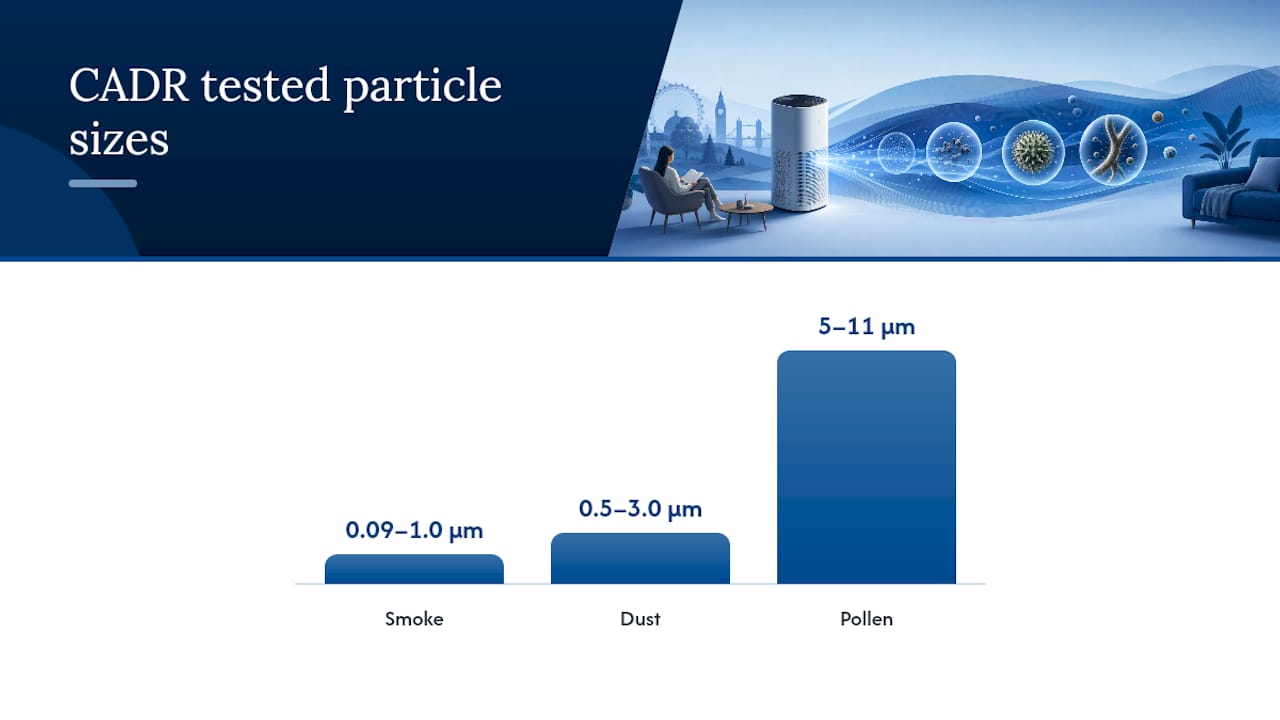
Three pollutants are tested separately because particle size changes how difficult removal is:
- Smoke (0.09–1.0 microns): the finest particles and the hardest to capture. Smoke CADR is the most demanding figure and the one AHAM uses to help guide suggested room size.
- Dust (0.5–3.0 microns): medium-sized particles typical of household dust and skin cells. The maximum measurable dust CADR in the chamber is capped at a certain limit.
- Pollen (5–11 microns): the largest particles, easiest to filter. Maximum measurable CADR for pollen is capped at a certain limit.
Because smoke particles overlap significantly with PM2.5 (fine particulate matter at 2.5 microns and below), a strong smoke CADR is the most useful figure for urban UK buyers dealing with traffic pollution, cooking fumes, or wildfire smoke events.
AHAM Verifide is the certification programme that independently verifies these figures. Models are submitted for testing, and AHAM conducts periodic sampling from market stock to confirm ongoing compliance. A model listed on the AHAM Verifide directory has had its CADR confirmed by a third party, not just declared by the manufacturer.
How to convert CADR figures and calculate what your room needs
Most imported air purifiers quote CADR in CFM. UK rooms are measured in metres. The conversion is straightforward: multiply CFM by 1.699 to get m³/h. So a unit rated at 200 CFM delivers approximately 340 m³/h of clean air.
The core sizing formula
To find the minimum CADR your room requires:
CADR (m³/h) = Room volume (m³) × Target ACH ÷ 60
Room volume is simply length × width × ceiling height, all in metres. Target ACH (air changes per hour) is typically 3–5 for a bedroom or living room, and up to 6 for a kitchen or a room with a known pollution source.
| Scenario | Target ACH | Formula note |
|---|---|---|
| Bedroom, low pollution | 3–4 | Standard sizing |
| Living room, urban area | 4–5 | Use smoke CADR as the limiting figure |
| Kitchen or high-pollution room | 5–6 | Add 20–30% safety margin |
| Wildfire or heavy smoke event | Use smoke CADR = room area (m²) | Special AHAM guidance |
The two-thirds floor-area rule
If you prefer a quicker check: your smoke CADR in CFM should be at least two-thirds of your room’s floor area in square feet. For a metric shortcut, convert your floor area to square feet (multiply m² by 10.76) and apply the same rule. This AHAM guidance is a conservative baseline, not a ceiling.
For wildfire or heavy smoke events, AHAM’s white paper recommends a more aggressive approach: choose a unit whose smoke CADR (in CFM) equals the room’s floor area in square feet, effectively targeting around 7.5 ACH rather than the standard 4.8.
How to choose the right CADR for your UK room
Getting the right unit is a five-step process. Work through it once and you will not need to revisit it.
-
Measure your room. Length × width × ceiling height in metres. A typical UK double bedroom might be 3.5 m × 4.0 m × 2.4 m = 33.6 m³. A standard lounge could be 4.5 m × 5.0 m × 2.4 m = 54 m³.
-
Choose your target ACH. For most bedrooms, 4–5 ACH is sufficient. Open-plan kitchen-diners benefit from 5–6 ACH. If anyone in the household has asthma or allergies, target the higher end of the range.
-
Calculate the required CADR. Using the formula above: a 33.6 m³ bedroom at 5 ACH needs a CADR of 33.6 × 5 ÷ 60 = 2.8 m³/min, or 168 m³/h. A 54 m³ lounge at 5 ACH needs 54 × 5 ÷ 60 = 4.5 m³/min, or 270 m³/h.
-
Check all three CADR figures. Use the lowest of the three as your effective CADR. A unit with a high pollen CADR but a weak smoke CADR will underperform on fine particles, which are the ones most likely to affect health in UK urban environments.
-
Verify the spec sheet before buying. Look for: AHAM Verifide certification, HEPA H13 or H14 filter grade, noise level in dB at a typical (not maximum) fan speed, filter replacement frequency and cost, and whether replacement filters are readily available in the UK.
For high-ceilinged rooms (above 2.7 m), recalculate using the actual volume rather than assuming a standard ceiling. Open-plan spaces are best treated as a single large room; do not split them into notional zones and size a small unit for each.
You will run it at a quieter, lower fan speed most of the time, which extends filter life and keeps noise below 40 dB, the threshold most people find acceptable for sleeping.*
How does CADR relate to air changes per hour?
CADR and ACH measure related but distinct things. CADR is an absolute rate: the volume of clean air the unit delivers per hour regardless of room size. ACH is a relative rate: how many times the total air volume of a specific room passes through the purifier per hour. Neither is more “correct”; they are useful at different stages.
The relationship is:
ACH = CADR (m³/h) ÷ Room volume (m³)
So a unit with a CADR of 270 m³/h in a 54 m³ lounge delivers exactly 5 ACH. Put that same unit in a 90 m³ open-plan space and ACH drops to 3.
Key distinctions to keep in mind:
- CADR is the figure on the box and the one used for comparison shopping. It is fixed for a given unit at a given fan speed.
- ACH is room-specific. It tells you whether a unit you already own is adequate for a particular space.
- For consumer purchasing decisions, CADR is the primary metric. ACH becomes more useful when you are planning ventilation for a specific room or assessing whether an existing unit is working hard enough.
- Healthcare and commercial settings often specify minimum ACH targets (typically 6–12 ACH for clinical environments). Residential guidance from AHAM is based on 4.8 ACH as the standard suggested room size basis, with higher ACH improving particle removal percentages.
Understanding how bathroom ventilation and mechanical airflow interact with ACH calculations can also help when planning air treatment across multiple rooms.
What CADR does not tell you
CADR is a useful shorthand, but it has real limits. Knowing them prevents expensive mistakes.
- Gases and odours are invisible to CADR. The test uses particles only. A unit with an excellent CADR can still fail to remove VOCs, formaldehyde, cooking smells, or nitrogen dioxide unless it also carries an activated carbon filter. CADR says nothing about that layer of filtration.
- Maximum fan speed is not your fan speed. CADR is always measured at the highest setting. Run the unit at a quieter setting, as most people do overnight, and effective CADR drops proportionally. A unit rated at 300 m³/h at full speed may deliver 150–180 m³/h at a mid-range setting.
- The test chamber is small. At roughly 28.4 m³, it is smaller than most UK living rooms. Real rooms have furniture, corners, and uneven air circulation. A unit that performs well in a controlled chamber may not distribute clean air evenly across a larger, furnished space.
- Filter loading reduces performance over time. A fresh filter captures particles efficiently. A clogged filter does not. CADR figures reflect a new filter at peak condition, not a filter six months into its service life.
- No energy or noise data. CADR tells you nothing about how loud the unit is or how much electricity it uses. Both matter for daily running costs and livability.
- Non-verified claims are common. Manufacturers selling outside the AHAM Verifide programme can state any CADR figure they choose. Different test methods across regions (particularly some Asian markets) use different chamber sizes and conditions, making direct comparisons unreliable.
For long-term performance, look beyond CADR to the Cumulative Cleaning Mass (CCM) rating. CCM measures how much total pollution a filter can handle before its efficiency drops, which matters far more than peak CADR if you live near a busy road or run the unit continuously.
A unit with a high CADR but a low CCM is like a fast car with a small fuel tank: impressive in short bursts, but not built for sustained heavy use.
Other checks that matter as much as CADR
Once you have a target CADR figure, these are the attributes that separate a genuinely good unit from one that merely looks good on paper.
Filter grade and particle capture
- H13 HEPA captures at least 99.95% of particles at 0.3 microns (the most penetrating particle size). This is the minimum grade worth specifying for allergy or asthma management.
- H14 HEPA captures 99.995% at 0.3 microns. Useful for very fine particles and higher-sensitivity environments.
- Avoid units described only as “HEPA-type” or “HEPA-like” without a stated grade. These are not standardised terms.
Long-term performance indicators
- CCM rating: expressed as a mass (grams). Higher CCM means the filter handles more total pollution before degrading. Particularly relevant for heavy-use or high-pollution environments.
- PM2.5 CADR: some manufacturers now publish a separate PM2.5-specific CADR figure alongside the standard smoke/dust/pollen trio. Where available, this is the most directly relevant figure for urban UK air quality.
Running costs and practicalities
- Noise at typical settings: check dB figures at the fan speed you will actually use, not just maximum. Below 40 dB is generally acceptable for a bedroom; below 50 dB for a living room.
- Power consumption: a unit running 24 hours a day at 50W costs roughly £65–£80 per year at current UK electricity rates. Check the wattage at your intended fan speed, not peak draw.
- Filter replacement cost and availability: a cheap unit with expensive or hard-to-source filters is not a bargain. Confirm UK availability before buying.
The ENERGY STAR room air cleaner specification provides a useful cross-check on energy performance and lists certified models. Pairing AHAM Verifide certification with ENERGY STAR listing gives you independent verification of both air-cleaning performance and energy efficiency in a single model.
Worked CADR calculations for common UK rooms
Example 1: small bedroom
Room: 3.0 m × 3.5 m × 2.4 m = 25.2 m³. Target ACH: 5.
- Required CADR = 25.2 × 5 = 126 m³/h
- Add 20% safety margin: 126 × 1.2 = 151 m³/h minimum
- If a model is rated in CFM: 151 ÷ 1.699 = approximately 89 CFM minimum
Example 2: medium lounge
Room: 4.5 m × 5.0 m × 2.4 m = 54 m³. Target ACH: 5.
- Required CADR = 54 × 5 = 270 m³/h
- Add 20% margin: 270 × 1.2 = 324 m³/h minimum
- CFM equivalent: 324 ÷ 1.699 = approximately 191 CFM minimum
Example 3: open-plan kitchen-diner
Room: 6.0 m × 7.0 m × 2.7 m = 113.4 m³. Target ACH: 6 (cooking fumes, higher ceiling).
- Required CADR = 113.4 × 6 = 680.4 m³/h
- Add 20% margin: 680.4 × 1.2 = 816 m³/h minimum
- CFM equivalent: 816 ÷ 1.699 = approximately 480 CFM minimum
For the open-plan example, a single domestic unit is unlikely to be sufficient. Two units positioned at opposite ends of the space, each rated at around 420–450 m³/h, will outperform one large unit placed centrally because they circulate air more evenly.
Placement note: position the unit where air can circulate freely, at least 30 cm from walls and furniture.
Why AHAM Verifide certification matters and how to check it
The AHAM Verifide programme is the most reliable independent verification available for residential air purifiers sold in the UK. Here is how the process works and what it actually guarantees.
- Manufacturer submits the model for testing. An independent laboratory runs the ANSI/AHAM AC-1 protocol in the standard 1,008 ft³ chamber at maximum fan speed, measuring decay rates for smoke, dust, and pollen.
- AHAM publishes the verified CADR figures and suggested room size. The suggested room size is derived from the smoke CADR using a basis of 4.8 ACH, as confirmed in the AHAM AC-1 FAQs. This is a conservative standard; running the unit in a smaller room than suggested will deliver higher ACH and better particle removal.
- AHAM conducts periodic market sampling. Units are purchased from retail stock and retested to confirm ongoing compliance. This is what distinguishes Verifide from a one-time self-declaration.
- Check the AHAM Verifide directory directly. Visit Ahamverifide and search by brand or model name. If a model does not appear, its CADR figures are unverified.
For wildfire or heavy smoke events, AHAM’s guidance shifts: choose a unit whose smoke CADR in CFM equals the room’s floor area in square feet, targeting approximately 7.5 ACH rather than the standard 4.8.
Pro Tip: Cross-check any AHAM-listed model against the ENERGY STAR certified room air cleaners list. A model that carries both certifications has been independently verified for both cleaning performance and energy efficiency, which is the strongest combination of trust signals available for a residential purchase.
A retailer’s perspective on buying air purifiers in the UK
The single most common mistake UK buyers make is choosing a unit based on price or appearance without checking whether its smoke CADR is adequate for the room. A purifier that looks right on a shelf can be genuinely undersized for a UK lounge or open-plan space, and running an undersized unit at maximum speed all day is both noisy and costly.
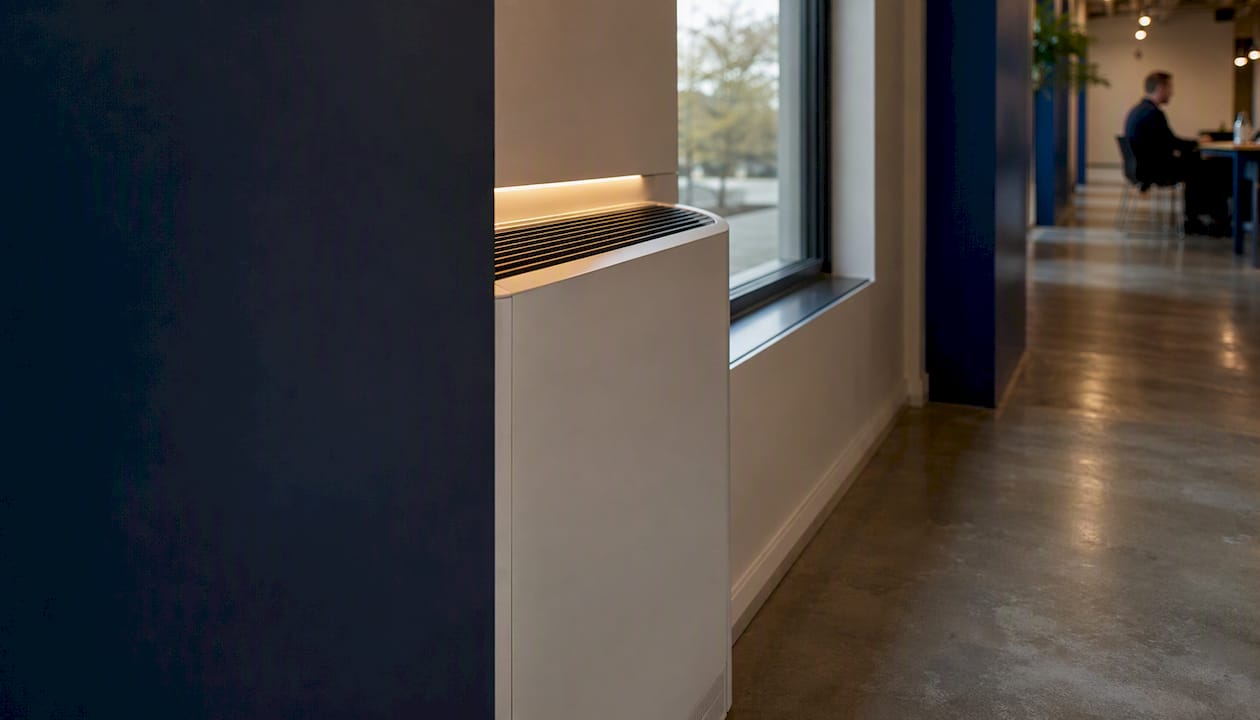
When selecting air purification products for UK customers, the priorities are straightforward: verified CADR matched to room volume, H13 or H14 HEPA filtration, and confirmed availability of replacement filters. A unit is only as good as its filter, and a filter you cannot replace in the UK within a reasonable lead time is a liability. Aftercare matters too: fast delivery, a clear returns policy, and accessible product support make a real difference when you are investing in something you will run every day.
Air purification from Simcodirect: practical support for UK buyers
Choosing the right air purifier is straightforward once you have the CADR figure your room needs. Simcodirect stocks air purification systems with fast UK delivery and a 30-day returns policy, so you are not locked into a unit that does not perform as expected.
Replacement filters are listed alongside the main products, making it easy to plan running costs before you buy. The best air purifiers guide for UK commercial facilities on the Simcodirect blog covers larger spaces and commercial applications in detail. For healthy home upgrades more broadly, the Homes2MoveYou guide to healthy home improvements is worth a read alongside your CADR calculations.
Visit Simcodirect to browse the current air purification range, check filter availability, and place an order with next-day UK delivery options.
Sources
These are the primary references behind the guidance in this article. Each is worth consulting if you want the original standards or deeper technical detail.