


When to replace your air purifier filter (and how to tell)
Replace HEPA filters every 6 to 12 months and carbon filters every 3 to 6 months, but let the filter itself decide the exact date. Homes with pets, smokers, or purifiers running around the clock often need fresh filters at the shorter end of that range, sometimes sooner.
The one rule worth memorising: check condition, don’t just trust the clock. Timer lights reset on a schedule; they don’t know if your filter is still working. A quick visual and airflow check tells you far more than any indicator light.
- HEPA filters: 6 to 12 months, shorter with pets or continuous use
- Carbon filters: 3 to 6 months, they saturate faster in kitchens and smoking households
- True HEPA filters: never wash them, water collapses the fibre matrix
- Pre-filters: usually washable and worth cleaning monthly
Washing a true H13 HEPA filter can cut its particle-capture efficiency to around 50 to 60%, which defeats the purpose of having one. If you’d rather not gamble on a worn filter, Simco Direct stocks genuine replacement HEPA filters with fast UK delivery.
Key Takeaways
Filter replacement should follow visible condition and airflow performance, not a fixed calendar date alone.
| Point | Details |
|---|---|
| Replace on condition | HEPA lasts 6 to 12 months, carbon 3 to 6 months, sooner with pets, smoking, or continuous use. |
| Never wash true HEPA | Washing can cut particle capture to around 50 to 60%, ruining filtration performance. |
| Maintain pre-filters monthly | Washing pre-filters extends main filter life and can save £20 to £40 a year. |
| Trust your eyes, not just lights | Timer indicators are reminders only; visual and airflow checks confirm actual condition. |
| Buy genuine, model-matched filters | Simco Direct’s replacement HEPA filters are matched to specific models with fast UK delivery. |
Table of Contents
- How often to replace your air purifier filter
- What are the signs a filter needs replacing?
- How to replace an air purifier filter step by step
- HEPA, ULPA, and washable filters: what not to wash
- Pre-filter care and cutting your annual filter bill
- Where to buy genuine replacement filters
- Publisher proof points and further reading
- What actually matters more than the calendar date
- Get your replacement filter sorted today
- Sources
How often to replace your air purifier filter
Manufacturer replacement intervals are printed on the box for a reason, but they’re built around average conditions in an average home. Yours probably isn’t average. A flat with two cats and a smoker will chew through a filter far faster than a quiet one-bedroom with no pets and windows shut most of the year.
Continuous operation is the biggest variable. A purifier running 24 hours a day in a bedroom will need attention sooner than one switched on for a few hours in the evening. Cooking oils, wood-burning stoves, and traffic pollution near busy roads all add particulate load that clogs pleats faster than the manufacturer’s lab tests assume.
Use these as starting points, then adjust:
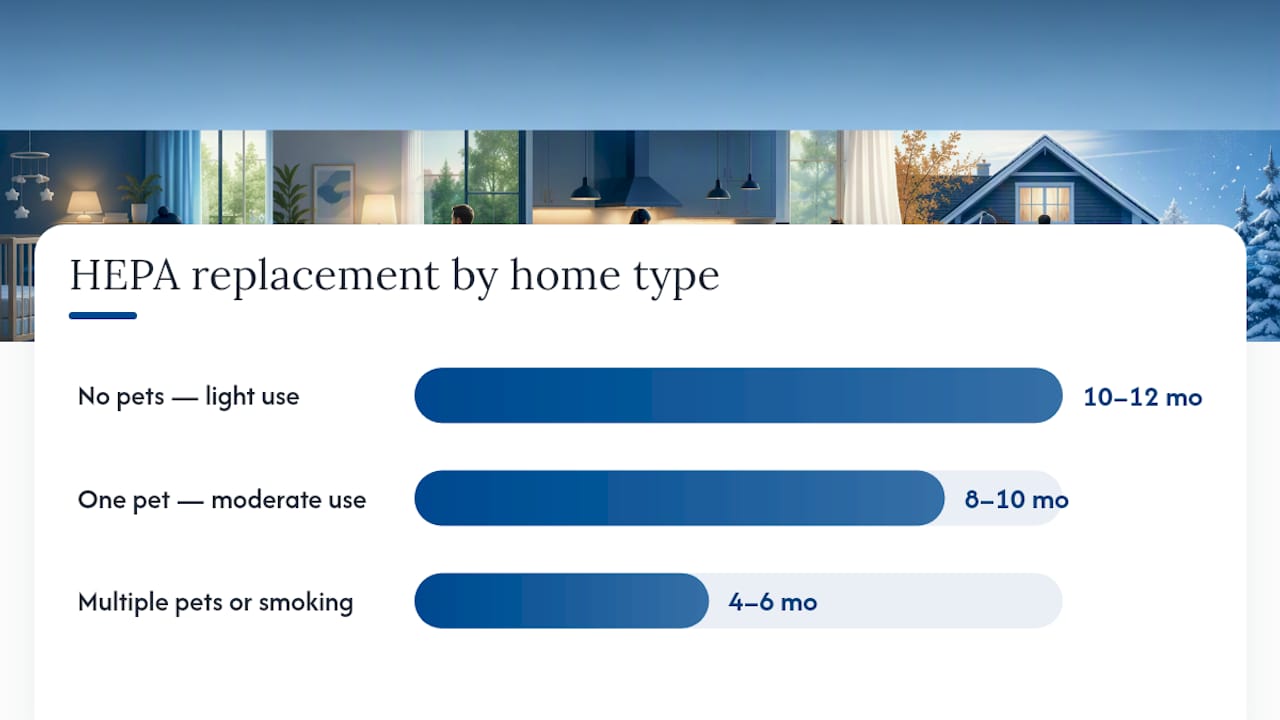
- No pets, light use, rural or suburban area: HEPA every 10 to 12 months, carbon every 5 to 6 months
- One pet or moderate daily use: HEPA every 8 to 10 months, carbon every 4 months
- Multiple pets, smoking, or continuous running: HEPA every 4 to 6 months, carbon every 2 to 3 months
- City centre or heavy traffic exposure: shorten every interval above by roughly a third
Write the installation date on the filter frame with a marker pen. It sounds basic, but it’s the single easiest way to build a personalised replacement calendar without relying on memory or a reset button that someone in the house might have already pressed.
What are the signs a filter needs replacing?
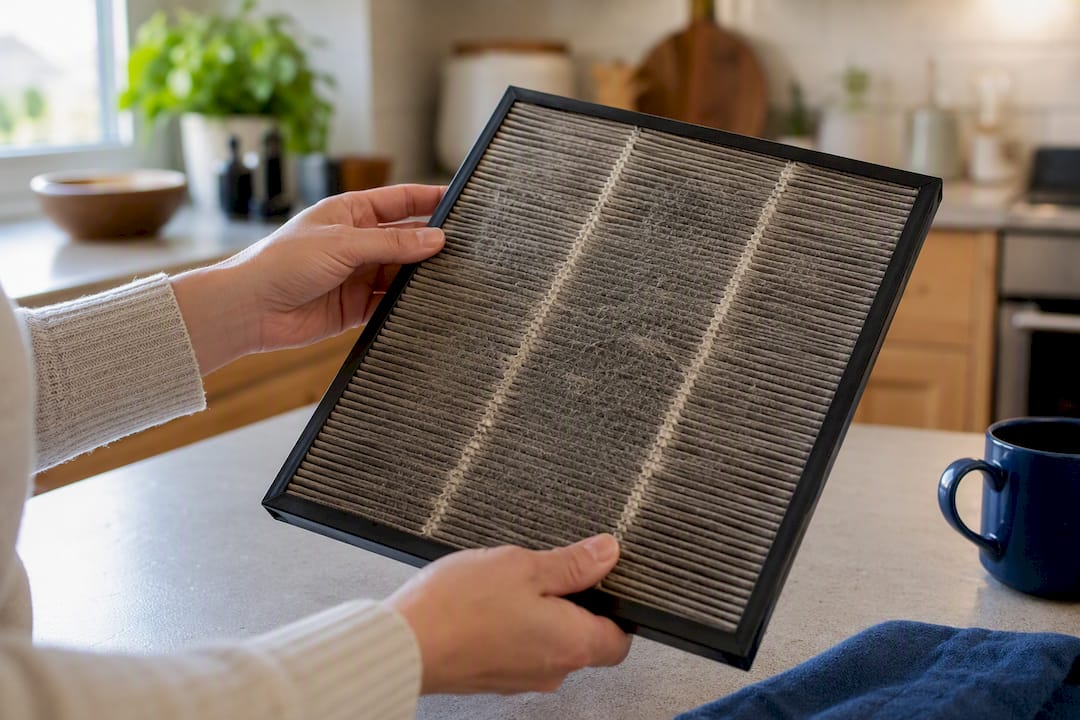
Your eyes and nose are better sensors than most built-in indicators. A HEPA filter that started white and now looks grey, brown, or has visible fluff and debris stuck to the pleats has been working hard and is due for retirement. Hold it up to a window; light passing through unevenly, or barely at all, is a clear signal.
- Reduced airflow: hold your hand near the outlet on the highest setting; a noticeably weaker breeze than when the unit was new means the filter is clogging
- Persistent odours: if the unit no longer neutralises cooking smells or pet odour, the carbon filter has likely reached saturation
- Worsening symptoms: increased sneezing, itchy eyes, or a stuffy feeling despite the purifier running suggests it’s no longer catching what it should
- Visible dust or discolouration: grey or brown staining across the pleats, especially near the intake side
Filter indicator lights work on a countdown timer, not a sensor reading actual filter condition. Manufacturer guidance is inherently conservative, so treat the light as a prompt to inspect, never as proof the filter is fine or finished.
Pro Tip: Keep a spare filter in the cupboard once your unit is six months old. Running out mid replacement, with the old filter already binned, means days of unfiltered air while you wait for delivery.
How to replace an air purifier filter step by step
Replacing a filter takes ten minutes if you work through it in order. Rushing the disposal step is where most people go wrong, so slow down there in particular.
- Unplug the unit and set it on a table or work surface with a bin bag ready nearby.
- Open the housing according to your model’s release catches, usually clips or a sliding panel at the back or side.
- Remove the old filter without shaking it. Shaking releases trapped particles straight back into your room air.
- Bag it immediately and carry it outside before sealing, rather than leaving it open on a kitchen counter.
- Wipe down the housing interior with a dry or slightly damp cloth, then wash or vacuum the pre-filter if fitted.
- Insert the new filter, checking the airflow arrow printed on the frame faces the correct direction.
- Reset the filter indicator using the button or menu specified in your manual.
- Run the unit on its highest setting for 20 to 30 minutes to clear any manufacturing residue before returning to normal use.
HEPA, ULPA, and washable filters: what not to wash
ULPA filters go further, capturing particles as small as 0.12 microns, and turn up mostly in cleanroom and medical settings rather than domestic purifiers. Both rely on that fibre structure staying dry and undisturbed.
Water swells and distorts the fibres, and vacuuming tears the delicate mat. That’s why washing a true HEPA filter can drop its capture rate to roughly half its rated performance, even though it looks clean and unbroken afterwards.
- Washable pre-filters: designed for water, they catch hair, lint, and larger debris before it ever reaches the HEPA layer
- “Washable HEPA” main filters: these typically sacrifice fine-particle capture compared with true H13 HEPA, fine for dust but weaker on allergens
- Activated carbon filters: adsorb odours and gases until every pore is saturated, then need full replacement, they can’t be recharged by washing or drying
- Best for allergy or asthma sufferers: disposable true HEPA, replaced on schedule, not a washable substitute
Pre-filter care and cutting your annual filter bill
Pre-filter maintenance is the cheapest, highest-return habit in this entire guide. A clean pre-filter blocks hair, dust, and larger particles before they ever reach the HEPA layer, which slows how fast that expensive main filter clogs.
- Wash foam or mesh pre-filters monthly where your manual permits it, and let them air dry for 24 to 48 hours before refitting; fitting a damp filter invites mould.
- Vacuum-only pre-filters need a soft brush attachment rather than water, done roughly every two weeks.
- Choosing a purifier with a washable pre-filter can save £20 to £40 a year compared with models that need frequent main-filter swaps.
- Budget realistically: most households spend somewhere between £40 and £120 annually on HEPA and carbon replacements combined, less if pre-filter care is consistent.
Consistent pre-filter washing is the difference between a HEPA filter lasting eight months and one lasting twelve.
Where to buy genuine replacement filters
Before ordering anything, confirm the model or part number printed on your purifier matches the listing exactly. A filter that looks similar but is a millimetre out on dimensions won’t seal properly, and a poor seal lets unfiltered air bypass the media entirely.
- Match part numbers precisely, not just the purifier’s general model family
- Check for stated airflow or CADR figures on the listing where the seller provides them
- Look for clear seller credentials: a returns policy, UK delivery times, and honest product photography
- Be wary of unusually cheap filters, since counterfeit filters perform significantly worse than genuine parts and can shorten your purifier’s working life
Genuine HEPA replacements typically run from around £15 for smaller units up to £50 or more for larger commercial-grade filters. Simco Direct’s replacement HEPA filter range is built to fit specific models rather than a generic one-size guess.
| Filter type | Typical replacement guidance |
|---|---|
| True HEPA (H13) | Every 6 to 12 months, never washed |
| Activated carbon | Every 3 to 6 months, finite adsorption |
| Washable pre-filter | Wash monthly, replace only when torn or misshapen |
| Washable “HEPA” main filter | Adequate for dust, weaker on fine allergens |
Publisher proof points and further reading
Simco Direct stocks replacement HEPA filters built for specific purifier models, backed by fast UK delivery and a 30-day returns policy if fit or performance isn’t right.
Two internal guides are worth reading alongside this one: the explanation of CADR ratings helps you judge whether a replacement filter will restore full performance, while the guide to air purifier placement explains why room position affects how fast filters clog in the first place. Cross-check part numbers against these pages before ordering.
What actually matters more than the calendar date
Most advice on this topic obsesses over exact month counts, as if every home breathes the same air. It doesn’t. A filter’s condition, not its age in months, is what determines whether it’s still protecting you, and too many guides bury that point under rigid replacement tables.
The conventional wisdom of “replace every six months, full stop” undersells the households that need to act sooner and wastes money for the households that don’t. A smoker’s filter and a no-pet suburban filter should never be on the same schedule, yet most manufacturer stickers imply they should.
If you take one thing from this guide, make it the habit of holding your filter up to the light every couple of months. That thirty-second check tells you more than any indicator light. Pair it with monthly pre-filter washing, and you’ll get more genuine use out of every HEPA filter you buy, while still replacing it before performance genuinely drops.
Buy quality when you do replace, though. A cheap, ill-fitting filter undoes all that careful maintenance in one go.
— Carl
Get your replacement filter sorted today
Once you know your purifier needs a new filter, hunting through generic marketplace listings hoping something fits is the last thing you want to do. Simco Direct lists replacement HEPA filters matched to specific models, so you’re ordering the right part the first time rather than guessing from a vague product photo.
That model-specific approach, paired with fast UK delivery and a 30-day returns policy, means you’re never stuck running a purifier on a failing filter while you wait to sort out the right fit. Browse the Biodrier Executive replacement HEPA filter now and check compatibility against your unit’s model number before you check out.
Sources
- How to change air purifier filters | Breathe Clean UK
- How often should you replace a HEPA filter? UK guide | Air Pure Review
- Are washable air purifier filters worth it? | CleanAirCritic