


UK Managers: 8 Rules to Buy Office Air Purifiers, Ventilation First
Air purifiers help where ventilation is inadequate, but they never replace it. For most offices, a recirculating HEPA purifier sized to the room’s CADR is the sensible default, with activated carbon added only if gases or odours are genuinely a problem. Before buying anything, check the HSE’s own ventilation guidance, confirm the HEPA certification is real, and factor in noise ratings and ongoing filter costs.
TL;DR:
- HEPA filters should have certified test evidence against recognized standards like BS EN 1822:2019 or ISO 29463 to verify particle removal claims.
- A CADR of around 250 m³/hr generally suits a 50 cubic metre room at 5 ACH, but always verify the manufacturer’s published CADR with room volume calculations.
- Noise levels at operational speeds significantly influence staff compliance; units should have a dBA rating suitable for continuous, quiet operation.
- Proper sizing and placement of units, such as positioning centrally and ensuring at least half a metre clearance, improve effectiveness and staff acceptance.
- Ventilation assessment via CO₂ monitoring remains essential before installing air purifiers, especially in spaces with no windows or limited airflow.
Table of Contents
- How air purifier for office technologies actually work
- Should ventilation come before an office air purifier?
- How do you size an air purifier for an office?
- What noise level is acceptable for an office air purifier?
- What does maintaining an office air purifier actually cost?
- Office air purifier procurement checklist
- Do office air purifiers help with more than dust?
- Can better office air quality actually lift productivity?
- What buyers get wrong about office air purifiers
- Get a commercial quote for office air treatment
- Sources
- FAQ
How air purifier for office technologies actually work
Most units sold as an “air purifier for office” use the same basic idea: pull air through a filter, trap particles, push clean air back out. What separates a genuinely useful machine from an expensive fan is what happens inside that filter stack.
HEPA filtration does the heavy lifting for particulate matter. A true HEPA filter captures at least 99.95% of particles at its most penetrating size, but the word “HEPA” on a box means nothing on its own. CIBSE’s technical guidance is blunt about this: the label gets used loosely, and buyers should demand test evidence against recognised standards such as BS EN 1822:2019 or ISO 29463 before trusting a unit’s claims. If a supplier can’t produce that certificate, treat the “HEPA” claim as marketing rather than fact.
Activated carbon targets a different problem entirely. It adsorbs gases, volatile organic compounds and odours that a HEPA filter simply passes through, because HEPA is a mechanical particle trap, not a gas filter. The trade off is airflow resistance. Denser carbon media slows the air moving through the unit, which is why CIBSE recommends pairing carbon with a proper pre-filter to protect the more expensive HEPA stage and keep pressure drop manageable. Worth stressing: CADR figures don’t measure gas removal at all — a high CADR tells you about particle clearance, nothing about VOCs or smells.
Enclosed UVC has a legitimate role in specific circumstances. Reviews from SAGE’s Environmental Modelling Group conclude that fibrous filtration and enclosed germicidal UV are both likely beneficial in spaces where ventilation can’t practically be improved. The key word is enclosed: the UV lamp must sit inside a sealed chamber so occupants aren’t exposed to UV light or ozone by-products.
Then there’s the category to approach with real scepticism:
- Ionisers and plasma units claim to charge particles so they clump and fall out of the air, but the same SAGE review flags limited independent evidence and potential risks, including ozone generation.
- Photocatalytic oxidation (PCO) promises to break down pollutants on a catalytic surface, yet reliable, independent performance data for office-scale units is thin.
- Unbranded “ionic” or “plasma” add-ons bolted onto an otherwise decent HEPA unit rarely come with any third-party test data at all.
None of this means avoid every non-HEPA technology outright. It means ask for the same standard of proof you’d expect from any other piece of equipment before it touches the air your staff breathe all day.
Should ventilation come before an office air purifier?
Yes, and this isn’t a matter of opinion. The HSE is explicit that employers have a duty to provide sufficient fresh or purified air under workplace regulations, and the guidance frames ventilation assessment as the first step, not an afterthought before buying kit. Good ventilation is linked to better concentration, fewer respiratory symptoms and lower staff absence, which is a stronger case than any air purifier for workplace product can make on its own.
The practical starting point is a CO₂ monitor, not a purifier. HSE’s own guidance on using CO₂ monitors treats rising CO₂ as a proxy for stale, poorly exchanged air. A cheap desktop sensor left running through a normal working day will tell you more about a room’s air quality than any spec sheet.
Statistic callout: HSE guidance notes that CO₂ levels in enclosed meeting rooms can climb from acceptable to poor within a few hours of continuous occupancy if fresh-air supply isn’t adjusted, a pattern easy to miss without a monitor running.
Where does that leave the purifier? It earns its place in specific situations:
- Small meeting rooms with no opening windows and limited mechanical ventilation.
- Internal offices or booths that rely entirely on whatever air drifts in from adjoining spaces.
- Temporary risk periods, such as a seasonal illness spike, where boosting air changes quickly matters more than a permanent ventilation retrofit.
Where a purifier is not suitable is anywhere near process-generated contaminants, such as workshop dust, solder fume or chemical vapour. HSENI’s guidance on local exhaust ventilation is clear that a portable recirculating unit cannot substitute for LEV where occupational hazards are being generated at source. Confusing the two is a genuine safety gap, not just a performance shortfall.
How do you size an air purifier for an office?
This is where most office purchases go wrong, and it’s entirely avoidable with a bit of arithmetic.
Step 1: Work out the room volume. Multiply length by width by ceiling height in metres to get cubic metres. A meeting room 5m by 4m with a 2.5m ceiling gives you 50 cubic metres.
Step 2: Decide your target air changes per hour (ACH). Four to six ACH is a reasonable working target for general office use; higher occupancy or higher risk periods justify pushing towards the top of that range or beyond.
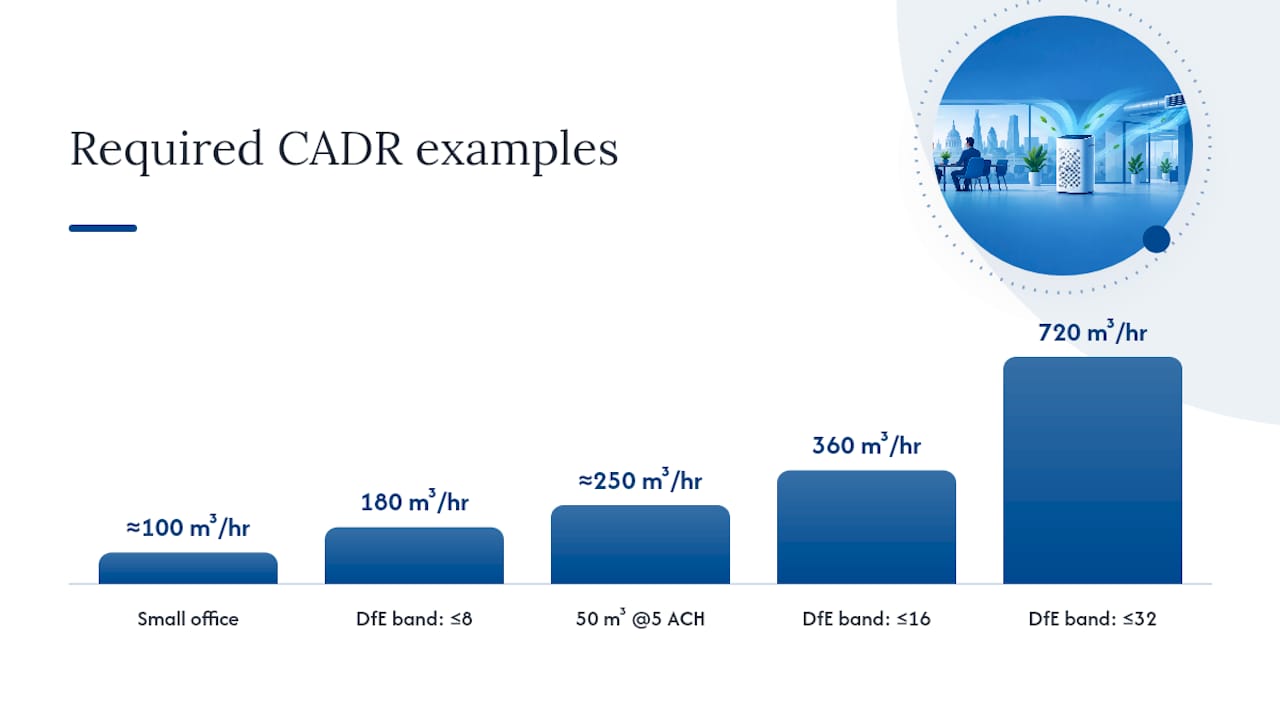
Step 3: Calculate required CADR. Multiply room volume by target ACH to get the clean air delivery rate in cubic metres per hour you need the unit to deliver. For that 50 cubic metre room at 5 ACH, you need a CADR of roughly 250 m³/hr.
Step 4: Check the unit’s published CADR against that figure, not against the manufacturer’s “recommended room size” claim, which is frequently generous.
A few worked examples make this concrete. The Department for Education’s air cleaning unit specification sets out CADR bands by occupancy that translate well to office use: roughly 180 m³/hr for up to 8 occupants, 360 m³/hr for up to 16, and 720 m³/hr for up to 32. A four-person meeting room sits comfortably within the lowest band. A single internal office with one or two desks needs far less, often well under 100 m³/hr, provided the room is small. An open-plan zone housing twenty desks is a different proposition entirely and usually needs either a genuinely large unit or, more sensibly, multiple smaller units distributed across the space.
This is where the 2/3 rule becomes useful as a sanity check. It’s a simplified guide suggesting a purifier’s rated CADR should cover at least two thirds of the room’s air volume per hour to have a meaningful effect on particulate levels in a reasonable timeframe. It’s not a regulatory standard. It’s more a practical rule of thumb worth applying alongside the ACH calculation above, not instead of it. Our CADR explainer walks through the maths in more detail if you want to check your working, and the room-size calculator speeds up the process for multiple rooms.
Pro Tip: Never take a manufacturer’s “suitable for rooms up to X m²” claim at face value. Ask for the published CADR figure in m³/hr and the room height they assumed. Two units claiming the same coverage can have wildly different real-world CADR once you strip out the marketing rounding.
Before signing off any purchase, demand this minimum evidence from the supplier:
- A published CADR figure in m³/hr, not just a vague room-size claim.
- Third-party HEPA test certification against BS EN 1822:2019 or ISO 29463.
- A sound-power or dBA rating at both minimum and maximum fan speed.
- Filter replacement intervals and part numbers, so running costs are predictable.
Skip any of these and you’re buying on trust alone, which is a poor basis for a piece of equipment meant to run eight hours a day.
What noise level is acceptable for an office air purifier?
Noise is the single biggest reason office purifiers end up switched off, sitting quietly in a corner doing nothing. Get the acoustic spec wrong and staff will simply unplug it during a call.
The DfE’s air cleaning unit specification sets maximum sound-power limits alongside its CADR bands, and while that spec was written for classrooms, the logic transfers directly to open-plan offices and meeting rooms. A unit that’s whisper-quiet on its lowest setting can turn into a genuine distraction on high, so always check the dBA rating at the fan speed you’ll actually run day to day, not just the marketing figure for the lowest setting.
Placement matters almost as much as the unit itself:
- Position centrally in the room rather than jammed into a corner, where airflow gets blocked before it circulates properly.
- Keep at least half a metre of clearance from furniture, walls and stacked paperwork.
- If there’s an identifiable pollutant source, such as a photocopier or a door that opens onto a car park, place the unit closer to that source rather than dead centre.
For an open-plan floor, several smaller units spaced across the area usually beat one large machine parked at one end. Air quality problems tend to be localised, clustered near print stations, kitchenettes or badly ventilated corners, and a single big unit can’t reach all of them equally. A small meeting room, by contrast, is exactly the scenario where one well-specified unit does the job.
On operating mode: running continuously at a low, quiet speed generally beats intermittent bursts at maximum fan speed, because particle levels creep back up quickly once a unit switches off. If the room also has mechanical ventilation or air conditioning, position the purifier so it doesn’t fight the existing airflow pattern, ideally drawing from a different part of the room than the supply vents.
Pro Tip: If staff keep turning a unit off, the problem is almost always noise, not effectiveness. Move it, not away from use altogether. For more detail on positioning by room type, see our placement guide.
What does maintaining an office air purifier actually cost?
Filters are consumables, and budgeting for them properly avoids the common trap of buying a good unit and then running it on a clogged filter for a year because nobody planned for replacements.
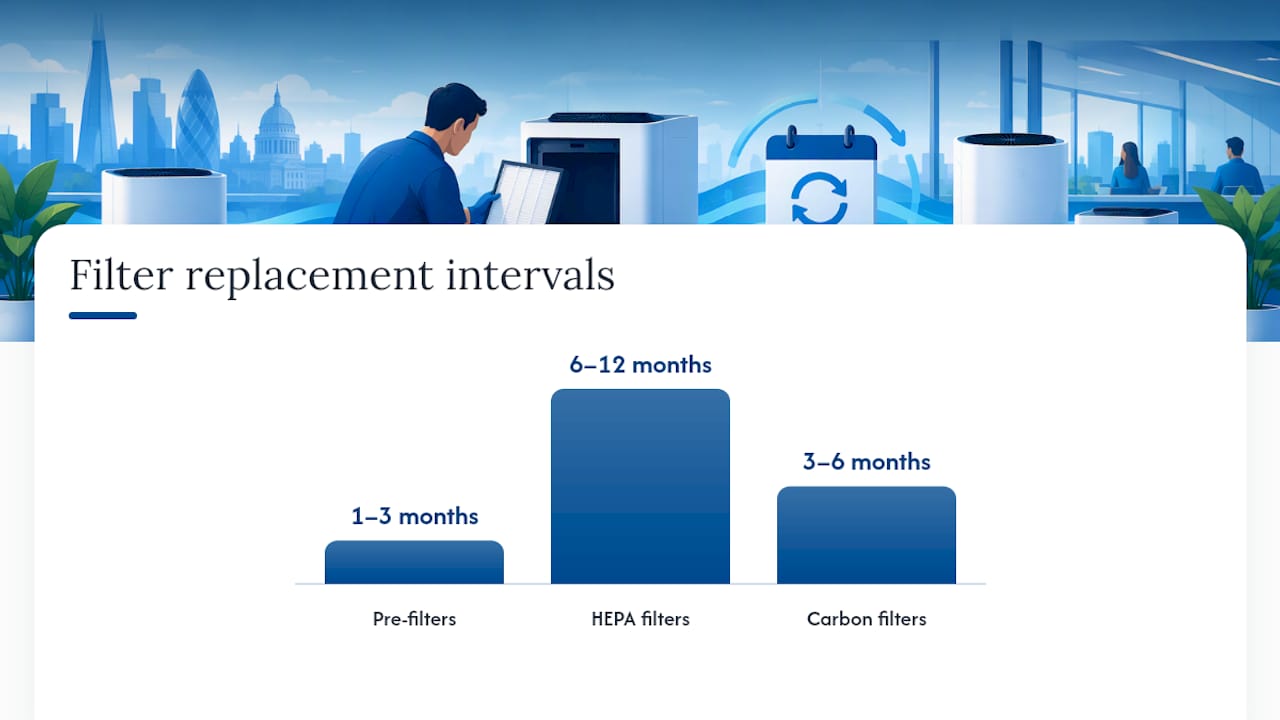
- Pre-filters (washable or replaceable foam/mesh) typically need attention every one to three months in a normal office, more often near dusty entrances or car parks.
- HEPA filters generally last six to twelve months depending on occupancy and local air quality, and a clogged HEPA filter forces the fan to work harder, which quietly pushes up your electricity bill.
- Carbon filters saturate faster than HEPA media, particularly in odour-heavy environments, and often need swapping every three to six months.
Running costs are mostly about fan power rather than the filters themselves. A unit left on continuous low speed costs relatively little to run over a year; the same unit constantly cycling to maximum speed to compensate for a blocked filter costs considerably more and performs worse. Replacing filters on schedule is the single biggest lever on total cost of ownership, more than the purchase price of the unit itself.
Before committing to a supplier, ask for the operating manual, confirmation that spare filters will remain available for the expected life of the unit, and the exact part numbers so procurement doesn’t get stuck chasing a discontinued filter two years in. Our guide on when to replace air purifier filters covers the visible and smell-based warning signs worth training reception or facilities staff to spot.
Office air purifier procurement checklist
A short, structured process avoids the most common mistake: buying on spec sheet alone without checking the room first.
- Assess ventilation first. Run a CO₂ monitor in the room for a full working day before assuming a purifier is even needed.
- Measure the room. Record length, width and ceiling height to calculate volume in cubic metres.
- Set your target ACH. Four to six ACH suits most general office use; adjust upward for higher occupancy or higher-risk periods.
- Calculate required CADR using the volume and ACH figures from steps 2 and 3.
- Shortlist units with published, tested CADR figures and certified HEPA to BS EN 1822:2019 or ISO 29463.
- Check dBA at your intended running speed, not just the lowest setting.
- Confirm filter costs and replacement intervals before purchase, not after.
- Agree a maintenance schedule with whoever owns facilities, including who checks filters and how often.
A compact office-assessment record makes step-by-step procurement genuinely usable across multiple rooms:
| Room detail | What to record |
|---|---|
| Room dimensions | Length × width × height (m) |
| Occupancy | Typical and maximum headcount |
| CO₂ reading | Peak reading over a full working day |
| Existing ventilation | Opening windows, mechanical extract, HVAC |
| Target CADR | Calculated from volume × target ACH |
Simcodirect supplies commercial air treatment products alongside its wider washroom, heating and bathroom ranges, with bulk pricing available for facilities teams specifying multiple units across a building. For sizing help or a commercial quote, our full air purifier buying guide is a practical next stop before you commit to an order.
Do office air purifiers help with more than dust?
Particulate matter gets most of the attention, but it’s not the only thing worth measuring in an office. VOCs from carpets, furniture adhesives, cleaning products and printer toner build up steadily in sealed buildings, and a HEPA filter does nothing to touch them, because it’s a mechanical trap, not a chemical one. Only activated carbon media addresses that gas-phase pollution, which is why a HEPA-only unit can leave a “stuffy” smell even while particle counts look fine.
Allergens are a slightly different story. Pollen, dust mite debris and pet dander carried in on clothing are particulate, so a good HEPA stage genuinely helps here, and staff with seasonal allergies or asthma are often the first to notice a well-placed unit working.
Pathogens sit closer to the ventilation-first argument than to purifiers alone. The SAGE EMG review found fibrous HEPA filtration and enclosed UVC likely beneficial specifically in poorly ventilated spaces where fresh air exchange is limited, reinforcing that air cleaning is a supplement to ventilation for reducing airborne pathogen load, not a replacement for it. Combining a properly specified purifier with a sensible cleaning regime covers more ground than either measure alone; a partner resource on cleaning practices and allergen control is worth a look if your facilities plan covers both.
Can better office air quality actually lift productivity?
The link between air quality and how people perform at their desks isn’t just intuitive, it’s backed by the same regulatory guidance driving the ventilation-first approach. HSE ties good ventilation directly to improved concentration and lower staff absence, which is a meaningful claim coming from a regulator rather than a marketing department.
Stuffy meeting rooms are the clearest everyday example. Anyone who has sat through a two-hour session in a sealed room with rising CO₂ knows the drop in alertness by the end, headaches, flagging attention, people struggling to follow a discussion they’d have grasped easily an hour earlier. That’s precisely the scenario HSE’s CO₂ monitoring guidance is designed to catch before it becomes routine.
Absence is the harder-edged business case. Poor indoor air quality is linked to higher rates of respiratory symptoms and general malaise among office staff, and while no single air purifier will single-handedly fix a sickness-absence problem, a coherent ventilation-first strategy with sensible supplementary filtration in the rooms that need it is a reasonable, evidence-aligned investment. The GLA’s nursery air filtration trial found measurable PM2.5 reductions within hours of properly specified units running, a useful reminder that results show up fast when the unit is sized and placed correctly, not months later.
What buyers get wrong about office air purifiers
Three mistakes come up again and again when offices choose an air purifier, and none of them are really about the technology itself.
The first is trusting the word “HEPA” on the box without asking for proof. CIBSE has flagged this loosely used label for good reason, and it’s the single easiest thing to check before spending any money.
The second is undersizing. Buyers pick a unit based on a manufacturer’s “suitable for rooms up to” claim rather than doing the CADR calculation against their actual room volume, and end up with a machine that’s cosmetically present but functionally too small.
The third is ignoring noise until after installation, then watching staff quietly switch the unit off within a week.
The fix for all three is the same: insist on certified HEPA test data, a published CADR figure, and an acoustic rating at your intended running speed, before you commit to an order. If you only take one thing from this article, run through the procurement checklist above before you buy, not after.
— Carl
Get a commercial quote for office air treatment
There are other routes to sorting office air quality, ventilation retrofits, HVAC upgrades, hiring a specialist installer, and each has its place depending on the building. An advantage for most facilities teams is having one supplier, bulk order pricing, and fast delivery, simplifying the procurement process when fitting out multiple rooms with properly specified units.
The air treatment range is offered alongside a wider washroom, heating and bathroom catalogue, with a 30-day returns policy available if a unit doesn’t suit the space once it’s running. If you’re specifying multiple rooms, the full product range is the fastest way to compare options and request bulk pricing for a whole floor rather than one meeting room at a time. If you’re planning a larger retrofit that includes electrical or installation work, a partner resource on discreet office installations covers the practical side of site surveys worth reading alongside your purifier order.
Contact the supplier for commercial quotes or specification support, bringing your CADR calculation to get clear guidance on which unit fits your room.
Sources
For readers who want to go straight to the primary guidance behind this article:
- Ventilation to reduce the spread of respiratory infections - HSE / GOV.UK
- SAGE EMG paper on potential application of air cleaning devices
FAQ
Should I have an air purifier in my office?
Only after checking ventilation first, since HSE guidance treats air cleaning as a supplementary measure, not a substitute for adequate fresh air. If a room has no opening windows or poor mechanical ventilation and CO₂ readings run high, a properly sized HEPA purifier is a sensible addition.
What type of air purifier is best for my office?
A recirculating HEPA purifier certified to BS EN 1822:2019 or ISO 29463 is the right baseline for most offices, with activated carbon added only if odours or VOCs are a specific concern. Avoid units relying solely on ionisers or unproven technologies without independent test evidence.
What is the 2/3 rule for air purifiers?
It’s a simplified guideline suggesting a unit’s rated CADR should cover at least two thirds of a room’s air volume per hour to meaningfully reduce particle levels. It works best as a sanity check alongside a proper ACH calculation based on room volume, not as a replacement for it.
What is the best air purifier for a small office?
For a single internal office or small meeting room, look for a compact unit with a published CADR matching your calculated requirement, typically well under 100 m³/hr for a small room. Check the DfE’s occupancy-based CADR bands as a reference point, and confirm the noise rating suits a quiet working space.