


Calculate Air Purifier Room Size: Get the CADR in 3 Minutes
Match your purifier’s smoke CADR to at least two thirds of the room’s floor area. That’s the AHAM rule of thumb, and it gives you the minimum capacity for genuine whole room cleaning rather than a token gesture at the air near the unit. Pair that with a target of 4 to 5 air changes per hour, and you’ve got everything you need to size a machine correctly before you spend a penny.
TL;DR:
- Match your purifier’s smoke CADR to at least two thirds of the room’s floor area, especially for standard ceiling heights.
- Calculate room volume if ceilings exceed 8 feet, and prioritize volume-based CADR calculations for taller rooms.
- Aim for about 4.8 air changes per hour, but consider higher ACH for households with pets, allergies, or wildfire smoke concerns.
- Proper placement, regular filter maintenance, and running the unit continuously on moderate to high speed are essential for achieving rated performance.
- Using multiple smaller units or oversizing becomes necessary for large or multi-zone spaces, but oversizing might reduce quiet operation and increase energy use.
Table of Contents
- How to measure your room and calculate required CADR
- How CADR relates to equivalent air changes per hour
- CADR bands for common room sizes
- Placement, running, and filter care that protect your CADR rating
- When to oversize, undersize, or add extra units
- Trusted calculators and tools to check your numbers
- Where to find more sizing help
- Balancing ideal ACH with everyday trade-offs
- Get the right purifier and filters without the guesswork
- Sources
How to measure your room and calculate required CADR
Grab a tape measure before you open a single product listing. Air purifier room size calculations start with three numbers: length, width, and ceiling height. Multiply length by width to get floor area in square feet or square metres. If your ceilings run higher than the standard 8 feet (2.4 metres), you need the volume too, because a tall room holds more air than a floor plan suggests.
Here’s the step-by-step process:
- Measure length and width in feet or metres, then multiply to get floor area.
- Measure ceiling height from floor to ceiling, ignoring sloped sections unless they’re substantial.
- Calculate volume if your ceiling isn’t standard: length × width × height.
- Apply the AHAM 2/3 rule for area-based sizing: required smoke CADR ≈ floor area × 0.67.
- Cross-check with ACH if you want a volume-based figure, using the formula CADR = (target ACH × room volume) ÷ 60.
A worked example makes this concrete. Take a 12 by 12 foot bedroom, a common size in UK homes once you account for a double bed, wardrobe, and a bit of floor space. That’s 144 square feet (roughly 13.4 square metres). Apply the 2/3 rule: 144 × 0.67 gives you a required smoke CADR of around 96, so you’d want a unit rated at 100 or above.
Now check that against ACH. With an 8-foot ceiling, the room volume is 1,152 cubic feet (about 32.6 cubic metres). Aiming for 4.8 equivalent air changes per hour, the sum is (4.8 × 1,152) ÷ 60, which comes out to roughly 92 CADR. Both methods land in the same ballpark, which is reassuring. For standard 8 foot or 2.4 metre ceilings, the area-based shortcut is normally close enough. Once ceilings climb past that, run the volume calculation, because the difference starts to matter.
How CADR relates to equivalent air changes per hour
ACH tells you how many times a purifier can theoretically clean the entire volume of air in a room every hour. Equivalent air changes per hour, or eACH, is the practical version of that figure, accounting for how effectively a real unit filters real air rather than a lab estimate. The formula connecting the two is CADR = (ACH × room volume) ÷ 60, so a bigger room or a higher ACH target both push your required CADR upward.
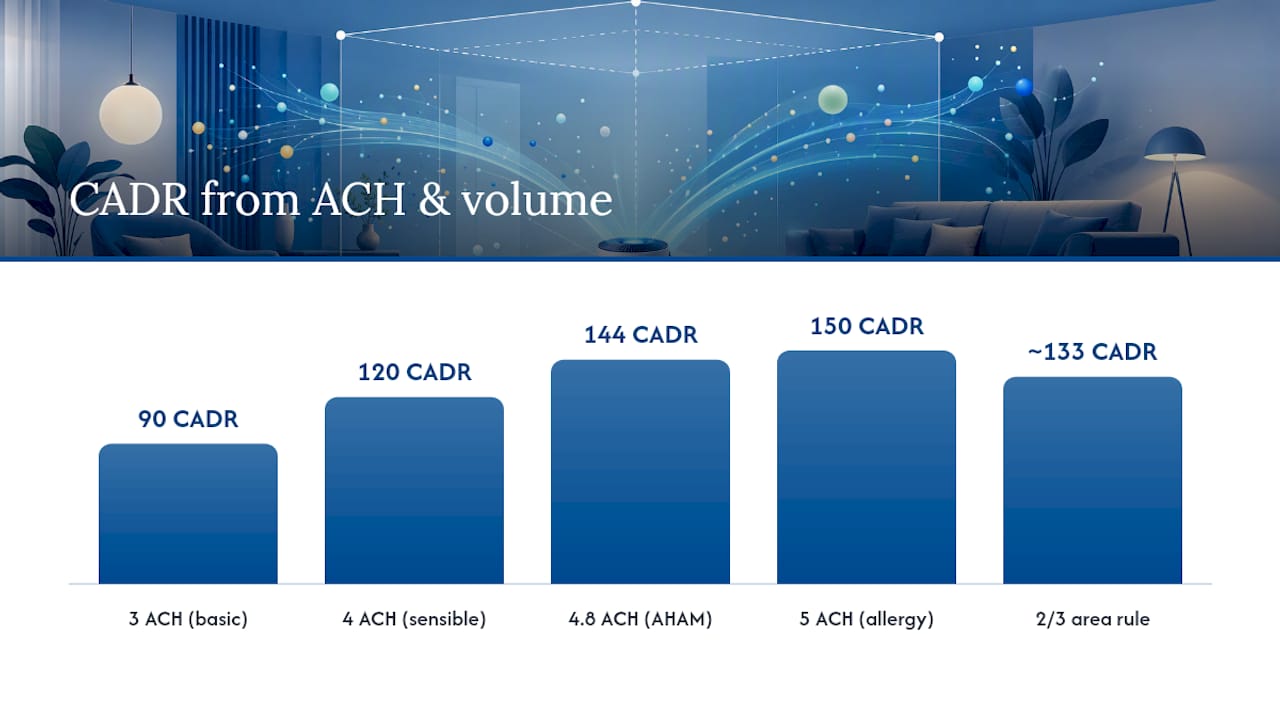
AHAM Verifide bases its Suggested Room Size rating on 4.8 eACH, a figure chosen because it delivers strong steady-state pollutant reduction without demanding an oversized, noisy unit. Indoor air quality researchers generally treat 3 ACH as the floor for basic ventilation benefit, so anything below that is doing very little. If you’re managing a general dust and pollen problem, 4 ACH is a sensible middle ground. Allergy sufferers or households dealing with pet dander often push for 5 ACH or higher. Wildfire smoke is its own category entirely, since particle concentrations spike fast and AHAM recommends matching smoke CADR to the full room area rather than two thirds of it.
Here’s a conversion example: a 200 square foot living room with a 9-foot ceiling has a volume of 1,800 cubic feet. To hit 5 ACH, you need (5 × 1,800) ÷ 60 = 150 CADR. That’s noticeably higher than the roughly 133 CADR you’d get from the 2/3 area rule alone, which shows why checking both methods matters once ceilings or ambitions rise above average.
CADR bands for common room sizes
Once you’ve done the maths once, you start recognising patterns. Most rooms in a typical UK home fall into a handful of size categories, and each one maps to a fairly predictable CADR band. These are starting points, not hard limits, but they’ll get you within striking distance without a calculator in hand.
A few conditions push those numbers higher. Pet owners and smokers should treat the 2/3 rule as a floor, not a target, and lean toward the 1x multiplier AHAM suggests for wildfire smoke. High ceilings above 9 feet inflate room volume faster than floor area suggests, so recalculate using ACH rather than trusting the area shortcut alone.
For genuinely large or awkward spaces, more than one modestly sized unit often beats a single oversized machine:
- Two smaller purifiers placed at opposite ends of an open-plan space circulate air more evenly than one unit working overtime in a corner.
- Zone-based placement means bedrooms get quieter units while living areas get higher-output ones.
- Splitting coverage by activity zone also cuts noise in the rooms where you sleep, which matters more than most buyers expect.
Placement, running, and filter care that protect your CADR rating
A purifier’s rated CADR assumes ideal conditions, and your living room is rarely that. Getting close to the number on the box comes down to placement and upkeep, not just buying the right model.
- Place the unit at least a foot from walls and furniture so air can circulate freely on all sides.
- Avoid corners and behind curtains, both of which choke airflow and quietly reduce effective coverage.
- Run on a moderate to high fan speed continuously rather than blasting it occasionally; steady operation beats short bursts.
- Keep doors and windows closed while it’s running, since open windows let filtered air escape and pull in fresh pollutants.
- Check filters monthly and replace them once airflow or odour changes, because a clogged filter can quietly drop performance well below its rated CADR.
Pro Tip: Point the outlet toward the centre of the room rather than at a wall. A purifier tucked against furniture with its exhaust blocked can lose a noticeable chunk of its rated output even when it sounds like it’s working hard.
For more on where units perform best in different room shapes, Simcodirect’s placement guide covers specific layouts in more depth.
When to oversize, undersize, or add extra units
Oversizing makes sense for allergy sufferers, households near a smoker, or anyone bracing for wildfire smoke season, where AHAM’s recommendation is to match CADR to the full room area rather than two thirds of it. Commercial spaces with high footfall also benefit from a margin above the minimum, since doors open and close all day and pollutant load never really settles.
Where oversizing stops paying off is everyday quiet operation. A unit rated well beyond what the room needs often runs on a lower fan speed to stay quiet, which defeats the point of buying the extra capacity in the first place. It also burns more energy on standby draw and chews through filters faster if you compensate by running it harder than necessary.
Multiple units make more sense than one large purifier once you’re covering more than one zone:
- Size each unit to its own room rather than trying to cover a whole floor from one central point.
- Put quieter, smaller units in bedrooms and higher-CADR units in living spaces and kitchens.
- Budget for filter replacements across every unit, since running several machines means several filter change schedules to track.
- Weigh the extra purchase cost against the noise and circulation benefits before committing to two units over one.
Trusted calculators and tools to check your numbers
Doing the maths by hand is straightforward, but a calculator catches mistakes and saves time once you’re sizing more than one room. Three tools are worth bookmarking.
- The Harvard Healthy Buildings portable air cleaner sizing tool calculates the CADR needed to hit a target eACH from floor area, ceiling height, and desired ACH, and reports results in both m³/hr and CFM.
- AHAM Verifide’s guidance explains the 4.8 eACH basis behind Suggested Room Size ratings, useful if you want to understand why a manufacturer’s stated coverage area is what it is.
- The whatSizeAppliance CADR calculator accepts floor area, ceiling height, and target ACH, then adds concern multipliers for pets, smoke, or heavy pollution.
Run your numbers through at least one of these before buying, particularly if your room has an unusual shape or a ceiling height outside the standard range.
Where to find more sizing help
A CADR explainer is available that walks through how the rating is measured and how it should guide your shortlist. If you’re weighing up capacity for a larger or open-plan space, the guide to air purifiers for UK commercial facilities covers higher-output scenarios in more detail.
This article was written by Carl. For product-specific questions, including which filter fits which model, Simcodirect’s support team can help you match a unit to your room before you order.
Balancing ideal ACH with everyday trade-offs
In practice, most households don’t need 5 ACH in every room. I’d prioritise the bedroom and the main living area first, since that’s where you spend most of your indoor hours, and accept a slightly lower target in spare rooms or hallways. Allergy households are the exception. There, a bit of deliberate oversizing on smoke CADR earns its keep. For everyone else, a correctly sized, quieter unit beats an oversized one running on low just to stay bearable at night. Whichever you choose, the calculation only holds if you keep the filter clean and the placement sensible.
— Carl
Get the right purifier and filters without the guesswork
Simcodirect stocks air treatment units and replacement filters with fast UK delivery and a 30 day returns policy, so getting the CADR wrong doesn’t mean being stuck with the wrong machine. Before you buy, check the smoke CADR listed on each product page against the room size figures above, and confirm that spare filters are readily available for the model you’re eyeing.
If you’re unsure which unit suits a particular room, or you want to check filter compatibility before committing, a support team can help you match capacity to space. Browse a range of electric heating and air treatment products or get in touch with questions about matching a specific model’s CADR to your room dimensions before you order.
Sources
- Portable air cleaner sizing tool — Harvard Healthy Buildings
- AHAM white paper: air cleaner ACH and suggested room size
- Air purifier sizing calculator — whatSizeAppliance