


UK Bathroom IP Ratings: IPX7 for Zone 0, IPX4 for Zones 1 and 2
Zone 0 requires protection against temporary immersion (IPX7) and must run on SELV at 12 V maximum. Zone 1 and Zone 2 require a minimum splash protection rating (IPX4), and all bathroom circuits must be protected by a 30 mA RCD. Get those two non-negotiables wrong, and no amount of stylish tiling saves the installation from being unsafe, and possibly illegal.
TL;DR:
- Correctly specified IP ratings are critical, with Zone 0 fittings requiring IPX7 and SELV at 12 V, and Zone 1 and 2 needing at least IPX4 with RCD protection.
- IP digits indicate water and dust resistance, with IPX4 suitable for zones 1 and 2, and IPX7 mandatory for Zone 0, but manufacturer declarations always take precedence.
- Proper measurement of zones and validation of fittings’ suitability prevent safety and compliance failures, especially around fixtures like showers and baths.
- Many accidents stem from fittings with high IP ratings but no proper manufacturer statement for bathroom use, making datasheet verification essential.
- Suppliers providing comprehensive documentation and tailored products, like Simcodirect, facilitate safer installation and easier compliance with the latest regulations.
Table of Contents
- Bathroom IP ratings and the zones they apply to
- What the IP digits actually tell you
- Zone-by-zone IP minimums and when to go higher
- Choosing the right fitting for lights, fans, heaters and rails
- Installer and homeowner handover checklist
- Where the rules actually come from
- What actually goes wrong on site
- Sourcing compliant bathroom fittings from Simcodirect
- Sources
Bathroom IP ratings and the zones they apply to
BS 7671 splits a bathroom into zones based on how likely each spot is to get wet, and the IP rating required scales with that risk. Get the boundaries wrong and you get the required rating wrong too, so it pays to measure rather than guess.
Zone 0 is inside the bath or shower tray itself, anywhere water sits or pools.
Zone 1 runs from the top of Zone 0 up to 2.25 metres above the floor, and covers the area directly above the bath or shower.
Zone 2 extends 0.6 metres beyond Zone 1, in every horizontal direction, up to the same 2.25 metre height, plus the space around a basin within 0.6 metres of the tap.
Anywhere outside those boundaries is unregulated in terms of zoning, though current IET guidance notes the old “Zone 3” designation no longer applies in practice, so treat that space with ordinary bathroom common sense rather than a formal zone rule.
| Zone | Location | Typical fittings found there |
|---|---|---|
| Zone 0 | Inside bath or shower tray | Whirlpool motors, in bath LED features |
| Zone 1 | Above bath/shower, up to 2.25m | Shower lights, extractor fans |
| Zone 2 | 0.6m beyond Zone 1, plus basin surrounds | Mirror lights, shaver sockets |
| Outside zones | Beyond 0.6m from Zone 2 | Standard sockets, switches, ceiling lights |
A fixed bath with an overhead shower pushes Zone 1 up and out further than a basin alone would, so measure from the actual fitting, not an assumed layout.
What the IP digits actually tell you
An IP rating is two digits defined by BS EN 60529. The first digit tells you how well a fitting resists solid objects and dust, on a scale of 0 to 6. The second tells you how well it resists liquids, from 0 to 9. Where you see an “X” instead of a number, that’s the manufacturer declining to test or declare that digit; an IPX4 fitting has simply not been rated for solids ingress, which is common and usually fine for bathroom lighting where dust isn’t the concern.
The second digit is what matters most in a bathroom, because water, not dust, is the risk you’re managing.
| Rating | Protection level | Where you’ll see it |
|---|---|---|
| IPX4 | Splashing from any direction | Zone 1 and 2 minimum, standard downlights |
| IPX5 | Low pressure water jets | Cleaning-heavy zones, some shower fittings |
| IP65 | Jets, plus dust-tight | Recommended upgrade for shower areas |
| IPX7 | Temporary immersion | Zone 0 fittings only |
| IPX7 | Immersion, plus dust-tight | Fully submersible fixtures |
Fact worth remembering: NICEIC’s own guidance sets the same floor most electricians work to: IPX4 or IPX5 for zones 1 and 2, and IPX7 for zone 0, with the manufacturer’s suitability statement as the final word.
The first digit still matters occasionally, particularly for recessed downlights in ceilings where insulation or debris could otherwise find its way into the fitting.
Zone-by-zone IP minimums and when to go higher
Section 701 of BS 7671 sets the baseline, and it’s worth knowing exactly what it says rather than relying on a rule of thumb passed down on site.
- Zone 0: IPX7 minimum, and the fitting must run on SELV at 12 V or below. Nothing mains-voltage belongs here, ever.
- Zone 1 and Zone 2: IPX4 minimum, rising to IPX5 where water jets are likely, for example where a power shower or a hose-down cleaning routine is in use.
- Outside the zones: technically IP20 is acceptable, but IP44 is the sensible baseline most fitters use anyway, given how much steam moves around a small bathroom.
Every circuit feeding a bathroom, regardless of zone, needs 30 mA RCD protection under Amendment 3:2024. That’s not zone-specific; it applies to the whole room.
Sockets and switches are restricted close to Zone 1, and standard 230 V sockets have no place within the specified distance of that boundary. The one accepted exception is a shaver supply unit built to BS EN 61558-2-5, sited where direct spray is unlikely.
Pro Tip: Many electricians specify one IP step above the legal minimum as standard, IP65 instead of IPX4 in shower areas, because it cuts down on call-backs from steam and cleaning damage over the fitting’s lifetime.
For SELV transformers and LED drivers feeding Zone 0 fixtures, keep the transformer itself in Zone 2 or outside the room entirely, and route the low-voltage cable so it doesn’t wander back through a wetter zone than necessary.
Choosing the right fitting for lights, fans, heaters and rails
Whatever you’re buying, check three things on the datasheet before it goes anywhere near a wall: the IP rating for bathrooms, whether it runs on SELV or mains, and the manufacturer’s stated suitable zone. A fitting can carry an impressive IP number and still be unsuitable if the manufacturer hasn’t declared it fit for bathroom use.
- Extractor fans: fine in Zone 1 or 2 when rated for it, but the isolation switch has to sit outside the wet zones entirely, ideally outside the room, so servicing never means reaching into a damp space.
- Lights: recessed downlights over a shower need at least IPX4, commonly IP65 in practice; surface fittings and mirror lights in Zone 2 can often run to the same minimum but check the manufacturer’s zone statement regardless.
- Heaters and towel rails: low-surface-temperature units are worth the extra cost wherever a heater sits close to where someone might brush against it, particularly in smaller bathrooms.
A guide to bathroom heating zones covers placement logic for rails and heaters in more depth if you’re specifying for a tight layout.
Installer and homeowner handover checklist
A rushed handover is where most compliance gaps slip through, so work through this in order rather than ticking boxes retrospectively.
- Measure and mark Zone 0, 1 and 2 on site before any fitting goes up, using the actual bath, shower tray or basin position.
- Pull the datasheet for every fitting and confirm both the IP rating and a written statement of suitability for that zone.
- Confirm the circuit is protected by a 30 mA RCD, and that any transformer, driver or isolation switch sits outside the wet zones.
- Keep every datasheet in the handover pack, and flag any recommended upgrade, such as IP65 over IPX4 where a power shower is fitted.
Pro Tip: Photograph the zone markings and fitting labels before boxing anything in. It’s a five-minute job on the day and it saves a much longer one if a dispute or an inspection comes up later.
Where the rules actually come from
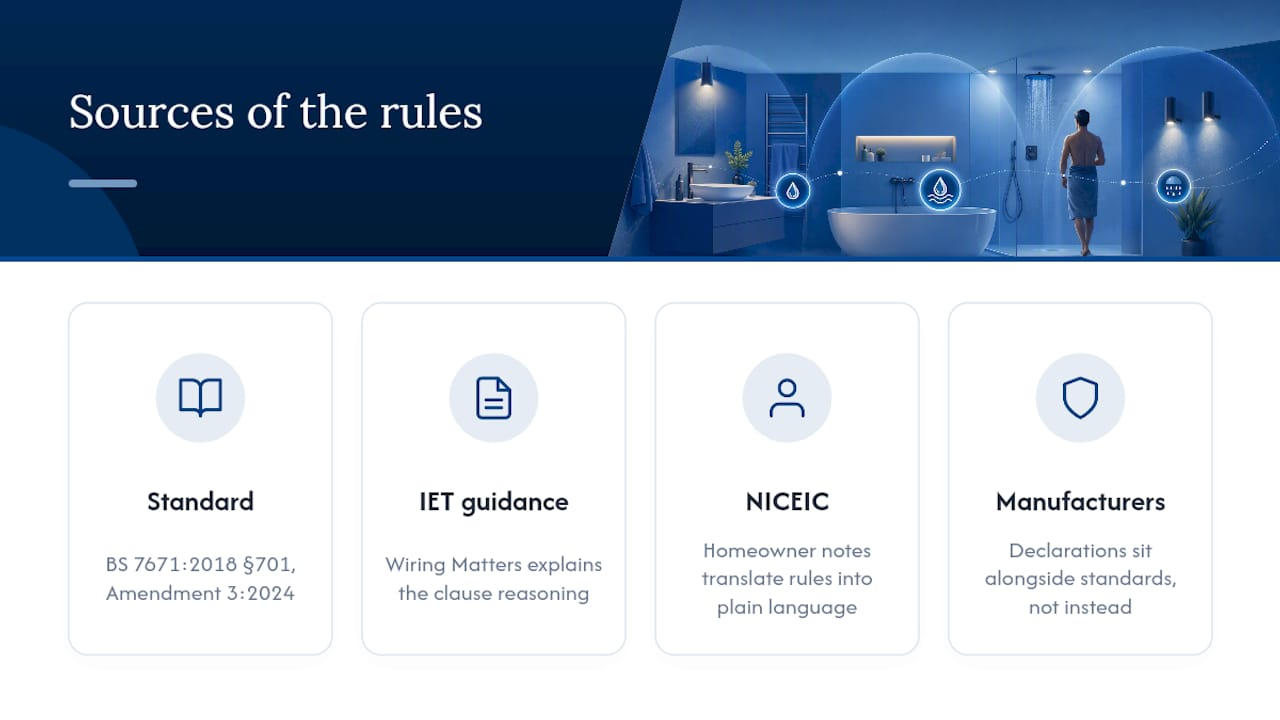
Everything above traces back to BS 7671:2018, incorporating Amendment 3:2024, specifically Section 701 for bathroom locations. The IET’s own Wiring Matters guidance is worth a read if you want the reasoning behind particular clauses, and NICEIC’s homeowner notes translate the same rules into plainer language. Manufacturer declarations sit alongside all of this, not instead of it.
What actually goes wrong on site
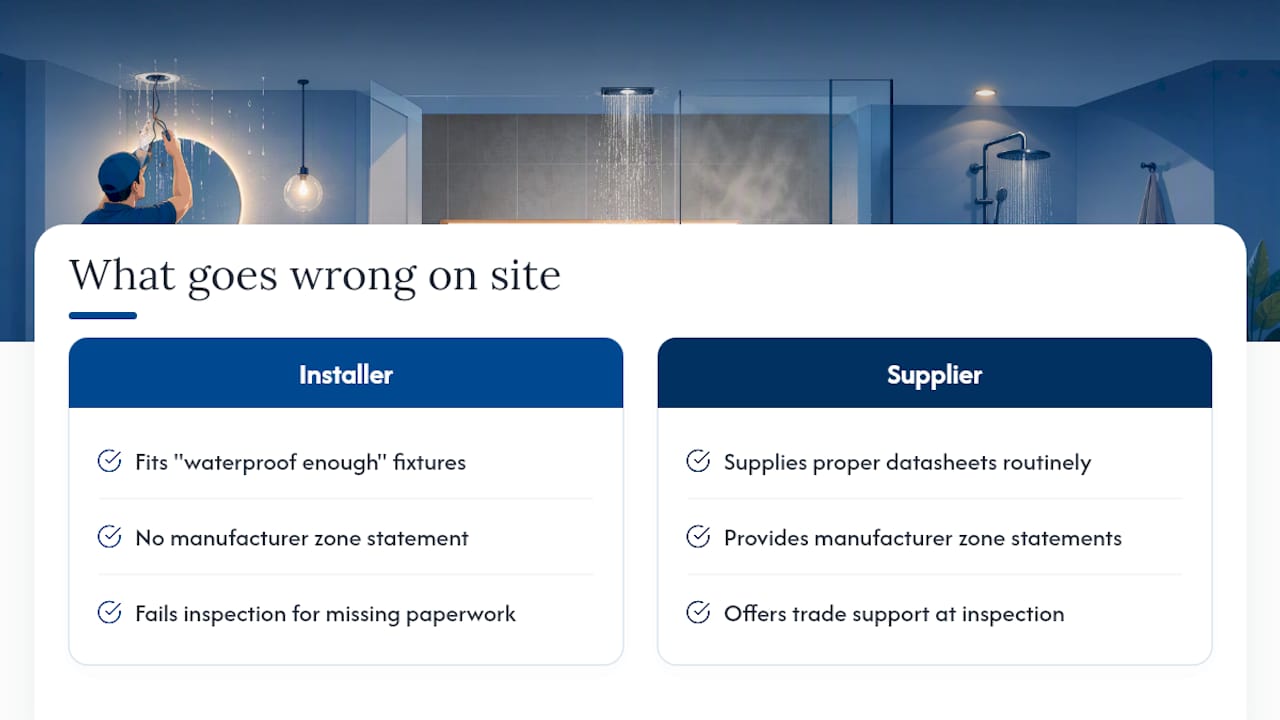
The most common mistake isn’t ignorance of the zones, it’s fitting something with a decent IP number but no manufacturer statement covering that specific zone. I’ve seen plenty of “waterproof enough” downlights go in over showers because the box looked right, only for the installer to have no paperwork to back it up at inspection.
Good suppliers earn their keep here by carrying proper datasheets and trade support as standard, not as an afterthought when someone asks.
— Carl
Sourcing compliant bathroom fittings from Simcodirect
Getting the paperwork right matters as much as getting the fitting right, and some suppliers stock IP-rated bathroom electricals with the manufacturer documentation you need at handover, not just a box with a rating printed on the side.
The range includes low surface temperature heating elements for tighter bathrooms where proximity to occupants matters, alongside standard and thermostatic heating elements for towel rails across every zone. Datasheets are available on request for products, which helps make specifying against Section 701 straightforward rather than a guessing game.
If you’re specifying for a shower room refit this month, look for a thermostatic heating element range and request the datasheet before ordering, so the zone and IP suitability are confirmed before anything reaches site.
Sources
- Bathrooms and electrics (NICEIC homeowner guidance)
- Bathroom electrical regulations and zones (TotalSkills guide)