


Bathroom ventilation fan types explained for homeowners
Bathroom ventilation fans are mechanical extract devices designed to remove moist, stale air from bathrooms, preventing condensation, mould growth, and structural damage. Understanding the different types of bathroom fans is the first step to making a genuinely good choice for your home. UK Building Regulations Approved Document F requires bathrooms with a bath or shower to have mechanical extract ventilation at a minimum of 15 litres per second for intermittent systems, or 8 litres per second for continuous operation. Getting that airflow right depends entirely on choosing the correct fan type for your specific bathroom layout, duct route, and usage pattern.
What are the main bathroom ventilation fan types explained?
Three core fan types cover the vast majority of residential bathroom installations: axial, centrifugal, and inline. Each works on a different operating principle, and each suits a different set of installation conditions. Choosing the wrong type is one of the most common and costly mistakes homeowners make.
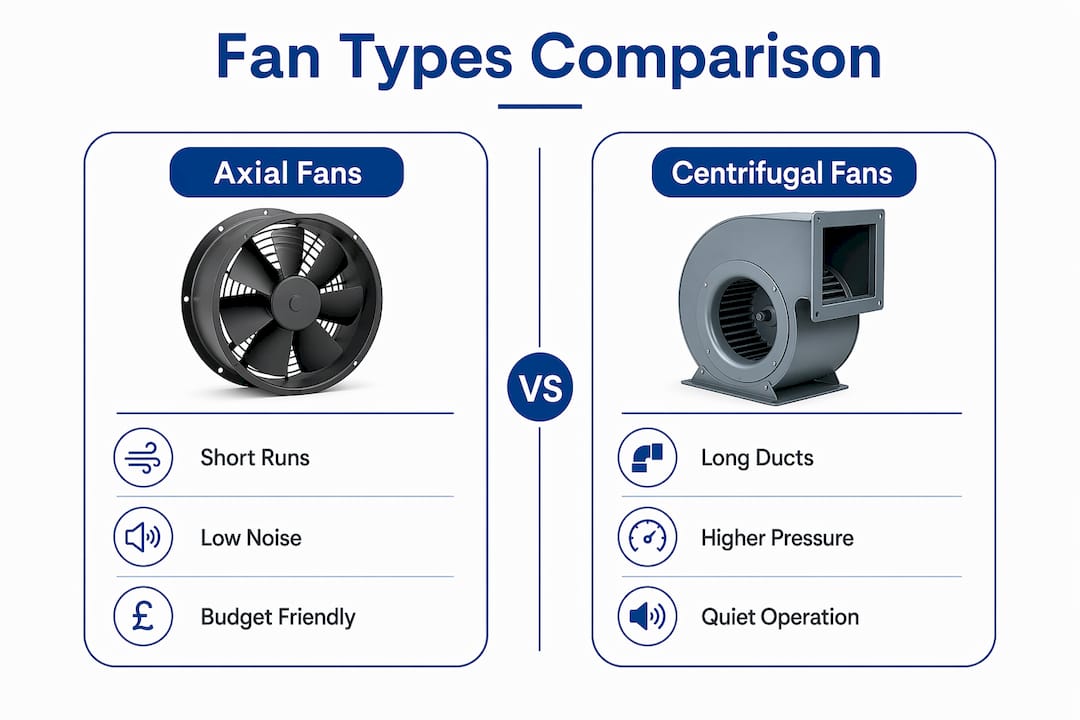
Axial fans are the most familiar type. They draw air straight through the unit along the axis of rotation, making them ideal for short, direct duct runs through an external wall. They are compact, affordable, and straightforward to install. The limitation is significant, though. Axial fans suffer from airflow drop-off in extended or bendy ducting, which means they are unsuitable for any route longer than roughly 1–2 metres or with multiple bends.
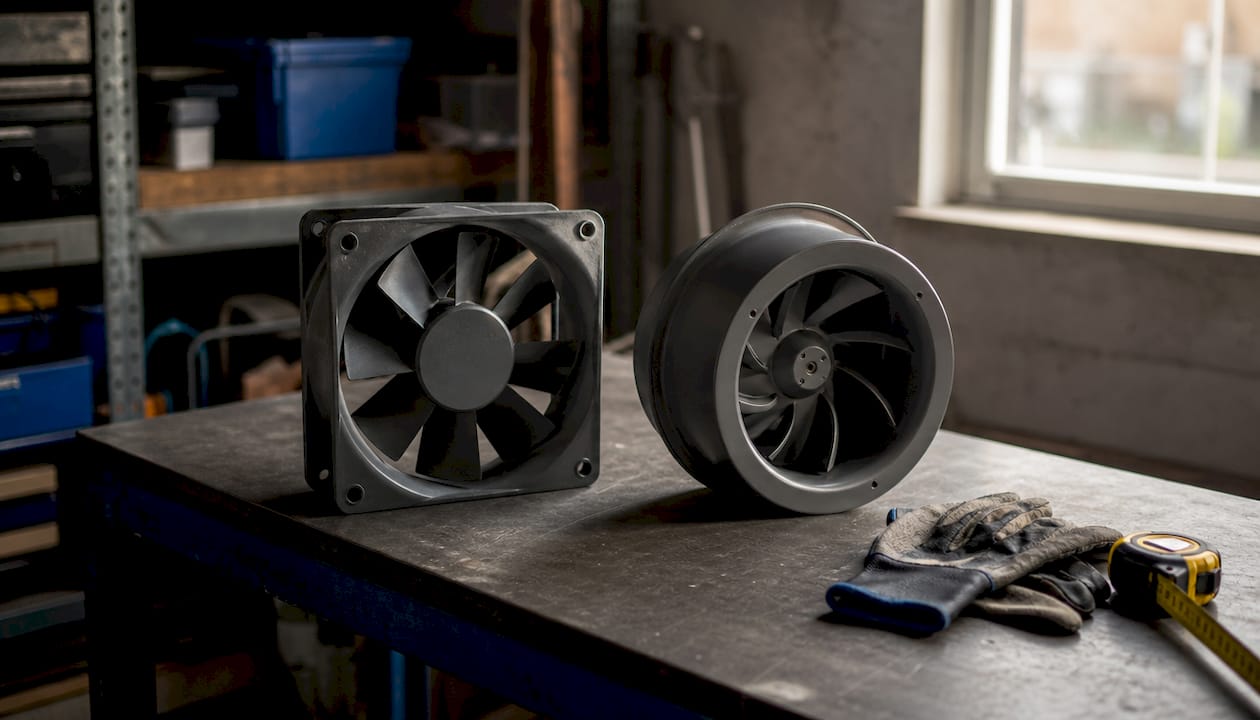
Centrifugal fans use a different mechanism. The impeller draws air in and then expels it at 90 degrees, generating considerably more static pressure. That pressure capability means centrifugal fans handle longer duct runs, multiple bends, and flexible ducting without losing meaningful airflow. They are the right choice when the duct route is anything other than a short, straight shot to the outside.
Inline fans sit inside the duct itself, typically in a loft space or ceiling void, rather than at the point of extraction. Because the motor is physically remote from the bathroom, noise levels at the grille are dramatically lower. This makes inline fans the preferred option for en-suites adjacent to bedrooms, or for any installation where quiet operation is a priority. They also handle long duct runs well, since they combine centrifugal-style pressure with flexible positioning.
| Fan type | Best suited to | Duct run | Noise level |
|---|---|---|---|
| Axial | Short, direct external wall routes | Short (up to ~1–2 m) | Moderate |
| Centrifugal | Longer or bendy duct routes | Medium to long | Moderate to low |
| Inline | Loft or ceiling void installations | Long | Very low at grille |
Pro Tip: Measure your duct route before buying any fan. Count every bend as equivalent to roughly 1.5 metres of straight duct when estimating resistance. A route with three bends and four metres of pipe is far more demanding than it looks on paper.
How do control features like timers and humidistats enhance fan performance?
The fan type determines whether air can physically be moved. The control type determines whether it is moved at the right time and for long enough. Getting the controls wrong wastes energy and leaves residual moisture in the room.
The simplest option is a fan wired directly to the lighting circuit. It runs when the light is on and stops when the light goes off. This works adequately in low-use bathrooms with short shower sessions, but it rarely clears moisture fully before the light is switched off.
Timer fans add a run-on period after the light is switched off. Run-on timers should provide at least 15 minutes of post-use operation to clear residual moisture effectively. That 15-minute minimum is a regulatory requirement, not a suggestion. Most adjustable timer fans allow you to set the run-on between 1 and 30 minutes, so you can match the duration to your bathroom’s actual drying time.
Humidistat fans operate differently. They monitor relative humidity in the room and switch on automatically when levels rise above a set threshold. Humidistat fans activate between 65–80% relative humidity, then switch off once the air returns to a safe level. This approach is more responsive than a timer because it reacts to actual moisture rather than assumed usage time.
The most capable option combines both controls. Combined timer and humidistat systems activate based on both light use and humidity levels, providing the most thorough moisture management in high-use bathrooms. For a busy family bathroom used by multiple people throughout the day, this combination is the most reliable way to stay on top of condensation.
Key control types and their best applications:
- Light-switched only: Low-use cloakrooms or guest bathrooms with very short occupancy
- Timer fan: Standard bathrooms where usage is predictable and sessions are brief
- Humidistat fan: Bathrooms with variable usage or where condensation is a persistent problem
- Combined timer and humidistat: Family bathrooms, high-use en-suites, and any bathroom prone to mould
Pro Tip: If you share a bathroom with teenagers, a humidistat control is worth every penny. A 20-minute shower produces far more moisture than a timer set for 15 minutes will clear. The humidistat keeps running until the air is actually dry.
What installation and compliance considerations affect fan effectiveness?
Selecting the right fan type and controls is only part of the picture. Installation quality and regulatory compliance determine whether the fan actually performs as intended once it is fitted.
UK Building Regulations Approved Document F sets the minimum airflow rates clearly: 15 l/s for intermittent extraction, 8 l/s for continuous systems. These are the rates that must be achieved at the point of installation, not the rates printed on the box. Nominal ratings often overstate real installed airflow, because manufacturers test fans in ideal conditions without duct resistance. Always verify actual performance against your installed duct configuration.
IP ratings are a legal requirement, not an optional upgrade. Bathrooms are divided into zones based on proximity to water sources:
- Zone 1 covers the area directly above the bath or shower tray, up to 2.25 metres from the floor. Fans installed here require a minimum of IP45.
- Zone 2 extends 0.6 metres beyond the edge of the bath or shower, and up to 2.25 metres from the floor. Fans here require a minimum of IP44.
- Outside zones (the rest of the bathroom) require at least IP20.
IP rating requirements vary by bathroom zone, and fitting an under-rated fan is both a safety risk and a compliance failure. Check the fan’s IP rating against its planned position before purchasing.
Ducting choices also affect performance significantly. Rigid smooth-bore duct outperforms flexible corrugated duct on every measure of airflow efficiency. Each 90-degree bend adds resistance equivalent to roughly 1.5 metres of straight pipe. A fan that meets the 15 l/s requirement in a short straight run may fall below compliance once real-world bends and flexible duct are factored in. Professional ventilation services routinely find that installed airflow is meaningfully lower than the nominal fan rating suggests.
Maintenance is the factor most homeowners overlook entirely. Cleaning the grille and impeller every 3–6 months prevents dust build-up that reduces airflow and causes noisy operation. A fan running at reduced capacity due to a clogged grille may no longer meet the regulatory minimum, even if it was compliant when first installed.
How to choose the best bathroom fan for your layout?
Matching the fan to the bathroom is a practical exercise, not a theoretical one. The right answer depends on four variables: duct route length and complexity, proximity to bedrooms or noise-sensitive areas, frequency of use, and whether the bathroom has a persistent condensation problem.
-
Small bathroom with a short external wall duct run. An axial fan with a timer control is the straightforward choice. Keep the duct run under 1.5 metres, use rigid duct where possible, and set the timer to at least 15 minutes.
-
En-suite adjacent to a bedroom. Noise is the primary concern here. An inline fan mounted in the ceiling void, with a humidistat control, delivers very low noise at the grille and responds automatically to moisture. This combination suits light sleepers and anyone who uses the en-suite early in the morning or late at night.
-
Family bathroom with heavy daily use. A centrifugal or inline fan with combined timer and humidistat controls is the most reliable option. Humidistat controls handle moisture unpredictability better than simple timers, particularly when multiple people use the bathroom in quick succession.
-
Bathroom venting through a loft or with a long duct run. Axial fans are not suitable here. Choose an inline or centrifugal fan rated for the actual duct resistance of your installation. Incorrect fan selection for duct length leads to premature motor failure and poor airflow, so this is not an area to cut costs.
-
Flat or apartment with persistent moisture issues. Inline fans with humidistat controls are the most effective solution. If the duct route is shared or restricted, consult a qualified installer to assess whether the existing ductwork can support adequate extraction. A qualified plumbing and ventilation professional can assess duct resistance and recommend the correct fan specification for your situation.
Signs that your current fan needs replacing include visible mould growth near the grille, audible rattling or grinding during operation, condensation on mirrors that persists for more than 20 minutes after a shower, and any fan that is more than ten years old without documented maintenance.
Key takeaways
Choosing the right bathroom ventilation fan requires matching the fan type, controls, and IP rating to your specific duct route, bathroom layout, and usage pattern.
| Point | Details |
|---|---|
| Fan type determines duct suitability | Axial fans suit short direct runs; centrifugal and inline fans handle longer or complex duct routes. |
| Controls affect moisture management | Humidistat and timer combinations provide the most thorough condensation control in high-use bathrooms. |
| IP ratings are a legal requirement | Zone 1 requires IP45 minimum; Zone 2 requires IP44 minimum. |
| Nominal ratings overstate real airflow | Always verify installed airflow against actual duct resistance, not the manufacturer’s stated figure. |
| Maintenance every 3–6 months is critical | Regular grille and impeller cleaning maintains airflow, reduces noise, and extends fan life. |
What I have learned from getting bathroom ventilation wrong
The most common mistake I see homeowners make is buying a fan based on price and box dimensions, then discovering the duct route makes it useless. An axial fan installed on a four-metre run with two bends will struggle from day one. The motor works harder, the airflow drops below compliance, and within two or three years the unit fails. The replacement cost, plus the mould remediation that often follows, far exceeds what a centrifugal or inline fan would have cost at the outset.
The second mistake is underestimating how much noise matters. A fan that sounds acceptable in a showroom feels intrusive at 6:30 in the morning when it is directly above your head. Inline fans genuinely change the experience. The grille is nearly silent, and the motor hum stays in the loft where it belongs.
My honest view on humidistats: they are not a luxury feature. In any bathroom used by more than one person, a timer alone is a compromise. Humidity does not follow a schedule. A humidistat does not care whether the light is on or off. It responds to the actual condition of the air, which is exactly what you want from a ventilation system.
Compliance is not bureaucracy for its own sake. The IP rating zones and airflow minimums in Approved Document F exist because bathrooms are genuinely hazardous electrical environments. A fan installed in the wrong zone with the wrong rating is a safety risk, not just a regulatory failure. Spend the time to get the specification right before installation, and the fan will repay you with years of quiet, effective service.
— Carl
Washroom products from Simcodirect
Simcodirect stocks a wide range of washroom accessories and bathroom essentials to complement any ventilation upgrade. Whether you are fitting out a new bathroom or refreshing an existing one, the Simcodirect washroom range covers everything from quality toilet roll holders to hand dryers and heating products. The Bobrick double toilet roll holder in brushed satin is a popular choice for homeowners who want durable, stylish fittings that match a well-finished bathroom. Simcodirect offers fast delivery, a 30-day returns policy, and a catalogue of trusted brands backed by genuine customer reviews.
FAQ
What is the difference between an axial and a centrifugal bathroom fan?
An axial fan moves air straight through the unit and suits short, direct duct runs. A centrifugal fan generates higher static pressure and handles longer or more complex duct routes without significant airflow loss.
What airflow rate does a bathroom fan need to meet UK Building Regulations?
UK Building Regulations require a minimum of 15 litres per second for intermittent extraction and 8 litres per second for continuous systems in bathrooms with a bath or shower.
What IP rating does a bathroom extractor fan need?
The required IP rating depends on the fan’s position in the bathroom. Zone 1 requires IP45 as a minimum, Zone 2 requires IP44, and areas outside these zones require at least IP20.
How long should a bathroom fan run after the light is switched off?
Run-on timers should operate for at least 15 minutes after the light is switched off to clear residual moisture effectively and meet regulatory requirements.
How often should a bathroom extractor fan be cleaned?
Cleaning the grille and impeller every 3–6 months prevents dust build-up that reduces airflow and causes noisy operation, maintaining both performance and compliance over the fan’s lifespan.