


Best paper towel dispensers for commercial washrooms
For most UK commercial settings, a wall-mounted, touch-free paper towel dispenser with a capacity of at least 200 towels is the right starting point. Match that to your peak footfall, confirm it meets the Workplace (Health, Safety and Welfare) Regulations 1992, and you have covered the three things that cause the most procurement regret: run-outs, hygiene failures, and accessibility complaints.
Quick verdicts by use case:
- High-traffic washrooms (offices, leisure centres): Wall-mounted, touch-free unit in stainless steel; sufficient towel capacity; Z-fold or roll format.
- Very high-traffic venues (airports, stadiums): Continuous system such as Tork PeakServe, which holds a very large volume of towels per load.
- Food-handling areas: Paper towels over hand dryers; touch-free dispenser to eliminate cross-contamination risk.
- Executive or low-footfall washrooms: Compact surface-mounted or counter-mounted unit; manual or automatic; aesthetic finish a priority.
- Space-constrained installations: Recessed dispenser (Bobrick Contura or TrimLine series) to keep the wall clear for wheelchair manoeuvring.
Compliance anchors to check before you order: Workplace (Health, Safety and Welfare) Regulations 1992, Equality Act 2010, and BS 8300 accessible design guidance.
Table of Contents
- Which dispenser type suits your venue and footfall?
- What are the main dispenser types and how do they work?
- How to choose: what facility managers must check before buying
- Maintenance, consumables and total cost of ownership
- UK compliance: what the law requires for dispenser installation
- Why Simcodirect is a practical procurement partner
- Final recommendations and next steps
- Key takeaways
- A practical perspective on getting this right
- Simcodirect’s commercial dispenser range
- Useful sources and further reading
Which dispenser type suits your venue and footfall?
Commercial washroom procurement guidance consistently points to one principle: match the dispenser to your peak traffic, not your average. The table below maps venue type to the most practical choice.
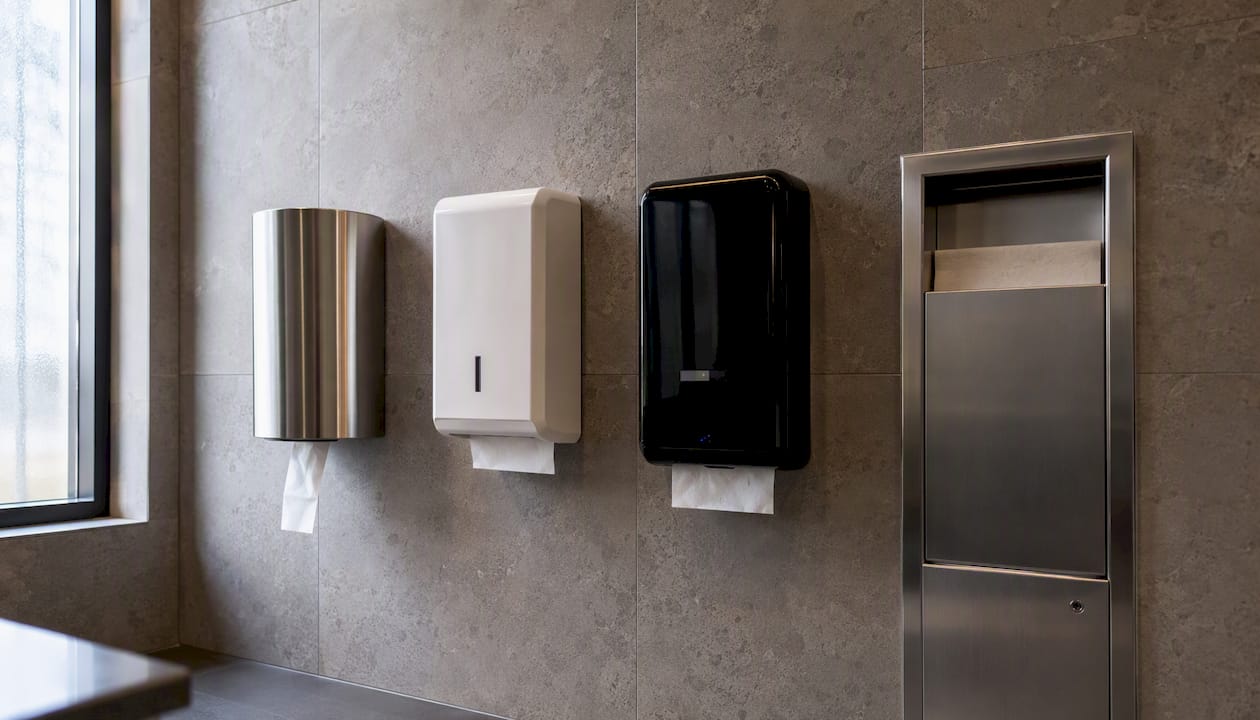
| Venue / footfall | Best for | Capacity | Hygiene type | Material | Installation | Towel format | Refill cadence |
|---|---|---|---|---|---|---|---|
| Home / low-footfall office | Compact aesthetics, low cost | 200 towels | Manual | Plastic or brushed steel | Surface or counter | C-fold, Z-fold | Weekly or less |
| Medium-traffic office or retail | Reliable daily use | 200 towels | Manual or touch-free | Stainless steel | Wall-mounted | Z-fold / interfold | Every 1–3 days |
| Busy office, pub, restaurant | Hygiene-critical; moderate run-out risk | — | Touch-free | Stainless steel | Wall-mounted | Roll or Z-fold | Daily |
| Airport, stadium, event venue | Maximum capacity; minimal staff intervention | very large capacity (continuous) | Touch-free | Stainless steel | Wall-mounted | Continuous roll | Every 2–5 days |
| Food-handling / healthcare-adjacent | Cross-contamination prevention | 200 towels | Touch-free | Stainless steel | Wall-mounted | Z-fold or roll | Daily |
| Executive washroom | Aesthetics; low footfall | 200 towels | Manual or auto | Brushed steel or chrome | Surface, counter, or recessed | C-fold or Z-fold | Weekly |
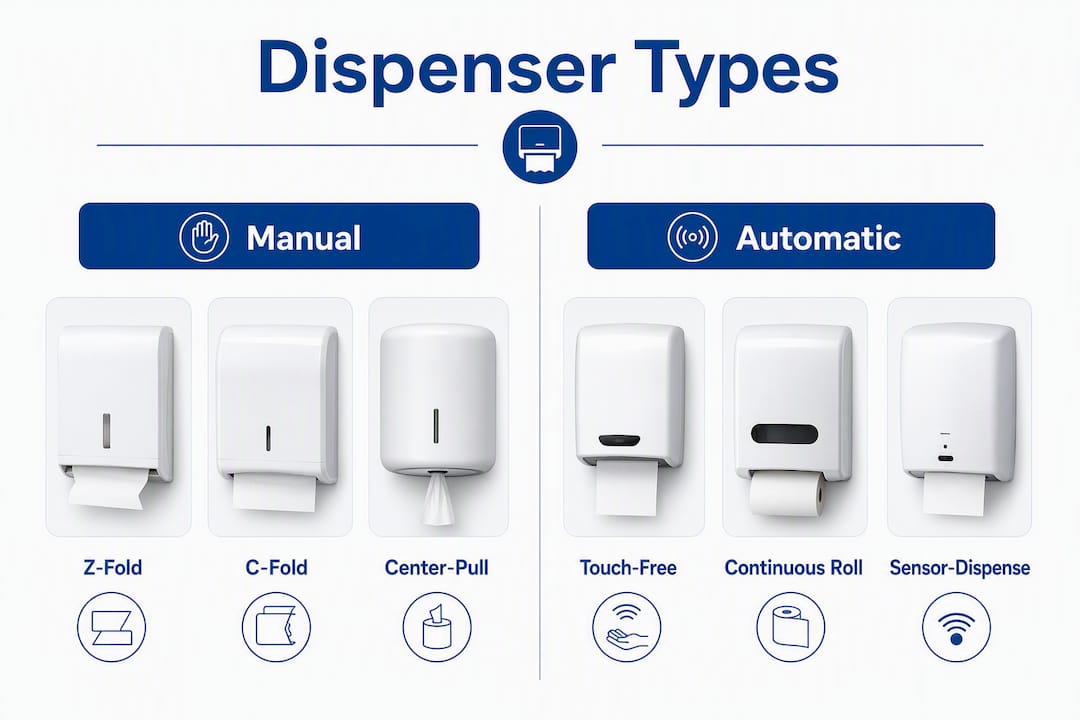
What are the main dispenser types and how do they work?
Understanding the mechanics of each format prevents the most common mistake: buying a dispenser that is incompatible with the towel refills you can actually source in the UK.
Z-fold and interfold (multifold) dispensers
Z-fold towels are folded in a concertina pattern so the next towel’s tail presents itself as the previous one is pulled. This single-sheet controlled dispensing reduces waste and limits hand contact with the stack. Z-fold may cost slightly more per unit than C-fold, but consumption tends to be lower because users take one sheet rather than grabbing a handful. These dispensers are wall-mounted, compact, and widely compatible with most commercial towel brands available in the UK.
C-fold dispensers
C-fold towels fold inward from both sides. The dispenser is simple and inexpensive, but users often pull multiple sheets at once, which increases waste. A reasonable choice for low-footfall settings where cost per unit is the primary concern.
Centre-pull (centrefeed) dispensers
Towels feed from the centre of a roll through a hole in the base of the dispenser. Popular in catering and food-prep environments because users can tear off exactly the length they need. Capacity varies by roll size, and the format works well in kitchens where a wall-mounted unit at counter height is practical.
Roll towel and continuous systems
Standard roll dispensers hold a single roll and are straightforward to refill. Continuous systems, such as the Tork PeakServe, take this further: the PeakServe holds over 2,100 towels and dispenses each in approximately 3 seconds, offering up to 250% more capacity than standard multifold systems. For a stadium or transport hub, that difference is the gap between a functioning washroom and a queue.
Automatic touch-free dispensers
Sensor-activated units dispense a pre-set sheet length without the user touching the dispenser. Touch-free dispensers are the standard choice for hygiene-critical areas because they eliminate the contact point that manual units share with every user. They require a power source (mains or batteries) and periodic sensor testing. Stainless-steel models with anti-fingerprint coatings, such as InoxPlus finishes, cut cleaning time noticeably.
Recessed and freestanding holders
Recessed dispensers sit flush with the wall, keeping the projection within BS 8300 limits for wheelchair manoeuvring space. Freestanding holders suit temporary installations or spaces where wall-mounting is not possible, though they are less appropriate for high-traffic or vandalism-risk environments.
Pro Tip: View windows and LED refill indicators are not luxury features. They prevent the single most common washroom complaint: an empty dispenser. Prioritise them for any unit that will be refilled by non-dedicated cleaning staff.
How to choose: what facility managers must check before buying
Getting this wrong costs more than the dispenser. A unit that runs out twice a day, or one that is mounted at the wrong height, generates complaints and staff time that dwarf the original purchase price.
Must-check criteria:
- Expected peak footfall per hour and daily total
- Compatible towel format (Z-fold, C-fold, centre-pull, roll, continuous)
- Capacity relative to refill cadence (daily, every two days, weekly)
- Wall space and projection depth (recessed vs surface-mounted)
- Durability requirement: stainless steel for high-use or vandalism-risk; plastic acceptable for low-footfall private areas
- Vandal resistance: locking mechanisms, tamper-proof fixings
- Power source for automatic units (mains preferred for high-traffic; battery for retrofit locations)
- Warranty duration and UK spare-parts availability
- Consumables availability: confirm the towel SKU is stocked by UK suppliers before committing to a dispenser format
Total cost of ownership questions to ask your supplier:
- What is the cost per 1,000 towels for compatible refills?
- How many minutes does a refill take, and how many refills per week at my footfall level?
- Is the system refillable or cartridge-based? Refillable systems generally lower ongoing running costs compared with cartridge alternatives over time.
- What is the warranty period, and is on-site service available in the UK?
- For automatic units: what is the battery life or power consumption, and what is the replacement cost?
Pro Tip: Size for peak footfall, not average. A washroom that handles 50 people per hour at lunch but 10 per hour the rest of the day needs a dispenser sized for that lunch peak. Controlled dispensing and refill indicators are the simplest operational safeguard you can add.
Maintenance, consumables and total cost of ownership
The sticker price of a dispenser is rarely the largest cost over three years. Consumables, refill labour, and battery replacements often exceed the unit cost within twelve months in a busy washroom.
Capacity matters most at scale. The Tork PeakServe continuous system holds a very large volume of towels and offers significantly more capacity than standard multifold dispensers, cutting the number of staff interventions required per day in very high-traffic venues.
| Venue type | Approx. refills per month | Estimated refill time (mins) | Key cost driver |
|---|---|---|---|
| Low-footfall (home / small office) | 2–4 | 2–3 | Unit cost and towel price per sheet |
| Medium-traffic (busy office / café) | — | 3–5 | Towel cost and staff time |
| High-traffic (pub / leisure centre) | — | 3–5 | Labour frequency and run-out risk |
| Very high-traffic (stadium / transport hub) | 4 (continuous) | 5–10 | Upfront system cost vs labour savings |
For automatic units, factor in battery replacement or mains wiring costs. Stainless-steel units with anti-fingerprint coatings such as InoxPlus reduce cleaning time and avoid the dull, smeared appearance that makes plastic units look neglected within weeks. A simple weekly wipe-down with a damp cloth is sufficient for most stainless-steel surfaces.
Scheduled checks rather than reactive refills are the practical answer for busy sites. Build refill rounds into the cleaning schedule at the same time as soap dispensers and bin liners.
UK compliance: what the law requires for dispenser installation
Workplace regulations
Regulation 21 of the Workplace (Health, Safety and Welfare) Regulations 1992 requires employers to provide suitable and sufficient hand-drying facilities in commercial workplaces. Paper towel dispensers satisfy this duty provided they are maintained, stocked, and accessible. “Suitable and sufficient” means the dispenser must be available when needed, which in practice means sizing for peak footfall and scheduling refills accordingly.
Equality Act 2010 and BS 8300
BS 8300 sets out accessible design guidance that affects dispenser placement directly. Dispensers must not project into wheelchair manoeuvring areas, and they should be operable with one hand. Mounting height for the dispensing point is typically within a range recommended by BS 8300, though the specific guidance should be confirmed for each installation. Recessed dispensers, such as the Bobrick TrimLine or Contura series, are the cleanest solution for tight spaces.
Food-handling settings
In food-handling environments, paper towels are generally preferable to hand dryers because dryers can circulate airborne particles. The Food Standards Agency advises that hand-drying method should not introduce contamination risk; touch-free paper towel dispensers address both the hygiene and the cross-contamination concern simultaneously.
Placement checklist:
- Dispensing point at 750–1,200 mm above floor level
- No projection into the 1,500 mm wheelchair turning circle
- Sensor test completed before final fixing (for automatic units)
- Dispenser accessible without reaching across a basin or obstruction
- Locking mechanism in place for public or vandalism-risk locations
Why Simcodirect is a practical procurement partner
Simcodirect stocks a range of commercial paper towel dispensers, including the Bobrick Contura and TrimLine series, surface-mounted and recessed options, and roll towel formats. Every product listing includes compatible towel formats, capacity metrics, material finish, and installation dimensions, which removes the guesswork from specifying a unit for a particular wall space or footfall level.
Practical strengths worth noting:
- Bobrick Contura dispenser with TowelMate: surface-mounted commercial unit with controlled dispensing; suitable for medium to high-traffic washrooms
- Bobrick TrimLine recessed dispenser: flush-wall installation for space-constrained or accessibility-critical settings
- Bobrick counter-mounted dispenser: compact option for executive washrooms or staffrooms
- Bobrick surface-mounted roll towel dispenser: roll format for higher-capacity requirements
- Fast UK delivery, bulk order pricing, and a 30-day returns policy
Pro Tip: When ordering, ask Simcodirect to confirm the compatible towel SKU codes for your chosen dispenser. A mis-sized refill is the most avoidable procurement error in washroom fitting.
Final recommendations and next steps
By venue
- Executive office or private washroom: Bobrick counter-mounted or surface-mounted unit; C-fold or Z-fold; manual or touch-free; brushed steel finish.
- Small retail or food outlet: Touch-free, wall-mounted unit; Z-fold or centre-pull; stainless steel; daily refill schedule.
- Busy office or leisure centre: Wall-mounted stainless-steel unit; Z-fold or roll; touch-free; capacity of at least 200 towels; Bobrick Contura or equivalent.
- Stadium, airport, or event venue: Continuous roll system (Tork PeakServe or equivalent); touch-free; very large towel capacity (over 2,100 towels); refill every few days.
Immediate next steps
- Measure clear wall space and confirm projection depth (recessed vs surface-mounted).
- Confirm the towel format your cleaning team already stocks, or decide now.
- Check power source availability for automatic units.
- Review peak footfall figures and use the table in this guide to select capacity.
- Request a quote or compatibility confirmation from Simcodirect before placing a bulk order.
Procurement checklist:
- Capacity confirmed against peak footfall
- Compatible towel SKU confirmed with supplier
- Mounting height checked against BS 8300 guidance
- Locking or vandal-resistant mechanism specified if required
- Warranty and UK service terms confirmed
- First refill cadence scheduled in cleaning rota
Key takeaways
The single most important decision when choosing a commercial paper towel dispenser is matching capacity to peak footfall, not average use, because run-outs during busy periods are the most visible and avoidable washroom failure.
| Point | Details |
|---|---|
| Match capacity to peak footfall | Size your dispenser for the busiest hour of the day, not the daily average, to prevent run-outs. |
| Touch-free for hygiene-critical areas | Sensor-activated dispensers reduce cross-contamination and are the standard for food, healthcare, and high-traffic washrooms. |
| Check compliance before installing | Workplace Regulations 1992, Equality Act 2010, and BS 8300 set legal and accessibility requirements for placement and provision. |
| Total cost of ownership beats sticker price | Factor in consumable cost per towel, refill labour, and battery or power costs over time before comparing units. |
| Simcodirect for UK procurement | Simcodirect stocks Bobrick commercial dispensers with full specification data; bulk pricing and a 30-day returns policy are available. |
A practical perspective on getting this right
The most common failure in commercial washroom specification is not choosing the wrong brand. It is choosing the wrong capacity. A facility manager who sizes a dispenser for average daily footfall will face run-outs every time there is a busy event, a full office day, or a seasonal peak. The complaints land on the facilities team, not the dispenser manufacturer.
The trade-off between upfront cost and labour savings is real and often underestimated. A continuous high-capacity system costs more to purchase than a standard multifold unit. But if your cleaning team is refilling a standard unit twice a day, five days a week, the labour cost over a year frequently exceeds the price difference. The maths is straightforward once you put a number on the time spent per refill.
The other thing most guides skip: sensor placement for automatic units. Sensors with a short activation range, typically 0.5–5 cm, can be triggered by nearby heat sources or motion, draining batteries and dispensing towels unnecessarily. Test the sensor behaviour before final mounting. It takes ten minutes and saves a surprising amount of frustration.
Simcodirect’s commercial dispenser range
Simcodirect offers a focused range of commercial paper towel dispensers built for UK washrooms, from compact Bobrick counter-mounted units for executive spaces to surface-mounted and recessed models for high-traffic facilities. Every listing includes compatible towel formats, capacity figures, and installation dimensions, so you can specify with confidence rather than guessing at the point of order.
Bulk pricing is available for multi-site or large-volume orders, and the 30-day returns policy means you can order a sample unit before committing to a full installation. Fast UK delivery keeps projects on schedule.
Browse the washroom accessories range at Simcodirect or go straight to the Bobrick Contura dispenser to check specifications and request a compatibility confirmation for your towel refills.
Useful sources and further reading
- Workplace (Health, Safety and Welfare) Regulations 1992, Regulation 21: the primary legal requirement for hand-drying provision in UK commercial workplaces.
- BSI Group: BS 8300 accessibility guidance: the standard governing accessible washroom hardware, mounting heights, and manoeuvring space.
- Tork PeakServe continuous hand towel dispenser: product specification and capacity data for the continuous roll system referenced in this guide.
- Tork Matic automatic hand towel roll dispenser: specification detail on stainless-steel finishes and anti-fingerprint coatings.
- Commercial washroom equipment: the UK buyer’s guide (We Can Source It): practical procurement guidance on matching equipment to footfall and comparing refillable vs cartridge systems.
- How to choose the right paper towel dispenser (Dudley Industries): guidance on controlled dispensing, viewing windows, and refill indicators.
- Hand dryers vs paper towel dispensers (Dolphin Solutions): trade-off analysis relevant to food-handling and hygiene-critical settings.