


Best portable air conditioners for UK commercial sites
For short-term or emergency cooling in UK commercial spaces, choose a dual-hose portable air conditioner with an inverter compressor, auto-evaporation, and Wi-Fi scheduling. That combination avoids the negative-pressure problem that undermines single-hose units, handles condensate without manual intervention, and lets you pre-cool before occupancy.
- Best short-term use cases: temporary offices, server-cabinet spill cooling, event venues, emergency heatwave response, short-term lettings
- Primary limitation: portable units run at 50–65 dB and draw 700–1,500 W, making them a stopgap rather than a permanent solution
- Where to order: Simcodirect stocks heating and cooling products with fast UK delivery and a 30-day returns policy; contact them directly for bulk or urgent orders
Table of Contents
- When does a portable unit make sense — and when should you upgrade?
- What specs should you demand on a commercial purchase order?
- How to size a portable unit: quick method and reference table
- What will it cost to run, and when does a fixed system pay back?
- Practical installation and placement tips for commercial spaces
- Procurement checklist for UK commercial buyers
- What are the next steps to order or commission a survey?
- Key takeaways
- A note from Carl
- Simcodirect: heating and cooling products for commercial buyers
- Useful sources and further reading
When does a portable unit make sense — and when should you upgrade?
Portable units suit temporary or spot-cooling roles: emergency heatwave response, single-room server spill, short-term event spaces, or rented premises where a fixed install is not permitted. For anything beyond that, the economics shift quickly.
| Scenario | Portable AC | Fixed split or VRF |
|---|---|---|
| Emergency / heatwave response | ✓ Deploy same day | ✗ Weeks to install |
| Short-term event or let | ✓ Hire or buy | ✗ Capital cost hard to justify |
| Single server cabinet or hotspot | ✓ Spot cooling | ✗ Oversized for the task |
| Multi-room or continuous use | ✗ Running cost penalty | ✓ Lower lifecycle cost |
| Client-facing space (noise-sensitive) | ✗ 50–65 dB intrusive | ✓ 19–38 dB, near-silent |
| Year-round climate control | ✗ Cooling only | ✓ Heat-pump mode available |
Three operational triggers should push you from temporary to permanent: the unit runs more than six hours daily for more than eight weeks per year; noise complaints arise in client-facing areas; or manual condensate draining is causing downtime. At that point, a fixed split or VRF system delivers lower cost per cooling-hour and far better comfort.
Pro Tip: Track cost-per-cooling-hour across a summer. If your portable is running daily and you are emptying the condensate tank more than twice a week, the lifecycle case for a fixed system is already made.
What specs should you demand on a commercial purchase order?
Getting the specification right before you raise a purchase order saves significant trouble later. These are the non-negotiable items.
- Cooling capacity: always request both kW and BTU figures. Typical commercial portables run from 7,000 to 14,000 BTU; match this to your room heat load, not just floor area.
- Venting type: specify dual-hose or hose-in-hose to maintain near-neutral room pressure. Single-hose units create negative pressure that draws warm outside air in through gaps, directly undermining the cooling effect.
- Energy efficiency: look for an EER of 2.8 or above for a dual-hose portable. Single-hose units typically achieve EER 2.0–2.5 under test conditions; real-room performance is lower.
- Condensate management: auto-evaporation or a condensate pump is mandatory for commercial sites. Manual draining in humid conditions causes automatic shutdowns and lost productivity.
- Noise level: specify a maximum of 55 dB at medium fan speed for open-plan offices. For plant rooms or voids, 65 dB is acceptable.
- Mobility and build: commercial-grade castors, a lockable cable, and a robust cabinet that survives repeated moves between floors or buildings.
- Warranty and support: minimum two-year commercial warranty, spare parts availability, and a named contact for bulk orders.
- Refrigerant confirmation: always verify the unit is refrigerant-based. Evaporative coolers perform poorly above 60–70% humidity and will not lower room temperature reliably during a UK heatwave.
Pro Tip: Insist on Wi-Fi scheduling as a procurement-grade requirement. Pre-cooling a space 30–45 minutes before occupancy cuts run-hours and reduces peak electricity draw without any manual intervention.
How to size a portable unit: quick method and reference table
The fastest reliable method is floor area multiplied by a BTU factor, adjusted for heat load. For a standard UK commercial office with moderate solar gain, use 500–600 BTU per square metre as a starting point. See the Simcodirect BTU guide for a full conversion reference.
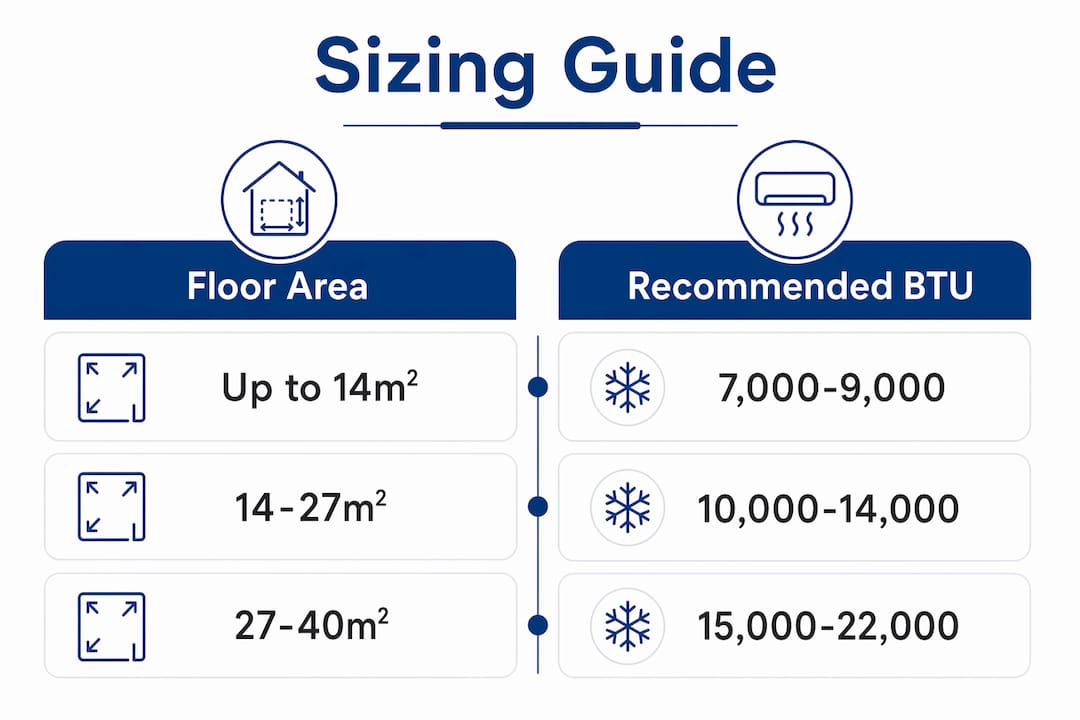
Worked example: a 40 m² open-plan office with south-facing glazing and four occupants. Base load: 40 × 550 = 22,000 BTU. Add 10% for high solar gain (+2,200 BTU) and 600 BTU per occupant (+2,400 BTU). Total: approximately 26,600 BTU, so specify a 24,000–28,000 BTU unit or two 12,000–14,000 BTU units positioned at opposite ends.
| Floor area (m²) | Recommended BTU | Approximate kW draw | Notes |
|---|---|---|---|
| Up to 14 | 7,000–9,000 | 0.7–0.9 kW | Small office, single occupant |
| 15–25 | 9,000–12,000 | 0.9–1.2 kW | Standard meeting room |
| 25–40 | 12,000–14,000 | 1.2–1.5 kW | Open-plan section |
| 40–60 | 18,000–24,000 | 1.8–2.4 kW | Two units recommended |
| Server cabinet spill | 12,000–14,000 | 1.2–1.5 kW | Direct airflow at rack intake |
Undersizing causes continuous running and premature compressor wear; oversizing reduces dehumidification because the unit short-cycles before moisture is removed. Always confirm the listed BTU is a refrigerant-based cooling rating, not an evaporative figure.
What will it cost to run, and when does a fixed system pay back?
A 9,000 BTU portable draws roughly 850–1,000 W. At the Ofgem price cap rate, an eight-hour run costs a few pounds per day. Running it regularly over a summer can add a notable amount to your electricity bill before maintenance.
A split system draws roughly 480 W for equivalent cooling, at approximately 13p per hour versus 19–41p for a portable. Over a 400-hour cooling season, the annual running cost difference is material. Hardware costs for portables sit at £240–£800, while a 12,000 BTU split system with F-Gas-qualified installation averages around £1,900. The split pays back within two to three cooling seasons for a continuously used space.
For genuine short-term needs — four to eight weeks, a one-off event, or emergency cover — hire rather than purchase is often the more cost-effective route. Rental removes capital outlay, maintenance responsibility, and storage costs between seasons. For energy efficiency improvements beyond cooling, a broader fabric-first approach to the building envelope will reduce the load on any cooling system.
Practical installation and placement tips for commercial spaces
Position the unit as close to the primary heat source as practical, with the exhaust hose routed as directly as possible to the window or wall panel. Every additional bend in the hose adds resistance and reduces efficiency.
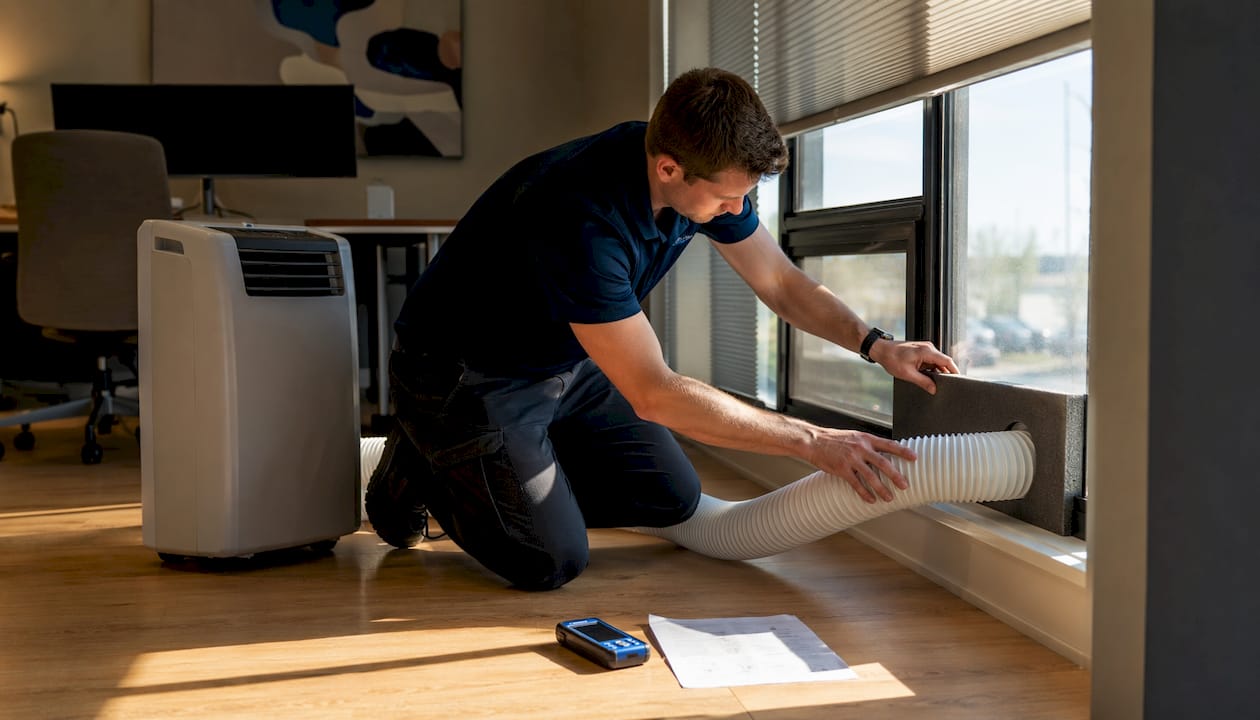
Seal the window opening properly. A purpose-made sliding panel or foam-seal kit prevents warm air re-entering around the hose. Good ventilation sealing practice applies here: any gap around the hose exit is a direct path for the heat you are trying to remove. Supplementary fans distribute cooled air further into the space and can reduce the number of units required on larger sites.
Use Wi-Fi scheduling to start the unit 30–45 minutes before occupancy. This cuts peak-hour run-time and keeps the unit from working against a fully heat-soaked room. For maintenance: clean filters every two weeks during peak season, check condensate daily in humid weather, and service the unit annually if it runs more than 400 hours per year.
Pro Tip: In multi-occupant spaces, place the unit near the return-air side of the room and use a low-energy pedestal fan to push cooled air across the occupied zone. This approach can extend effective coverage by 20–30% without adding another AC unit.
Procurement checklist for UK commercial buyers
Before raising a purchase order, confirm these points with your supplier.
Electrical supply: most commercial portables run on a standard 13A single-phase socket. Units above 3.5 kW may require a 16A or 32A circuit. Confirm socket ratings and RCD protection before delivery.
Warranty and returns: specify the warranty term on the PO, confirm spare-parts lead times, and check the supplier’s commercial returns policy. Simcodirect operates a 30-day returns policy, which provides a clear fallback if a unit arrives damaged or underperforms.
Bulk orders and lead times: for multi-site deployments or event cooling, request bulk-order pricing and confirm stock availability before committing. Summer demand spikes quickly; order in April or May rather than waiting for a heatwave.
Rental vs purchase decision: for requirements under eight weeks, rental removes capital risk and storage obligations. For anything longer, purchase and resale or part-exchange is usually more economical. Document service-level expectations, including response time for replacement units, in any rental agreement.
What are the next steps to order or commission a survey?
Portable units are the right call for emergency cover, short-term lets, events, and single-room hotspots. If the need is ongoing, multi-room, or noise-sensitive, commission a fixed split or VRF survey now rather than after another difficult summer.
Three immediate actions: (1) order the correctly sized portable from Simcodirect for immediate dispatch; (2) contact a rental supplier if the requirement is under eight weeks; (3) commission a heat-load survey for any space that needs cooling for more than two months per year.
Before delivery, confirm: clear access to the target room, a suitable window or wall panel for hose exit, a correctly rated socket within 1.5 metres of the intended position, and a condensate drain point or auto-evaporative unit specified on the order.
Key takeaways
For UK commercial buyers, a dual-hose portable with auto-evaporation and Wi-Fi scheduling is the correct short-term choice; anything running daily beyond eight weeks warrants a fixed split or VRF system instead.
| Point | Details |
|---|---|
| Match capacity to heat load | Use 500–600 BTU per m² as a baseline; adjust for solar gain, occupancy, and equipment heat. |
| Specify dual-hose venting | Single-hose units create negative pressure and deliver significantly less effective cooling in real rooms. |
| Mandate auto-evaporation | Manual condensate draining causes shutdowns; include auto-evaporation or a pump on every commercial PO. |
| Set a dB limit | Specify 55 dB maximum at medium fan speed for open-plan offices; 65 dB is acceptable for plant rooms. |
| Require Wi-Fi scheduling | Pre-cool scheduling cuts run-hours and supports duty-cycle management across a portfolio of units. |
| Simcodirect for procurement | Simcodirect supplies heating and cooling products with fast UK delivery, bulk-order pricing, and a 30-day returns policy. |
A note from Carl
The most common mistake I see commercial buyers make is treating a portable unit as a permanent fix. It rarely is. The noise alone — 50–65 dB against a split system’s 19–38 dB — becomes a real problem in client-facing spaces within a week. The running cost gap compounds that over a season.
That said, portables have a genuine role: emergency cover, temporary offices, event cooling, and server-spill situations where you need cooling today, not in three weeks. The key is buying with the right specification from the start: dual-hose, auto-evaporation, Wi-Fi scheduling, and a commercial warranty. Get those four things right and a portable unit will do exactly what it is supposed to do.
Simcodirect’s 30-day returns policy means you are not locked in if a unit is wrong for the site. For bulk enquiries, urgent orders, or advice on whether a fixed system survey makes more sense for your property, get in touch directly.
Simcodirect: heating and cooling products for commercial buyers
Simcodirect supplies a broad range of heating and cooling products to property managers, facility teams, and contractors across the UK, with fast delivery and competitive pricing on single units and bulk orders alike.
The product catalogue covers air conditioning units, electric heaters, designer radiators, and ancillary equipment — everything a commercial buyer needs for a property upgrade or emergency maintenance order. The Dimplex Q-Rad RF panel radiator is one example of the specification-grade products available, with full technical data and delivery details presented clearly on each product page.
To order, browse the product range at simcodirect.co.uk, add to basket, and check out with standard or express delivery. For bulk quotes or urgent commercial requirements, contact the team directly through the website. Stock varies by season, so for summer cooling orders, placing in advance avoids the lead-time delays that arrive with every heatwave.
Useful sources and further reading
- Portable air conditioning units: UK buying guide — covers BTU sizing, dual-hose design, evaporative vs refrigerant cooling, and running-cost examples for UK buyers.
- Are portable air conditioners worth it for UK commercial spaces? — lifecycle and cost comparison between portable and fixed systems for commercial use.
- Portable air conditioning: the complete guide — condensate management, Wi-Fi scheduling, and maintenance cadence for commercial sites.
- Split vs portable AC — detailed running-cost comparison using Ofgem price cap figures, noise data, and lifespan benchmarks.
- Portable AC vs fixed installation — noise comparison data (50–65 dB portables vs 19–38 dB split systems) and commercial space considerations.
- Considerations for air conditioning units — supplementary fan use and airflow distribution for improving portable unit coverage.
- Air conditioning buying guide UK — hardware price ranges and split-system installation cost context.