


Boiling water tap safety: UK checks homeowners and installers must make
Modern boiling water taps can be safe when they combine child safe controls, the correct safety devices, and installation to UK requirements. That safety depends on three things working together: hardware features like insulated spouts and two stage locks, compliant plumbing and electrical work, and proper commissioning by someone who knows what they’re checking. Building Regulations, WRAS approval, and a documented commissioning record are your main proof points. The sections below cover the features, the installation rules, the maintenance routine, and the everyday habits that keep a tap safe for years.
TL;DR:
- Most safety features depend on clear compliance with building regulations, WRAS approval, and correct installation by qualified professionals.
- Common risks include splash burns during use, unnoticed faults like dripping relief valves, and improper routing of safety discharge pipes.
- Installation must meet specific criteria such as adequate mains pressure, visible discharge routes, and compliance approval before use.
- Routine checks include verifying the tundish is dry, area clearance, and monitoring flow or pressure changes for early fault detection.
- Effective safety relies on layered hardware, proper commissioning, and household habits like steady pouring and lower temperature use when possible.
Table of Contents
- What makes a boiling water tap safe to use?
- What are the real risks and limitations?
- When does a boiling tap installation need building control approval?
- How do you commission and maintain a boiling water tap safely?
- How should households use a boiling tap safely day to day?
- Who’s behind this guidance?
- An installer’s view on when to proceed
- Ready to fit a boiling tap the right way?
- Where to check the rules yourself
- Sources
- FAQ
What makes a boiling water tap safe to use?
Every reputable boiling water tap relies on layered hardware to stop hot water reaching the wrong place at the wrong time. The child lock is the first line of defence. Most designs use a two stage push, push, turn action, sometimes paired with an illuminated ring that shows the tap is live, a pattern popularised by systems such as the Quooker safety design, which pairs the mechanical lock with a visual cue so a toddler can’t trigger a flow by accident.
Beyond the lock, several other features do the quiet work of preventing scalds:
- Spring loaded handles that shut off the moment you release them, rather than staying open like a standard mixer tap.
- Insulated, often rotatable spouts that keep the outer casing cool to touch even when boiling water is running through it.
- A flow design that produces an aerated or non-solid stream rather than a hard jet, which cuts down on splashback when filling a cup or pan.
- Backflow prevention built into the valve body, stopping contaminated water siphoning back into the mains supply.
When you’re comparing spec sheets, look specifically for a WRAS approval mark and a clear list of the fitted safety devices. A tap that only advertises “instant boiling water” without detailing the shut off mechanism or lock type is one to ask more questions about before you buy.
What are the real risks and limitations?
No safety feature eliminates risk entirely, and boiling water taps carry their own failure patterns worth knowing before you fit one. Scalds still happen through splash exposure during filling, a full jet hitting skin if a control sticks, or simple distraction, someone answers the door mid-pour and leaves a cup filling unattended.
There’s a behavioural angle too. Research from the Dutch Burns Foundation found households often perceive taps as inherently safer than kettles, which can lower everyday vigilance even though the water is just as hot. The study recorded no severe burns from taps in its sample, but the sample size limits how confidently that finding generalises.
Installation faults cause a separate category of problems:
- Relief discharge pipework hidden behind cabinetry instead of routed somewhere visible.
- Incorrect mains pressure that the unit wasn’t specified for.
- Inadequate electrical provision, such as running the unit from a shared socket rather than a dedicated supply.
Spitting, coughing, or fluctuating temperature at the spout usually points to trapped air or a tired filter rather than anything dangerous, but they’re worth investigating early.
Pro Tip: If your installation wasn’t commissioned and documented by a competent engineer, check your warranty terms before you assume a fault will be covered. Insurers and manufacturers increasingly ask for that paperwork.
When does a boiling tap installation need building control approval?
UK compliance isn’t optional extra reading, it’s the difference between a tap that’s genuinely safe and one that only looks the part. Here’s what installers and homeowners need to confirm before and during fitting:
- Check the notifiable threshold. LABC guidance sets the line at 15 litres of stored hot water. Units storing more than that generally need building control notification; smaller instant systems and standard electrical work often fall outside this, but always confirm with your local authority.
- Confirm the fitted safety devices. You need temperature and pressure relief, a thermal cut out, and where relevant an expansion vessel. Scottish Government technical guidance on heat safety is explicit that stored water must not be allowed to exceed 100°C, and that relief discharge has to be routed somewhere visible and safe, typically via a tundish.
- Verify WRAS approval on the paperwork, not just the marketing copy, and check it against the Water Fittings Regulations requirements for the specific model you’re fitting.
- Assess the electrical supply. Most units need a dedicated circuit rather than a shared plug socket, and the discharge route must sit well clear of any electrics.
- Do the site checks before you fit anything: mains pressure, cupboard space for the tank, access for future servicing, and a discharge path that doesn’t run behind sealed panels.
How do you commission and maintain a boiling water tap safely?
Commissioning is where a lot of preventable damage happens, usually because someone skips a step to save ten minutes. Follow this sequence:
- Fill before you energise. The tank must be full of water before the heating element switches on. Energising a dry element can destroy the unit outright, according to installation guidance from trade fitters, so this step isn’t negotiable.
- Flush and purge the lines to clear air and any residue from the pipework before first use.
- Test every safety control, the child lock, the indicator light, the temperature limit, and the automatic shut off, one at a time.
- Watch the relief valve and tundish. A brief discharge during heat up is normal. Continuous dripping afterwards is not, and points to a pressure or expansion fault that needs investigating rather than ignoring.
- Record the commissioning details, including the baseline temperature setting and filter type fitted. This record matters for warranty claims and for whoever services the unit next.
After that, routine maintenance is mostly filter changes and the occasional de-air after any plumbing work nearby. A checklist of first fill and testing steps is worth keeping to hand for reference.
How should households use a boiling tap safely day to day?
Good habits matter as much as good hardware. Keep the cup or pan close to the spout and pour with a steady, deliberate hand rather than rushing. Anyone using the two stage lock should understand how it works. Young children should be kept away from the tap entirely, not just trusted to respect the lock.
You don’t always need water at a full boil. Many tasks, tea, instant food, washing up, work fine at a slightly lower setting, and reserving true boiling point for the jobs that actually need it is both safer and cheaper to run.
A few daily checks take seconds:
- Glance at the tundish. It should be dry, not dripping.
- Keep the area around the spout clear of cables or sockets.
- Note any change in flow, pressure, or noise, since that’s usually the earliest sign of a filter or valve issue.
Pro Tip: Leaving the tap powered overnight is standard practice for most households, since the tank is small and well insulated. If you’re away for an extended period, switching it off at the isolator is a sensible precaution rather than a necessity.
Who’s behind this guidance?
This article is written by Carl, drawing on UK Building Regulations, WRAS requirements, and trade installation practice. For deeper technical detail, see the Simcodirect installation guide covering commissioning steps in full. Compatible units are available with UK delivery and a returns policy, backed by documentation to support WRAS verification during fitting.
An installer’s view on when to proceed
Before I’d sign off a job, I want to see four things: adequate mains pressure, enough cupboard space for the tank, a discharge route I can actually see, and clarity on whether the work is notifiable. If pressure is marginal or there’s no realistic place to route discharge safely, I’d delay the retrofit rather than force it. Commissioning by someone competent isn’t a formality, it’s what keeps the household safe and keeps the warranty valid if something goes wrong later.
— Carl
Ready to fit a boiling tap the right way?
There are suppliers offering hardware that matches the compliance checklist, providing instant water heaters and boiling tap accessories in one place, with UK delivery and a returns policy if the fit or spec isn’t right.
Browse the full washroom and heating range to compare instant water heater options, or go straight to a specific model like the Zip Aquapoint unvented water heater if you already know the spec you need. If you’re mid installation and need a replacement element, the thermostatic heating element range covers common servicing needs too. Check current stock and place your order today.
Where to check the rules yourself
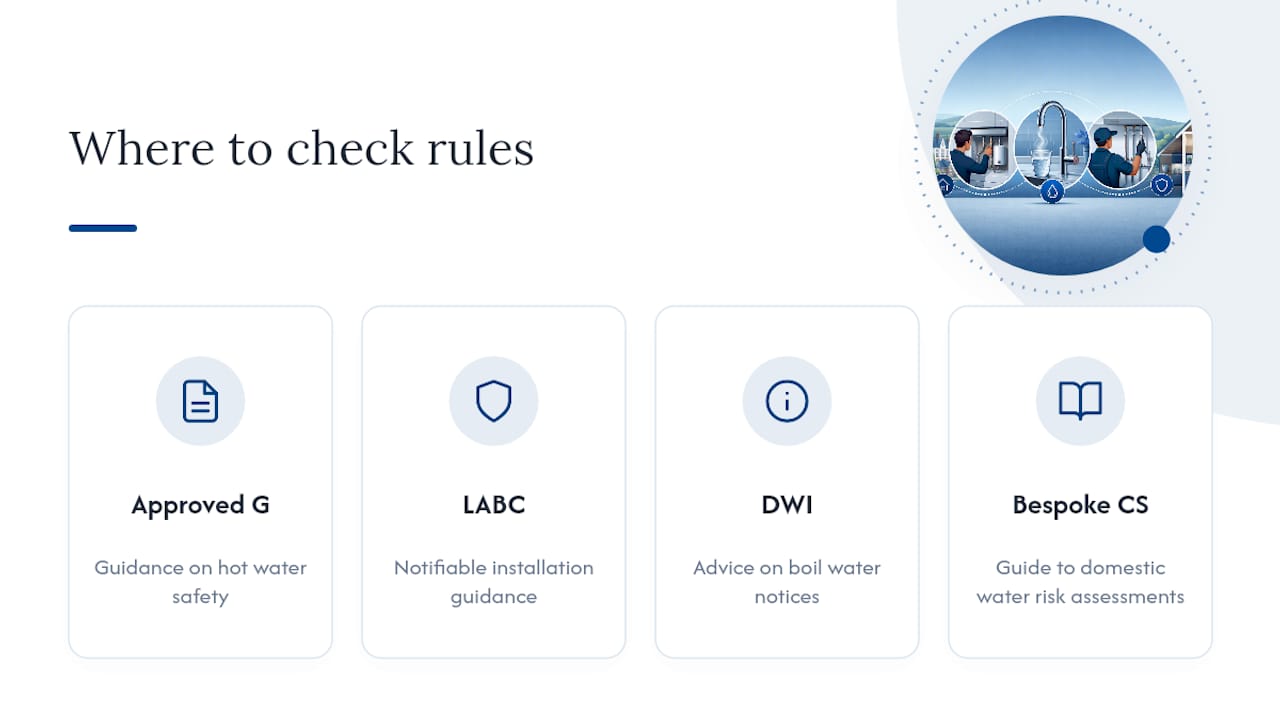
For primary detail, see Approved Document G guidance on hot water safety, LABC’s notifiable installation guidance, and the Drinking Water Inspectorate’s advice on boil water notices. For wider compliance context, Bespoke Compliance Solutions’ guide to domestic water risk assessments is a useful reference for facilities managers.
Sources
- Building standards technical handbook 2020: danger (heat) — Scottish Government
- Don’t find yourself in hot water! — LABC
- Hot water tap installation guide for UK cafés and homes — ADS Coffee Supplies
FAQ
What are the downsides of a boiling water tap?
The main downsides are installation complexity compared with a standard tap, occasional spitting or flow issues from air or filter buildup, and a higher upfront cost that includes professional fitting in most cases.
Should I turn my boiling water tap off at night?
Most manufacturers design units to stay powered continuously since the tank is small and well insulated, so switching off isn’t required for daily use, though isolating it during extended absences is a sensible precaution.
Does boiling tap water make it safe to drink?
Boiling water does kill most bacteria and viruses, which is why the Drinking Water Inspectorate advises boiling during a formal boil water notice, but this applies to genuine contamination events rather than everyday mains water.
What are the downsides of a Quooker style boiling water tap?
Systems using a two stage push, push, turn lock and illuminated ring add a learning curve for new users, and like all boiling taps they need proper commissioning and periodic filter changes to keep performing safely.
Is a boiling water tap safer than a kettle?
Evidence from the Dutch Burns Foundation suggests households perceive taps as safer and recorded no severe burns from taps in its sample, though researchers caution the sample size limits how confidently that can be generalised.