


1 kW = 3,412 BTU/hr: BTU vs Watts for UK Radiators, Avoid Delta T
One watt equals 3.412141633 BTU/hr, and one BTU/hr equals 0.29307107 W. That’s the whole conversion in one line. The catch is that BTU on its own measures energy, while BTU/hr measures a rate of energy transfer, which is power, and that’s the only figure directly comparable with watts.
TL;DR:
- Using the correct formulas, converting between watts and BTU/hr involves multiplying or dividing by 3.412141633 or 0.29307107, depending on direction.
- Resistance heaters nearly convert electrical power to heat at almost 100 percent efficiency, but heat pumps and air conditioners draw less power than their BTU/hr rating suggests due to efficiency ratios like EER.
- Radiator outputs are influenced by the Delta T rating, so matching the heat-loss calculation and radiator’s specified DT value is essential to avoid undersizing.
- Most practical conversions assume that 1 kilowatt equals approximately 3,412 BTU/hr, but chaining multiple conversions with full decimal precision enhances accuracy.
- Correctly interpreting the difference between energy (BTU) and power (BTU/hr) is crucial to avoid common mistakes in heating calculations.
Table of Contents
- BTU vs watts: how to convert between the two correctly
- Quick reference: watts to BTU/hr conversion table
- Electrical input vs thermal output: where the conversion misleads
- Radiator sizing and the Delta T trap
- A publisher’s note on getting the numbers right
- Choosing radiators and heaters once you know the numbers
- Sources
BTU vs watts: how to convert between the two correctly
Two formulas cover every conversion you’ll ever need for heating or appliance work:
P(W) = P(BTU/hr) × 0.29307107 P(BTU/hr) = P(W) × 3.412141633
Keep both handy, because you’ll use one far more than the other depending on whether you’re reading a heater’s spec sheet or an appliance’s power label. Here’s how they work with real numbers:
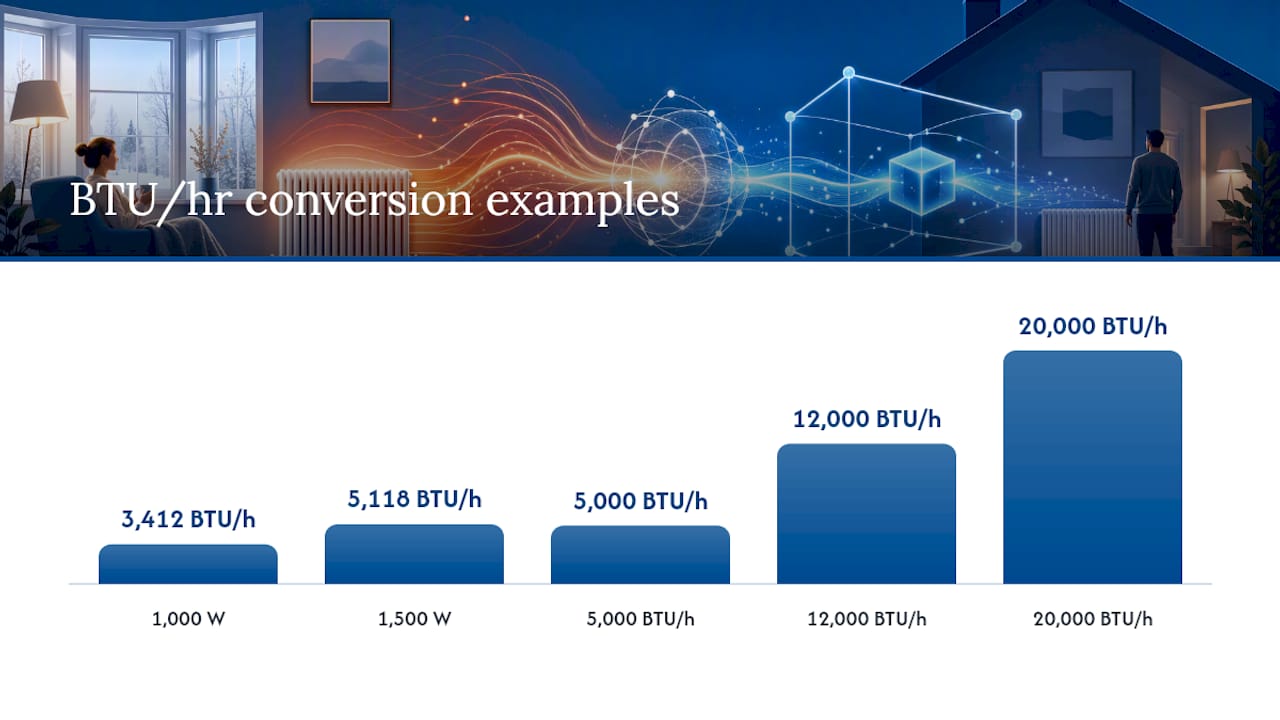
- 1,000 W → 1,000 × 3.412141633 = 3,412 BTU/hr
- 1,500 W → 1,500 × 3.412141633 = 5,118 BTU/hr
- 12,000 BTU/hr → 12,000 × 0.29307107 = 3,517 W
- 5,000 BTU/hr → 5,000 × 0.29307107 = 1,465 W
- 20,000 BTU/hr → 20,000 × 0.29307107 = 5,861 W
Scaling up to kilowatts follows the same logic. Since 1 kW = 1,000 W, you get 1 kW ≈ 3,412 BTU/hr. Most trade calculators round the factor to 3.412, which is fine for everyday sizing but introduces a tiny error if you’re chaining several conversions together, so keep the fuller decimal for anything that needs precision.
Three mistakes trip people up repeatedly. First, confusing BTU with BTU/hr. A BTU alone is a lump of energy; BTU/hr is that energy delivered every hour, which is what makes it a power figure like watts. Second, rounding too early in a multi-step calculation, which compounds errors across a full heat-loss survey. Third, and most costly in practice, assuming BTU/hr output always equals electrical watts drawn, which only holds true for straightforward resistance heating.
Quick reference: watts to BTU/hr conversion table
Print this or save it. It covers the values you’ll actually meet on appliance boxes, radiator datasheets and heater spec sheets.
Every figure in that table is a fixed mathematical conversion, derived from the joule as the base energy unit, not an estimate or manufacturer-specific value. It will hold true whether you’re sizing a bedroom radiator or an industrial air handler.
Electrical input vs thermal output: where the conversion misleads
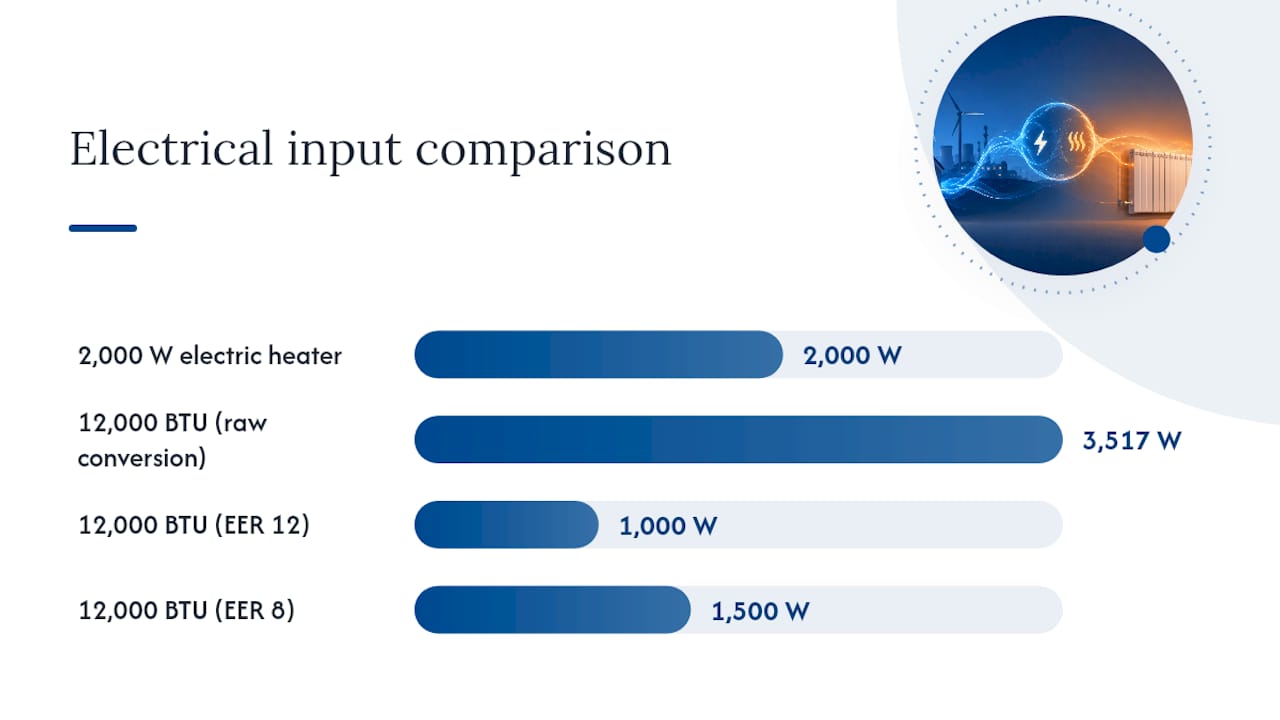
For a plug-in resistance heater, the conversion above tells you almost exactly what you’re getting. Electrical input converts to heat output at close to 100%, so a 2,000 W panel heater delivers roughly 6,824 BTU/hr of heat, and the maths lines up with reality.
Air conditioners and heat pumps break that neat relationship, because they move existing heat rather than generate it from electricity. A unit rated at 12,000 BTU/hr of cooling capacity does not draw 3,517 W from the wall. It draws far less, because it’s shifting heat rather than converting electrical energy directly into it.
This is where the efficiency ratio EER (or COP for heat pumps) comes in. The formula is:
Electrical watts = BTU/hr ÷ EER
- A 12,000 BTU/hr unit with an EER of 12 draws 12,000 ÷ 12 = 1,000 W electrically.
- The same 12,000 BTU/hr capacity with an EER of 8 would draw 1,500 W instead.
Statistic to remember: a 12,000 BTU/hr air conditioner rated at EER 12 pulls just 1,000 W from the mains, roughly a third of what the raw BTU/hr to watts conversion would suggest. Treating BTU/hr as electrical consumption on a cooling or heat pump appliance will leave your running-cost estimate wildly wrong.
Always check the nameplate watts or the published EER/COP figure when budgeting electricity costs for any appliance that moves heat rather than generates it directly.
Radiator sizing and the Delta T trap
Radiator output figures aren’t universal constants the way the BTU to watts conversion is. They’re measured against a specific temperature difference, called Delta T (DT), between the radiator’s average water temperature and the room’s air temperature. DT50 has long been the standard reference point across the trade, though older systems and some modern low-temperature heat pump setups run closer to DT30.
Here’s why that matters: a radiator rated at 2,000 BTU/hr at DT50 will produce noticeably less heat at DT30, because the smaller temperature gap between radiator and room slows the rate of heat transfer. If your heat-loss calculation was done at DT50 but your boiler or heat pump actually runs the system at DT30, you’ll end up with an undersized radiator that never quite heats the room properly, even though the spec sheet number looked adequate on paper.
Two practical fixes:
- Match the DT rating used in your room heat-loss calculation to the DT rating quoted on the radiator’s datasheet, not a different figure from a different source.
- Round up slightly when a room sits between two standard radiator sizes, since a marginally oversized radiator runs cooler for longer and gives you more comfortable, controllable heat than one that’s undersized.
Pro Tip: When comparing radiators from different suppliers, check the DT figure quoted alongside the BTU/hr rating before you compare numbers directly. Two radiators both listed as “2,000 BTU/hr” can perform very differently in your home if one is rated at DT50 and the other at DT60.
A publisher’s note on getting the numbers right
Our guides exist because the maths behind heating specs trips up more people than it should. We publish the radiator size guide and heater sizing content precisely because the conversions in this article aren’t abstract. They’re the numbers stamped on many product datasheets.
Every electric radiator and heater we list carries a rated output in watts, and you can run it through the formulas above to check it against a BTU/hr figure from an old boiler manual or a room heat-loss calculation someone else did years ago. If you’re starting from scratch on room sizing, our electric heater sizing guide walks through the room-volume approach in more depth, and the radiator size guide covers the Delta T question in UK-specific terms rather than generic averages.
— Carl
Choosing radiators and heaters once you know the numbers
Once you’ve converted your room’s heat requirement into watts or BTU/hr, the next step is matching that figure to an actual product, and here’s where the spec sheet becomes genuinely useful rather than a page of numbers.
For most UK rooms, you’re choosing between three broad types. Electric panel radiators, like the Dimplex Q-Rad, give you a rated wattage you can convert straight to BTU/hr using the formula above, making them the simplest to size against a heat-loss calculation. Towel radiators, such as the Titan Chrome Straight Towel Radiator or the Platinum Chrome Electric Curved Towel Radiator, suit bathrooms where the DT caveat matters most, because bathroom systems often run at lower temperatures than the rest of the house. Convector heaters, including the Dimplex DX Convector, work well for quick, responsive heating in smaller or occasionally used rooms.
Whichever type you’re weighing up, check two things before you buy: the rated BTU/hr or watts, and the DT rating it was tested against where the supplier states one. Many retailers list rated output clearly on product pages, so you can run the conversion yourself before committing, and some offer returns policies that help if the maths still surprises you once it’s fitted.
Sources
For independent verification of any figure in this article, the following resources are worth bookmarking: BLUETTI’s watts to BTU/hr guide for the underlying formula and EER guidance, RapidTables’ BTU/hr to watts calculator for quick one-off conversions, and TradeCalculator’s radiator sizing tool for UK-specific DT-based radiator sizing.
- BTU/hr to watts conversion calculator
- Radiator Sizing Calculator — BTU & Watt Calculator for Any Room | TradeCalculator
- Radiator sizing BTU calculator explained | Axiom Eco Homes