


BTU: what it means for UK homeowners
A BTU, or British thermal unit, is a measure of heat energy. One Btu is the amount of heat needed to raise one pound of water by 1°F. That single fact underpins every heating and cooling spec you will encounter when shopping for radiators, heat pumps, or air conditioners. When manufacturers list a “BTU” figure on a product, they almost always mean Btu/h (British thermal units per hour), which is a rate of heat output, not a total energy quantity.
Two conversions you will use constantly:
- 1 Btu ≈ 1,055 joules — the base energy equivalent, useful for comparing with SI figures
- 1 kW ≈ 3,412 Btu/h — the practical conversion for matching appliance specs to UK product literature
A higher Btu/h number means greater heating or cooling capacity, which generally suits a larger space. But capacity alone tells you nothing about running costs. That depends on efficiency, which is a separate figure entirely.
Table of Contents
- What does BTU actually mean?
- BTU versus Btu/h: the difference that matters for conversions
- How to read appliance BTU numbers in practice
- Why BTU output doesn’t tell you what you’ll pay to run it
- Practical steps for UK homeowners sizing heating or cooling
- Why the UK uses kW, and what that means when you shop
- Key takeaways
- Why homeowners get BTU wrong more often than they should
- Useful sources
What does BTU actually mean?
The British thermal unit is a unit of heat energy from the imperial measurement system. Physically, 1 Btu equals roughly 1,055 joules (or about 252 calories), which is the modern SI equivalent. To put that in perspective, one Btu is roughly the heat released by burning a single match.
There are actually several closely related definitions of the Btu, each tied to a slightly different water temperature reference point. The variation between them is less than 0.5%, so for practical home heating purposes it makes no difference which definition a manufacturer uses.
The name has persisted despite the UK’s adoption of SI units because the HVAC industry, particularly in North America, never moved away from it. British and European product literature now typically uses kilowatts, but imported equipment, online spec sheets, and some older UK product pages still quote Btu/h. Knowing the conversion means you are never stuck comparing apples with oranges.
BTU versus Btu/h: the difference that matters for conversions
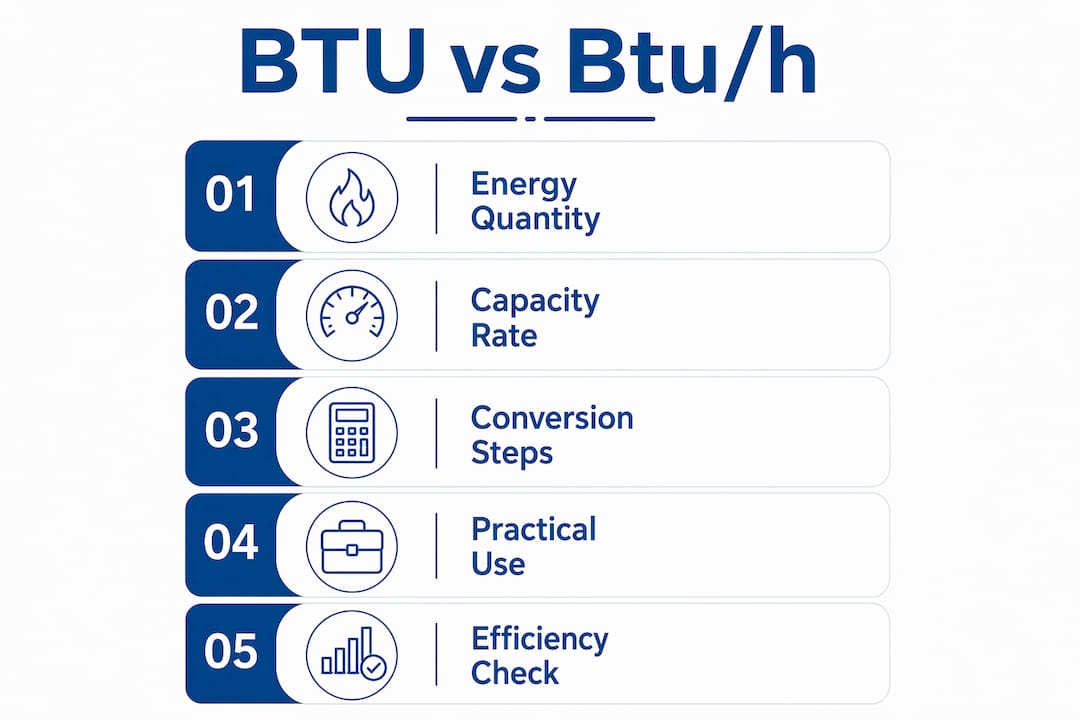
This is where most homeowners get tripped up. BTU is a quantity of energy. Btu/h (sometimes written BTUH) is a rate of energy transfer, specifically how much heat an appliance can move in one hour. When a spec sheet says a portable air conditioner is “12,000 BTU”, it means 12,000 Btu/h — a capacity figure. Manufacturers routinely drop the “/h” shorthand, which is a known source of consumer confusion.
The practical conversions you need:
| From | To | Formula |
|---|---|---|
| Btu/h to kW | kW | Divide Btu/h by 3,412 |
| kW to Btu/h | Btu/h | Multiply kW by 3,412 |
| Btu to joules | J | Multiply Btu by 1,055 |
| kWh to Btu | Btu | Multiply kWh by 3,412 |
Worked examples:
- 12,000 Btu/h ÷ 3,412 = 3.52 kW (a typical single-room air conditioner or small electric heater)
- 3 kW × 3,412 = 10,236 Btu/h (a standard UK fan heater, such as the Chelsea 3 kW fan heater from Simcodirect)
Once you have the kW figure, you can compare directly with any UK radiator or heater spec.
How to read appliance BTU numbers in practice
Manufacturers list Btu/h to describe capacity, not energy consumption. The number tells you how much heat the unit can deliver (or remove, for cooling) per hour under test conditions. Here is what common ratings actually mean for room sizing:
- 12,000 Btu/h: Often called 1 ton of cooling capacity in HVAC shorthand. Suitable for a single bedroom or small living room, roughly 15–25 m².
- 25,000 Btu/h: Appropriate for a large open-plan living space or a mid-sized commercial room. Think open-plan kitchen-diners or larger lounges.
- 40,000 Btu/h: Whole-house or large commercial territory. At this output, you are looking at multi-room systems or sizeable commercial installations.
These are rough guides. Actual requirements depend on insulation, ceiling height, window area, and orientation. A poorly insulated Victorian terrace may need considerably more capacity per square metre than a modern new-build.
A word on oversizing. Fitting a unit with too high a Btu/h rating is a common mistake. An oversized air conditioner short-cycles — it reaches the set temperature quickly, shuts off, then restarts repeatedly. That pattern reduces humidity control, increases wear on the compressor, and can actually make a room feel clammy rather than comfortable. For heating, an oversized boiler or heat pump runs inefficiently at part load. Matching capacity to the room’s actual heat loss is always the right approach.
Pro Tip: If a product page only lists “BTU” with no “/h”, treat it as Btu/h for any appliance that heats or cools continuously. The energy-quantity interpretation (a single Btu) is essentially never what a consumer product spec means.
Why BTU output doesn’t tell you what you’ll pay to run it
Capacity and running cost are two entirely different things, and conflating them is one of the most expensive mistakes a homeowner can make. A 12,000 Btu/h (3.5 kW) heat pump and a 12,000 Btu/h (3.5 kW) electric resistance heater deliver the same heat output per hour. Their electricity bills will look nothing alike.
The heat pump might achieve a coefficient of performance (COP) of 3.0, meaning it delivers 3 kWh of heat for every 1 kWh of electricity consumed. The resistance heater converts electricity to heat at a 1:1 ratio. Same Btu/h capacity, roughly three times the running cost for the resistance heater.
Efficiency labels and seasonal performance metrics are what actually determine your bills. The figures to look for:
- COP / SCOP (coefficient of performance / seasonal COP): used for heat pumps; higher is better
- SEER (seasonal energy efficiency ratio): used for air conditioners and heat pumps in cooling mode
- Energy label rating (A+++ to G on UK/EU-style labels): a quick proxy for relative efficiency
A unit’s Btu/h rating is a first filter for suitability. Once you have confirmed the capacity is right for the space, the efficiency figures decide whether the appliance is worth buying. For a deeper look at how efficiency ratings translate to running costs, the EER and SEER metrics are worth understanding before you commit to a purchase.
Pro Tip: When comparing two appliances with similar Btu/h ratings, divide the annual energy consumption figure (in kWh, usually on the energy label) by your electricity tariff rate. That gives you a direct annual cost comparison far more useful than the capacity figure alone.
Practical steps for UK homeowners sizing heating or cooling
When you see a BTU figure on a product page or installer quote, work through these steps before making a decision.
- Convert Btu/h to kW. Divide the Btu/h figure by 3,412. This gives you a number you can compare directly with UK radiator and heater specs. A Platinum Chrome Electric Curved Towel Radiator, for example, lists its output in watts or kW — the format you need for direct comparison.
- Estimate the room’s heat loss. A rough rule of thumb for a well-insulated UK room is around 50–75 W per m² (0.05–0.075 kW/m²). Multiply your floor area by that figure to get a ballpark kW requirement. For older or poorly insulated properties, use the higher end or commission a proper heat-loss survey.
- Check the energy label and seasonal efficiency figures. Never buy on capacity alone. Look for the SCOP, COP, or SEER rating and the annual kWh consumption figure.
- Confirm sizing with an installer. For heat pumps, underfloor heating, or whole-house systems, a professional heat-loss calculation is not optional — it is the only way to size correctly.
Red flags to watch for:
- A spec sheet that lists “BTU” without clarifying whether it means Btu/h (capacity) or total Btu (energy quantity)
- No efficiency rating or energy label on the product listing
- An installer quoting a unit significantly larger than your heat-loss estimate without explaining why
- Btu/h figures that seem implausibly high for the room size described
Call a professional when you are dealing with a heat pump installation, a low-temperature underfloor system, or a home with unusual construction. These scenarios require accurate heat-loss calculations, not rule-of-thumb estimates.
Why the UK uses kW, and what that means when you shop
The UK measures appliance output and energy billing in kilowatts and kilowatt-hours. Your electricity meter records kWh; your radiator spec sheet lists kW; your boiler’s output is rated in kW. BTU figures appear mainly on imported equipment, some online marketplaces, and American-origin product documentation.
UK radiator output ratings follow the BS EN 442 standard, tested at a delta T of 50°C (DT50). That means the radiator is tested with flow water at 75°C and a room temperature of 20°C. If your heating system runs at lower flow temperatures — as most modern heat pumps do — the radiator’s actual output will be lower than the rated figure. Simple Btu/h-to-kW arithmetic does not account for this. A radiator rated at 1,500 W under DT50 conditions might deliver only 900–1,000 W at the lower flow temperatures typical of a heat pump system. This is one reason why low-temperature system sizing requires professional input rather than a quick conversion.
When browsing product pages, look for the kW or watt output figure rather than converting from Btu/h yourself. Simcodirect lists full specifications on product pages, including output ratings, so you can compare directly without needing to convert. The Simcodirect heating guide covers how these figures apply to specific product categories if you want further reading.
For designer radiators in bathrooms, the same principles apply: match the kW output to the room’s heat-loss requirement, and check whether the rating is given at DT50 or a lower delta T before assuming the figure is directly comparable.
Key takeaways
BTU is a unit of heat energy, but on appliance spec sheets it almost always means Btu/h — a capacity rate — and converting that figure to kW is the essential first step for any UK homeowner comparing products.
| Point | Details |
|---|---|
| BTU is a heat energy unit | One Btu raises one pound of water by 1°F; it equals roughly 1,055 joules. |
| Appliance specs mean Btu/h | Manufacturers list capacity (rate), not total energy; divide by 3,412 to get kW. |
| Capacity is not running cost | A unit’s Btu/h tells you what it can do, not what it will cost; check SCOP, COP, or SEER. |
| UK products use kW | British product specs and energy bills use kW and kWh; always convert for direct comparison. |
| Oversizing causes problems | Too high a Btu/h rating leads to short-cycling, poor humidity control, and wasted energy. |
Why homeowners get BTU wrong more often than they should
The BTU figure is the number that gets quoted first in every product listing, every installer quote, and every online comparison. It feels authoritative. But it answers only one question: can this unit physically move enough heat for the space? It says nothing about how efficiently it does so, how it performs at part load, or what it will cost to run across a heating season.
The gap that catches most people out is the efficiency question. A high-capacity unit with a poor SCOP will cost more to run annually than a correctly sized unit with a strong seasonal performance figure, even if the Btu/h numbers look similar. The capacity figure is the starting point, not the conclusion.
There is also the DT50 issue that rarely gets mentioned in consumer-facing content. If you are retrofitting radiators for a heat pump, the rated kW output on the product page was measured at conditions your heat pump will never reach. You need radiators sized for the actual flow temperature your system will run at, which typically means going larger than a straight conversion would suggest. A heat-loss survey from a qualified installer costs a few hundred pounds and can save you from a system that never quite warms the house properly.
Treat BTU as a filter, not a verdict. Use it to eliminate obviously unsuitable products, then do the efficiency and sizing work before you buy.
Useful sources
These are the primary references used in this article. For detailed sizing calculations or regulatory questions, consult the relevant standard or a qualified heating engineer.
- NIST Glossary: British Thermal Unit — the authoritative scientific definition and joule equivalent from the US National Institute of Standards and Technology.
- U.S. Energy Information Administration: British thermal units — clear explanation of Btu in the context of fuel energy content and the kWh relationship.
- GOV.UK: Future Homes Standard consultation (Part L) — UK government building regulations context, including low-temperature system guidance and the BS EN 442 testing standard.
- Wikipedia: British thermal unit — comprehensive background on definitions, variants, and the distinction from the obsolete Board of Trade Unit.
- Simcodirect: What does BTU stand for? — Simcodirect’s own guide covering BTU in the context of heating products available on the site.
This article is general information for homeowners and does not constitute professional engineering or installation advice. For precise sizing, consult a qualified heating engineer or check the relevant British Standard for your system type.