


Choosing designer radiators for bathrooms: 2026 guide
A designer radiator is defined as a heating unit that combines measured heat output with a considered aesthetic form, making it a functional fixture rather than a purely decorative one. Choosing designer radiators for bathrooms requires balancing three factors: sufficient wattage for the room, a material that resists moisture, and a finish that suits your design scheme. Get any one of these wrong and you end up with either a cold bathroom or a radiator that corrodes within two years. This guide covers every decision point, from heat loss calculations aligned with CIBSE Guide A and MCS 020 standards, to fuel type compliance and installation practicalities.
How to calculate heating requirements when choosing designer radiators for bathrooms
Heat output is the single most important specification to check before anything else. A family bathroom over 8m² requires 1,200–2,000 Watts to reach the recommended comfort temperature of 22°C. That figure comes from CIBSE Guide A and MCS 020 heating standards, which account for room volume, insulation quality, and ventilation rates.
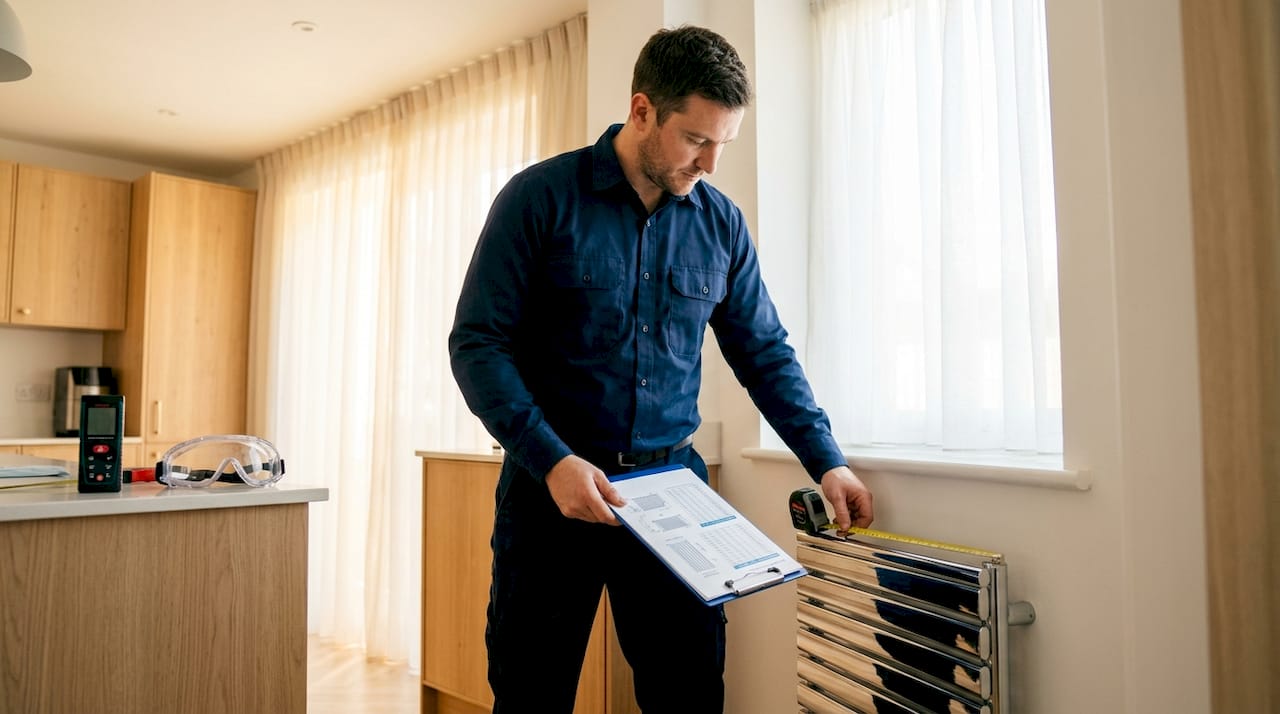
Professional installers calculate output requirements using BTUs or Watts based on room volume and heat loss, not just floor area. A poorly insulated bathroom with an external wall and an extractor fan loses heat far faster than a well-insulated internal one of the same size. Always factor in these variables before selecting a model.
Wattage ratings on radiator specifications are given at ΔT50, a standard temperature difference used across the industry. The British Radiator Manufacturers Association (BRMA) provides standardised output data at this benchmark, giving reliable estimates for comparison. Your installer will then adjust these figures for your actual operating conditions.
One figure that catches many homeowners out involves heat pumps. At heat pump flow temperatures of 35–45°C, radiator output drops significantly, requiring larger or more efficient units to maintain comfort. Towel rails lose around 60–70% of their rated output at these lower temperatures, whereas a full-size panel radiator typically remains adequate.
Key wattage benchmarks by bathroom size:
| Bathroom size | Approximate wattage needed |
|---|---|
| Up to 4m² | 600–900W |
| 4m²–8m² | 900–1,200W |
| Over 8m² | 1,200–2,000W |
Pro Tip: Always add 10–15% to your calculated wattage requirement to account for heat loss through windows, doors, and ventilation. A radiator running at 80% capacity lasts longer and heats more evenly than one running flat out.
What materials and finishes work best for bathroom radiators?
Material choice determines how long a radiator lasts in a humid bathroom environment. Aluminium radiators offer corrosion resistance and faster heat-up times than steel, making them a strong choice for bathrooms where moisture levels fluctuate throughout the day. Steel remains the most widely used material, provided it carries a quality powder coating or chrome finish to protect against rust.
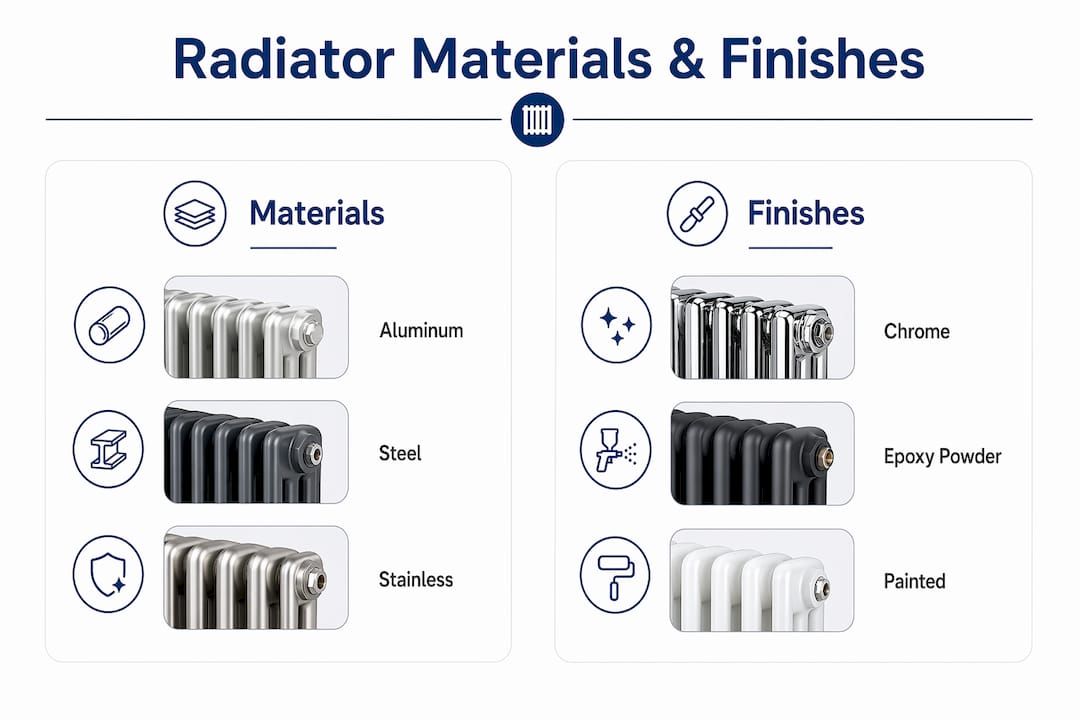
Cast iron is rarely specified for modern bathrooms. It is heavy, slow to heat, and difficult to retrofit into contemporary spaces. The design trends for 2026 lean firmly towards aluminium and steel in slim, vertical formats with matte or metallic finishes.
Finish options now go well beyond polished chrome:
- Chrome: Classic, moisture-resistant, and easy to clean. The Titan Chrome straight towel radiator is a popular choice for contemporary bathrooms.
- Matte black: Strong contrast against white sanitaryware; suits industrial and minimalist schemes.
- Coloured powder coatings: Anthracite, brushed gold, and stone effect finishes are all growing in popularity for 2026 bathroom renovations.
- Curved profiles: The Platinum Chrome curved towel radiator demonstrates how form can complement function without compromising output.
Pro Tip: In bathrooms with poor ventilation, choose a radiator with a factory-applied epoxy powder coat rather than a standard paint finish. Epoxy coatings bond more firmly to the metal and resist the repeated cycle of steam and condensation far better.
Which fuel type suits your bathroom heating setup?
The three fuel types for bathroom radiators are hydronic (wet), electric, and dual fuel. Each has distinct installation requirements and regulatory implications.
Hydronic systems connect to your central heating circuit via 15mm BSP compression fittings, using isolation valves and valve sets for installation. They are the most cost-effective to run when your boiler or heat pump is already active. The limitation is that they provide no heat during summer when the central heating is off.
Electric towel radiators solve the summer problem but carry stricter regulatory requirements. Under BS 7671, electric towel radiators require an IP44 rating when positioned in Zones 1 or 2 of a bathroom. Zone 1 covers the area directly above the bath or shower; Zone 2 extends 600mm beyond that perimeter. Wiring must connect to a fused spur, not a standard plug socket, and the work must comply with Part P of the Building Regulations.
Dual fuel radiators combine both systems in a single unit. They run off the central heating in winter and switch to an electric element in summer, providing year-round warmth without running the boiler. The Platinum Chrome dual fuel curved towel radiator is a practical example of this approach, offering flexibility without requiring two separate units.
“Dual fuel towel radiators are the most practical choice for UK bathrooms. They give you the efficiency of hydronic heating in winter and the convenience of electric operation in summer, all from one unit that fits the same wall space as a standard towel rail.”
Step-by-step approach to selecting and installing a bathroom radiator
A clear process prevents the most common and costly mistakes.
-
Assess your heating requirement. Calculate the room volume (length × width × height in metres), note the insulation standard, and identify any external walls or windows. Use CIBSE Guide A benchmarks or an online heat loss calculator to establish your minimum wattage.
-
Choose your style, size, and material. Match the radiator height and width to your available wall space. Vertical radiators suit narrow walls; horizontal models work well beneath windows. Select a finish that coordinates with your taps, shower fittings, and sanitaryware.
-
Confirm your fuel type and regulatory compliance. Decide between hydronic, electric, or dual fuel based on your existing heating system. For electric models, confirm the IP rating is appropriate for the zone position. Check that your installer is registered under Part P for any electrical work.
-
Plan the installation location carefully. Hydronic radiators need proximity to existing pipework. Electric models need a nearby fused spur. Both need adequate clearance from towel storage and door swings. The Consort Toweldry towel radiator is a useful reference for compact installations where wall space is limited.
-
Commission and test before finishing. Run the radiator through a full heating cycle before tiling or boxing in any pipework. Check for leaks at all compression fittings and confirm the thermostat or timer operates correctly.
Pro Tip: Ask your installer to provide the corrected heat output figure at your actual flow temperature, not just the ΔT50 rating on the product label. This single step prevents the most common cause of a cold bathroom after installation.
Common mistakes to avoid when selecting bathroom radiators
The most frequent error is relying on a towel rail as the sole heat source in a family bathroom. Standard towel rails produce only 200–400 Watts, which is well below the 1,200–2,000W needed for a typical family bathroom. The result is a bathroom that never reaches 22°C, and a towel rail running continuously to compensate, which increases energy bills.
Other mistakes worth avoiding:
- Ignoring IP ratings for electric models. Fitting a non-IP44 rated electric radiator in Zone 1 or Zone 2 is a Building Regulations offence and a safety risk.
- Choosing a radiator purely for looks. A beautiful matte black ladder rail that outputs 350W will not heat a 10m² bathroom, regardless of how well it suits the décor.
- Overlooking pipework access. A hydronic radiator positioned on an external wall with no nearby pipework will require significant additional plumbing work, adding cost and disruption.
- Forgetting about towel drying capacity. A panel radiator heats the room efficiently but offers no rails for drying towels. Many designers recommend pairing a primary panel radiator with a secondary chrome towel rail for the best of both functions.
Key takeaways
The most effective approach to choosing designer radiators for bathrooms is to calculate your wattage requirement first, then select material and finish, and confirm fuel type compliance before purchasing.
| Point | Details |
|---|---|
| Calculate wattage first | Bathrooms over 8m² need 1,200–2,000W; always verify against CIBSE Guide A benchmarks. |
| Match material to environment | Aluminium and coated steel resist bathroom humidity; avoid uncoated cast iron in wet rooms. |
| Confirm fuel type compliance | Electric models in Zones 1 or 2 must carry an IP44 rating and comply with BS 7671. |
| Dual fuel offers year-round use | Dual fuel radiators run on central heating in winter and electric in summer from one unit. |
| Separate heating from drying | Pair a primary radiator for heat output with a towel rail for drying comfort. |
Why I always start with the heat calculation, not the catalogue
Most homeowners open a product catalogue before they open a heat loss calculator. I understand the appeal. The design choices are more enjoyable than the arithmetic. But after working with dozens of bathroom renovation projects, the pattern is consistent: the bathrooms that disappoint are almost always the ones where the radiator was chosen for its appearance first and its output second.
The detail that surprises most people is how severely heat pump systems reduce radiator output. A towel rail rated at 600W at ΔT50 might deliver fewer than 200W at a heat pump flow temperature of 40°C. That is not a marginal difference. It is the difference between a warm bathroom and a cold one, and no amount of chrome finish compensates for it.
My practical advice is to get a heat loss figure from your installer before you look at a single product. Once you know your minimum wattage, the design selection becomes straightforward. You are choosing between options that all meet your heating requirement, rather than hoping a beautiful radiator will somehow be warm enough.
Dual fuel models are, in my view, the most sensible choice for most UK bathrooms. The ability to run on electric during the months when the boiler is off is genuinely useful, and the cost premium over a standard hydronic model is modest. The flexibility they provide over a ten-year lifespan more than justifies the upfront difference.
— Carl
Simcodirect’s range of designer bathroom radiators
Simcodirect stocks a wide selection of designer radiators suited to every bathroom specification, from compact electric models to full dual fuel towel radiators in chrome and curved profiles.
The range includes the Platinum Chrome dual fuel curved towel radiator for year-round flexibility, the Dimplex Q-Rad RF panel radiator for electric-only installations, and a broad selection of chrome and coloured towel radiators to suit 2026 bathroom design trends. All products come with fast delivery and a 30-day returns policy. Simcodirect’s team can advise on output specifications and compliance requirements to help you select the right model with confidence.
FAQ
What wattage does a bathroom radiator need?
A bathroom over 8m² requires 1,200–2,000W to reach a comfortable 22°C, based on CIBSE Guide A standards. Smaller bathrooms of 4m² or under typically need 600–900W.
Can a towel rail heat a bathroom on its own?
Standard towel rails produce only 200–400W, which is insufficient as the sole heat source in a family bathroom. Combine a towel rail with a panel radiator for adequate warmth and drying capacity.
What IP rating does an electric bathroom radiator need?
Electric towel radiators positioned in Zones 1 or 2 of a bathroom must carry a minimum IP44 rating under BS 7671. All electrical installation work must comply with Part P of the Building Regulations.
What is a dual fuel towel radiator?
A dual fuel towel radiator connects to both the central heating circuit and an electric element, allowing it to operate independently of the boiler. This makes it practical for year-round use in UK bathrooms.
Does a heat pump affect radiator output?
Yes. At heat pump flow temperatures of 35–45°C, radiator output drops considerably compared to the rated ΔT50 figure. Towel rails lose around 60–70% of their output at these temperatures, so larger radiators are necessary in heat pump installations.