


Choosing Towel Rails for UK Bathrooms: A Smart Guide
A towel rail is defined as a wall-mounted heating fixture designed primarily to warm towels and provide supplementary bathroom heat. Choosing towel rails for UK bathrooms means balancing three factors that most homeowners underestimate: heat output, room size, and style. Get any one of these wrong and you end up with cold towels, a freezing bathroom, or a rail that looks great but does almost nothing useful. The CIBSE Guide A sets the comfort temperature for UK bathrooms at 22°C, and hitting that target requires understanding exactly what your towel rail can and cannot do.
What size and heat output should I choose for a towel rail?
Heat output is the single most important spec to check before buying. Standard towel rails emit 200–400 Watts, while a radiator of the same physical size emits 800–1,500 Watts. That gap is enormous. It means a towel rail alone will rarely heat a full-sized bathroom to a comfortable temperature.
Room size drives the decision. MCS 020 heat loss calculations factor in room volume, construction type, window area, and insulation level to determine the minimum output needed. A small en-suite under 5m² may manage with a larger towel rail, such as a 1,200mm wide model, but a main bathroom over 8m² almost always needs a dedicated radiator alongside it.
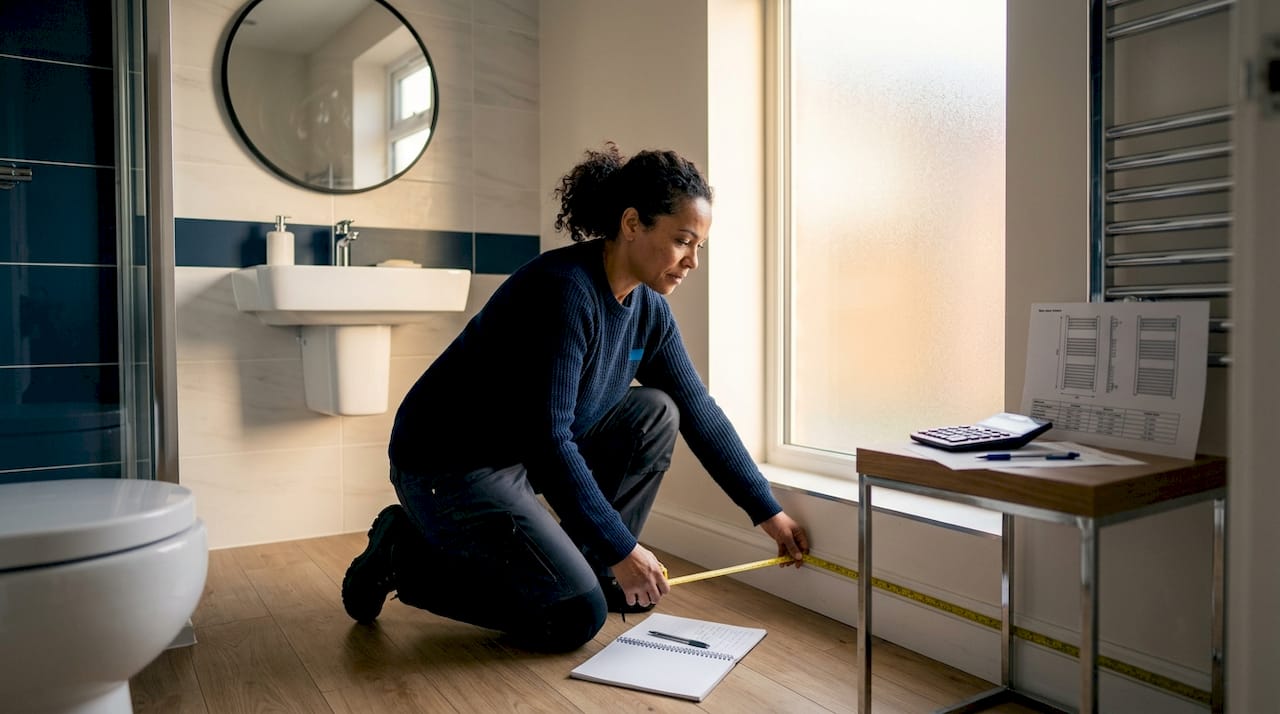
Undersizing your towel rail creates two problems. The rail works harder to compensate, running longer and costing more on your energy bill. Your towels also stay damp because the surface temperature never gets high enough to drive off moisture quickly.
| Bathroom size | Recommended approach | Typical output needed |
|---|---|---|
| Under 5m² (en-suite) | Large towel rail alone | 300–400W |
| 5m²–8m² (medium) | Towel rail + small panel radiator | 400–700W total |
| Over 8m² (main bathroom) | Towel rail + full radiator | 700W+ total |
Pro Tip: Always check the Delta T50 wattage figure on the product spec sheet. Manufacturers sometimes list output at Delta T60, which inflates the number. Delta T50 reflects real-world UK central heating temperatures.
Which towel rail styles work best in modern vs traditional bathrooms?
Style matters, but it should never override heat performance. The three most common formats in UK bathrooms are ladder rails, curved rails, and flat panel rails. Each style offers a different towel capacity and wall projection profile, which affects how well the rail fits your layout and how many towels you can actually hang.
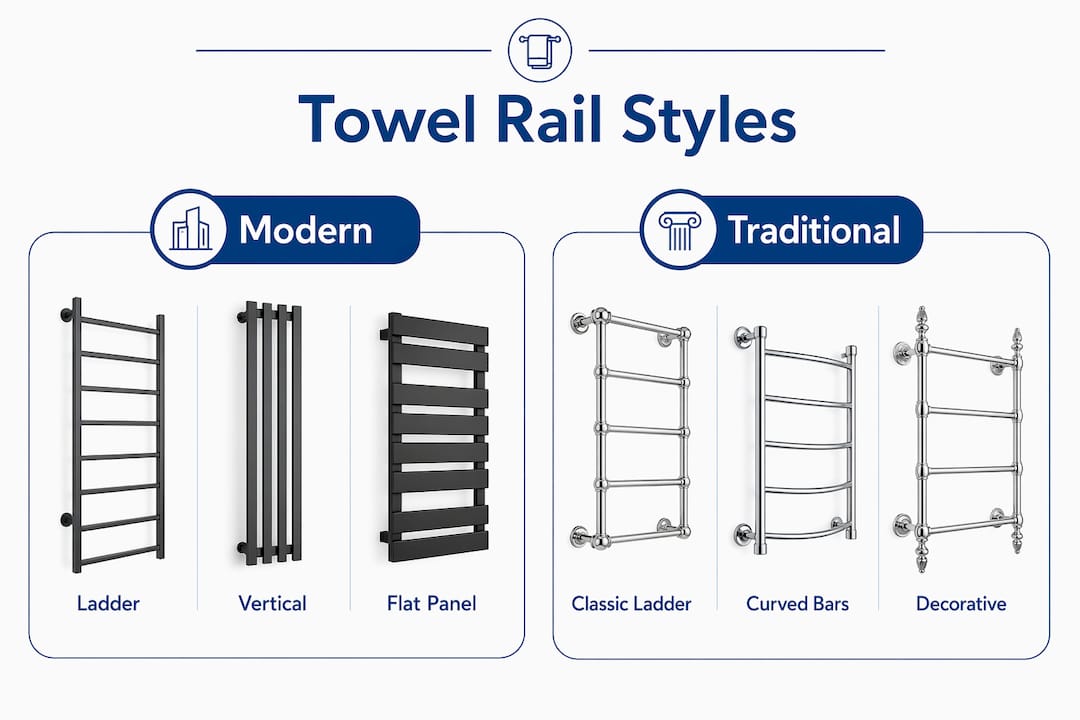
Ladder rails are the most versatile. Their multiple horizontal bars give you maximum towel space, and they suit both modern and traditional bathrooms depending on the finish. A polished chrome ladder rail reads as classic. The same shape in matte anthracite reads as contemporary. Curved rails add a softer silhouette and work well in period-style bathrooms with roll-top baths and traditional taps. Flat panel rails project less from the wall, making them the right call for narrow bathrooms where every inch counts.
Finish selection matters as much as shape. Chrome and stainless steel finishes remain the most durable and the easiest to keep clean in a humid bathroom environment. Brushed brass suits warmer, more luxurious schemes. White powder-coat blends into white-tiled walls for a minimal look. Anthracite pairs well with dark grout and industrial-style fixtures.
Here is a quick breakdown of how style affects function:
- Ladder rails: High towel capacity, good heat distribution across multiple bars, suits most bathroom sizes
- Curved rails: Moderate towel capacity, softer aesthetic, best for traditional or transitional schemes
- Flat panel rails: Lower projection, fewer bars, best for tight spaces where wall depth is limited
- Designer rails: Often prioritize looks over output. Always verify the wattage before buying
Pro Tip: For a tidy, stylish bathroom, choose a ladder rail with at least five bars. Fewer bars mean towels overlap and dry unevenly, which defeats the purpose of a heated rail entirely.
How does installation type affect your towel rail choice?
The installation method you choose locks in your running costs and your flexibility for years. Three main types exist: standard unheated wall-mounted rails, electric heated rails, and plumbed heated rails connected to your central heating system.
Electric heated towel rails are the most flexible option. They work in any bathroom regardless of where your pipework runs. Installation takes 2–4 hours and requires a fused spur connection, which means a qualified electrician must complete the work in a UK bathroom under Part P of the Building Regulations. Running costs are moderate because you control the rail independently of your boiler.
Plumbed rails connect directly to your central heating circuit. They cost more to install but run on your existing boiler, which keeps long-term energy costs lower. The trade-off is that they only heat up when your central heating is on, unless you fit a dual-fuel kit that adds an electric element for summer use.
Wall material determines your fixing method, and getting this wrong is a safety risk. Dot and dab plasterboard walls have a void behind the board and require specialist fixings such as corefix anchors or long frame fixings that reach the masonry substrate. Standard wall plugs will pull straight out of hollow plasterboard under the weight of a full towel rail. Fixing into timber studs gives the most secure result of all. Solid brick or block walls take standard wall plugs without issue.
Pro Tip: Before drilling, use a stud finder and a hollow-wall detector. Knowing your wall type before you buy the rail lets you choose the right fixing kit and avoid a return trip to the hardware store.
Can a towel rail replace a radiator as primary bathroom heating?
The short answer is no, in most cases. BRMA data and MCS 020 standards confirm that towel rails do not produce enough output to maintain 22°C in a typical UK bathroom during winter. They are towel warmers first and space heaters second.
The most common mistake homeowners make is choosing a towel rail based on looks and assuming it will handle all the heating. A stylish low-output rail in a main bathroom will leave the room cold from october through march. The fix is straightforward: pair the towel rail with a discreet panel radiator sized to cover the room’s heat loss. The rail handles towel warming. The radiator handles the room.
Specific situations where a towel rail alone may suffice:
- A well-insulated en-suite under 5m² with a single exterior wall
- A bathroom above a heated room with no cold floor
- A bathroom with underfloor heating already installed
Situations where a secondary radiator is non-negotiable:
- Main bathrooms over 8m²
- Rooms with large windows or poor insulation
- Older UK homes with solid walls and no cavity insulation
Pairing a designer towel rail with a discreet panel radiator gives you the best of both worlds. You get the visual impact of a well-chosen rail and the heating performance your bathroom actually needs. For homeowners considering bathroom heating combinations, understanding how different heat sources work together makes a real difference to comfort and running costs.
Key Takeaways
Choosing the right towel rail for a UK bathroom requires matching heat output to room size, selecting a style that fits your layout, and using the correct fixings for your wall type.
| Point | Details |
|---|---|
| Heat output gap | Towel rails emit 200–400W; radiators emit 800–1,500W, so most bathrooms need both. |
| Size the rail to the room | En-suites under 5m² can use a large rail alone; main bathrooms over 8m² need a radiator too. |
| Style affects function | Ladder rails offer the most towel capacity; flat panel rails suit narrow spaces. |
| Wall type dictates fixings | Dot and dab walls need corefix or frame anchors; timber studs give the most secure mount. |
| Pair for performance | A stylish low-output rail plus a discreet panel radiator delivers comfort and good looks together. |
What I’ve Learned After Years of Watching Homeowners Get This Wrong
The pattern repeats itself constantly. A homeowner spends weeks choosing the perfect brushed brass ladder rail, installs it in a 9m² main bathroom, and then spends every winter complaining that the room never gets warm. The rail looks stunning. It just doesn’t heat the space.
My honest advice: decide on your heating strategy before you decide on your style. Calculate the heat loss for your bathroom using MCS 020 as a framework, or ask a heating engineer to do it. Once you know the wattage you need, you can decide how to split that load between a towel rail and a radiator. Then, and only then, should you start browsing finishes.
The combination approach works every time. A mid-output ladder rail in chrome or anthracite paired with a slim vertical panel radiator tucked behind the door gives you warm towels, a warm room, and a bathroom that looks considered rather than cluttered. The panel radiator does not need to be a design statement. It just needs to do its job.
One more thing on installation: do not skip the wall-type check. I have seen towel rails ripped clean off dot and dab walls because someone used standard wall plugs. A corefix fixing costs almost nothing extra. A repair to cracked plasterboard and retiling costs a great deal more. Get the fixings right the first time, and your rail will stay exactly where you put it for decades.
For organized towel storage that complements your heated rail, think about how you fold and hang towels too. A rail with five or more bars lets you hang towels flat rather than folded, which dries them faster and keeps them warmer longer.
— Carl
Simcodirect’s Range of Towel Rails and Bathroom Accessories
Simcodirect stocks a broad selection of towel rails and bathroom heating products suited to UK homeowners at every stage of a renovation.
Whether you need a slim rail for a compact en-suite or a wide ladder rail for a family bathroom, Simcodirect carries options across all the popular finishes, including chrome, anthracite, white, and brushed brass. The range extends beyond towel rails to include complementary bathroom accessories that complete a well-planned space. The chrome towel shelf pairs well with any heated rail and adds practical storage without cluttering the room. Simcodirect also offers quality bathroom accessories like the Bobrick Double Toilet Roll Holder in Brushed Satin to finish your renovation with the details that matter. Fast UK delivery and a 30-day returns policy mean you can order with confidence.
FAQ
What is the difference between a towel rail and a radiator?
A towel rail emits 200–400W and is designed primarily to warm towels. A radiator of the same size emits 800–1,500W and is designed to heat the room.
Can I use an electric towel rail without a plumber?
Yes, but you still need a qualified electrician. UK Building Regulations (Part P) require a certified electrician to install the fused spur connection in a bathroom.
What fixing type do I need for a dot and dab plasterboard wall?
Dot and dab walls require corefix anchors or long frame fixings that reach the masonry behind the void. Standard wall plugs will not hold safely in hollow plasterboard.
How do I know if my towel rail is big enough for my bathroom?
Use MCS 020 heat loss calculations as a guide. A bathroom over 8m² almost always needs a towel rail plus a separate panel radiator to reach the 22°C comfort standard.
Which towel rail finish lasts longest in a UK bathroom?
Chrome and stainless steel finishes are the most durable in humid bathroom conditions. They resist corrosion and are straightforward to clean, making them the most practical long-term choice.