


108–135 W/m³: Calculate the Right Electric Heater Size for UK Homes
Most ordinary rooms need somewhere between 1kW and 2kW of electric heat. Get a reliable figure by measuring the room’s volume and multiplying it by a rate of 108 to 135 watts per cubic metre. Push towards the higher end of that range if the room has poor insulation, single glazing, an exposed wall, or a tall ceiling, since all four push heat loss up faster than a simple floor-area guess would suggest.
TL;DR:
- A room with high ceilings, poor insulation, or large single-glazed windows requires closer to 135 watts per cubic meter for accurate heating calculations.
- For a typical small bedroom, a heater between 1,500W and 1,800W suffices if the room volume is about 21.6 cubic meters with good insulation and double glazing.
- Conclusions on heater wattage should be rounded to standard sizes like 750W, 1,000W, 1,500W, or 2,000W to match thermostatic controls and reduce running costs.
- Incorrect sizing often results from oversizing for safety instead of considering controls, leading to higher energy bills and uneven heating.
- The most efficient placement for a heater is near external walls or under windows, with furniture kept clear to promote proper air circulation.
Table of Contents
- Electric heater size: quick rules of thumb and immediate checks
- How to calculate electric heater size step by step
- Typical room sizes and recommended heater wattage
- What changes the required wattage: insulation, glazing, and volume
- How heater type and controls affect comfort and running cost
- Where to position an electric heater for best results
- Running costs and when electric heating isn’t the right fit
- What installers get wrong about sizing electric heaters
- Matching your calculated wattage to the right heater
- Sources
Electric heater size: quick rules of thumb and immediate checks
Before reaching for a tape measure, a rough lookup often gets you close enough to shop with confidence. A small single bedroom typically needs around 750W to 1,000W, a double bedroom usually sits nearer 1,000W to 1,500W, and a standard living room commonly needs 1,500W to 2,000W.
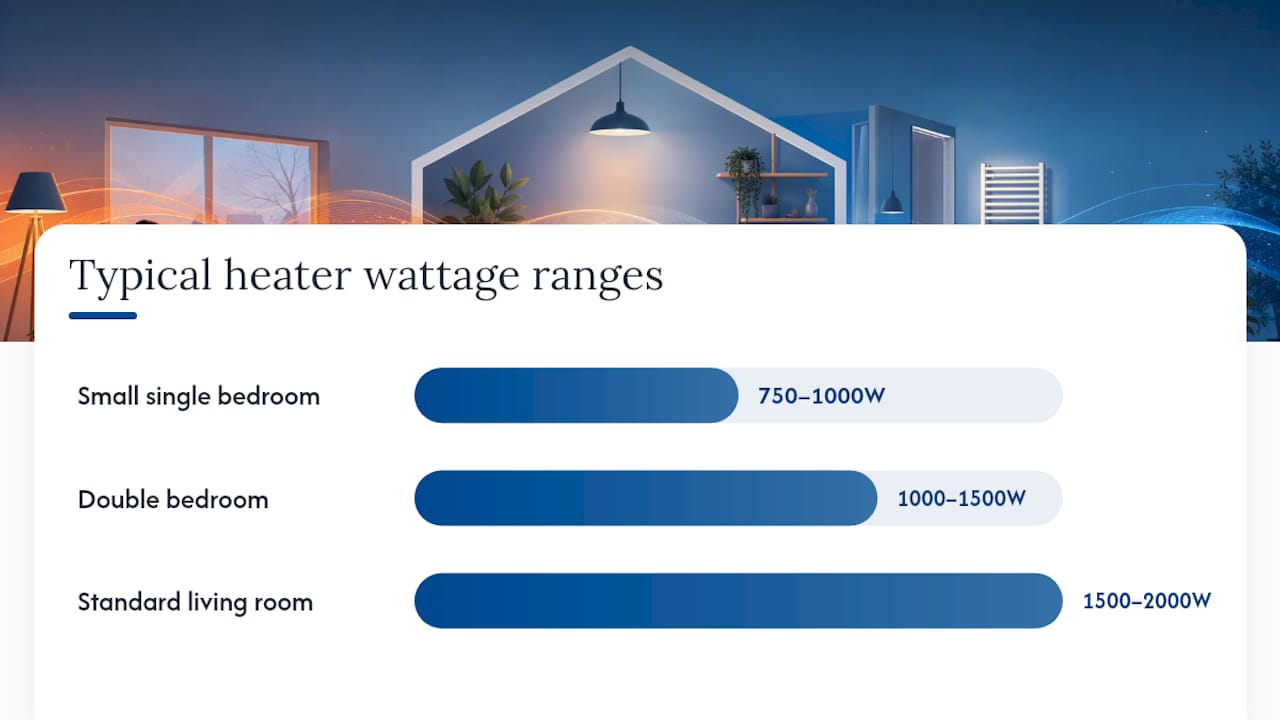
These figures work fine for a like-for-like replacement in an averagely insulated home built from the 1970s onwards. They stop being reliable the moment your room breaks the mould: a Victorian bay window, a converted loft with sloped ceilings, or a conservatory bolted onto the back of the house. In those cases, run the step-by-step calculation instead.
Before buying anything, check three things:
- Insulation age and quality — cavity wall insulation and loft insulation fitted after 2000 behave very differently to solid brick with no insulation at all.
- External wall count — a corner room with two external walls loses heat faster than a room tucked in the middle of the house.
- Ceiling height — anything above the standard 2.4m adds volume that a floor-area rule of thumb will quietly ignore.
How to calculate electric heater size step by step
The most accurate DIY method uses room volume rather than floor area, because volume captures the effect of ceiling height that a flat area figure misses entirely. This is the same logic Viessmann’s heating guidance points to when explaining why a simple square-metre multiplier can undersize a room with high ceilings.
- Measure the internal dimensions. Use the inside face of the walls, not the outside of the building. Record length, width, and height in metres.
- Calculate volume. Multiply length × width × height to get cubic metres (m³).
- Apply a base multiplier. Multiply the volume by a figure between 108 and 135 watts per m³. Use 108 for a well-insulated bedroom with double glazing; move towards 135 for a living room, a room with single glazing, or one that catches a lot of wind and cold on an exposed wall.
- Adjust for glazing and orientation. A north-facing room with a large single-glazed window loses noticeably more heat than an equivalent south-facing room, and heat-loss surveys routinely show this gap is worth accounting for rather than ignoring.
- Add margin for warm-up speed. If you want the room to heat quickly rather than hold a steady background temperature, add roughly 10 to 15% on top of the base figure. This mirrors the overload allowance that BEAMA’s electric heating guidance recommends for heavier construction that takes longer to warm through.
Worked example: A small bedroom measures 3m × 3m × 2.4m, giving a volume of 21.6m³. With good double glazing and average insulation, apply the lower multiplier of 108 W/m³: 21.6 × 108 = 2,332.8W. That looks high for a small bedroom. It is, because this particular room has an unusually tall ceiling for its floor area. Drop the multiplier to account for the room being used mainly overnight, and a 1,500W to 1,800W heater with good thermostatic control will comfortably do the job.
Pro Tip: Round up to the nearest common heater wattage (750W, 1,000W, 1,500W, 2,000W) rather than chasing a precise figure to the decimal point. Manufacturers design controls and thermostats around these standard bands, and a heater that’s slightly oversized with a good thermostat costs less to run than one that’s undersized and stuck on full power all evening.
Typical room sizes and recommended heater wattage
The table below assumes average insulation standards, standard double glazing, and a 2.4m ceiling height, unless stated otherwise.
Rooms with single glazing, solid brick walls, or exposed corners will sit above these ranges. A simplified alternative, if you can’t measure precisely, is applying roughly 0.12 times the floor area as a rough approximation, though this is a cruder shortcut than the volume-based method above and shouldn’t replace it where accuracy matters.
What changes the required wattage: insulation, glazing, and volume
The multiplier you choose isn’t arbitrary, it reflects real physical differences in how fast a room loses heat. Getting this wrong in either direction either wastes money on an oversized unit or leaves you cold with an undersized one.
- Insulation quality (U-value) — poorly insulated solid walls lose heat far faster than modern cavity walls with insulation, so older properties need multipliers towards the top of the 108–135 W/m³ range or above it.
- Glazing type and window area — single glazing loses substantially more heat than double or triple glazing, and a room with a large glazed wall behaves differently to one with a single small window.
- Orientation and exposure — a north-facing room with generous glazing typically needs meaningfully more wattage than an equally sized south-facing room with the same window area.
- Ceiling height and draughts — tall ceilings increase volume, and gaps around doors, floorboards, or old sash windows let warm air escape through infiltration rather than through the walls themselves.
- Use pattern — a room you want to heat quickly for an hour needs a different approach to one you keep at a steady background temperature all day; the former benefits from extra overload capacity, the latter from efficient, low-level output.
How heater type and controls affect comfort and running cost
Wattage tells you how much heat a heater can produce, but the type of heater and its controls decide how comfortable the room actually feels and how much you pay for that comfort.
- Fan heaters respond fastest, useful for a quick blast of warmth in a small space, but they don’t hold heat once switched off.
- Panel convectors and modern electric radiators offer a good balance of responsiveness and steady background warmth, particularly with a built-in thermostat.
- Oil-filled radiators heat up slower but retain warmth longer after switching off, suiting rooms used for extended periods.
- Storage heaters need particular attention to controls: automatic charge control and an adjustable heat release rate can save up to 15% of seasonal energy compared with basic manual settings.
Pro Tip: A correctly sized heater with a poor thermostat can cost more to run than a slightly larger one with proper modulation, because good controls stop the unit cycling on and off at full power all evening.
Where to position an electric heater for best results
Getting the wattage right only pays off if the heater is sited sensibly. Position matters almost as much as the number on the box.
- Place convectors and radiators on external walls or beneath windows, where cold air first enters the room. For more ideas on optimizing bathroom layouts, see small bathroom lighting: space-saving layered ideas.
- Keep curtains, sofas, and furniture clear of the unit so warm air can circulate properly.
- Mount wall units at the manufacturer’s recommended height rather than tucking them low behind furniture.
- Consider two smaller heaters instead of one large unit in long, narrow rooms or open-plan spaces with uneven heat distribution.
Running costs and when electric heating isn’t the right fit
Running an electric heater at full output for an hour costs the wattage divided by 1,000, multiplied by your electricity tariff’s price per kWh. A 2,000W heater running flat out for an hour uses 2 kWh, so the actual cost depends entirely on your tariff, but that simple sum is worth doing before you commit to a particular size.
- Good thermostatic control cuts real-world running costs significantly below the full-power figure, since most rooms don’t need continuous maximum output once warm.
- Correct sizing avoids the false economy of buying too small and running a heater flat out for hours to compensate.
- If your calculation lands above roughly 2.5kW for a single room, it’s worth stepping back and asking whether electric resistance heating is genuinely the right long-term solution, or whether the room needs better insulation first.
Running-cost reality check: heater specification sheets and online calculators almost always quote figures based on full-power operation. In practice, a well-controlled heater cycles rather than runs continuously, so real bills tend to sit noticeably below the worst-case number on the box.
What installers get wrong about sizing electric heaters
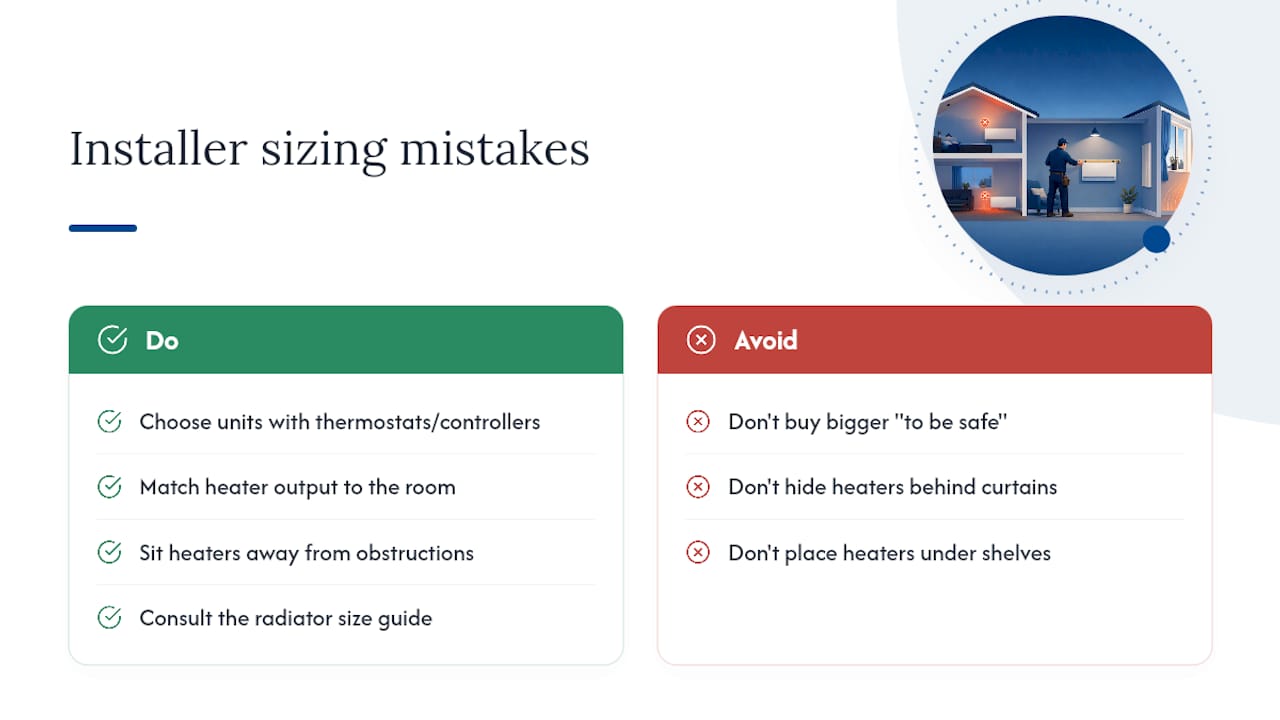
Most sizing mistakes I see come from one instinct: buying bigger “to be safe” without checking the controls that come with it. A 2,500W heater with no thermostat costs more to run than a well-controlled 1,800W unit in the same room, and it heats the room unevenly too. The second mistake is siting, heaters shoved behind curtains or under a shelf lose a surprising amount of their effective output before it ever reaches you.
If you want a deeper dive into matching heat output to a specific radiator model, our radiator size guide covers the calculation from a different angle.
— Carl
Matching your calculated wattage to the right heater
Once you’ve got a wattage figure from the calculation above, the next step is straightforward: find a heater built for that output with controls that suit how you’ll actually use the room. Simcodirect stocks electric heaters across the common wattage bands, from compact panel units for bedrooms to higher-output convectors for living rooms and kitchen diners, so you’re matching the number you’ve calculated to a real product rather than guessing at a shop shelf.
For a steady, thermostatically controlled option that suits most bedrooms and living rooms, the Dimplex Q-Rad RF panel radiator offers smart electric heating with proper zone control built in. If you need a lower-cost convector for a smaller space, the Dimplex DX convector heater covers the entry-level end of the wattage bands worked out above. Check the control type and installation requirements listed on each product page before you buy, particularly if you’re replacing a hard-wired unit rather than a plug-in one. Browse the full electric heater range on Simcodirect to find the wattage and control combination that matches your room.
Sources
The calculations in this guide follow the volume-based approach set out in Viessmann’s heating advice and the overload and insulation guidance in BEAMA’s electric heating design guide. For the formal design conventions behind U-values and design temperatures, CIBSE’s domestic heating design guide sets the professional standard that quick calculators simplify from.
- Heater room size calculator (Home Energy Scout)
- How many BTU to heat a room? (Viessmann UK)
- Heat pump and electric resistance heating guide (BEAMA)