


Hand dryer guide for commercial washrooms: 2026
A hand dryer is an electric device designed to dry freshly washed hands quickly and hygienically, and it plays a direct role in washroom hygiene management and infection control. For facility managers and business owners, choosing the right unit affects not just user experience but also compliance, running costs, and microbial risk. The Workplace (Health, Safety and Welfare) Regulations 1992 require UK businesses to provide clean, functional drying facilities. Getting that choice right means understanding dryer types, hygiene evidence, maintenance demands, and site-specific needs before you buy.
What are the main types of hand dryers?
Three core technologies dominate the commercial market: warm air dryers, jet or blade dryers, and hypervelocity models. Each works differently and suits different environments.
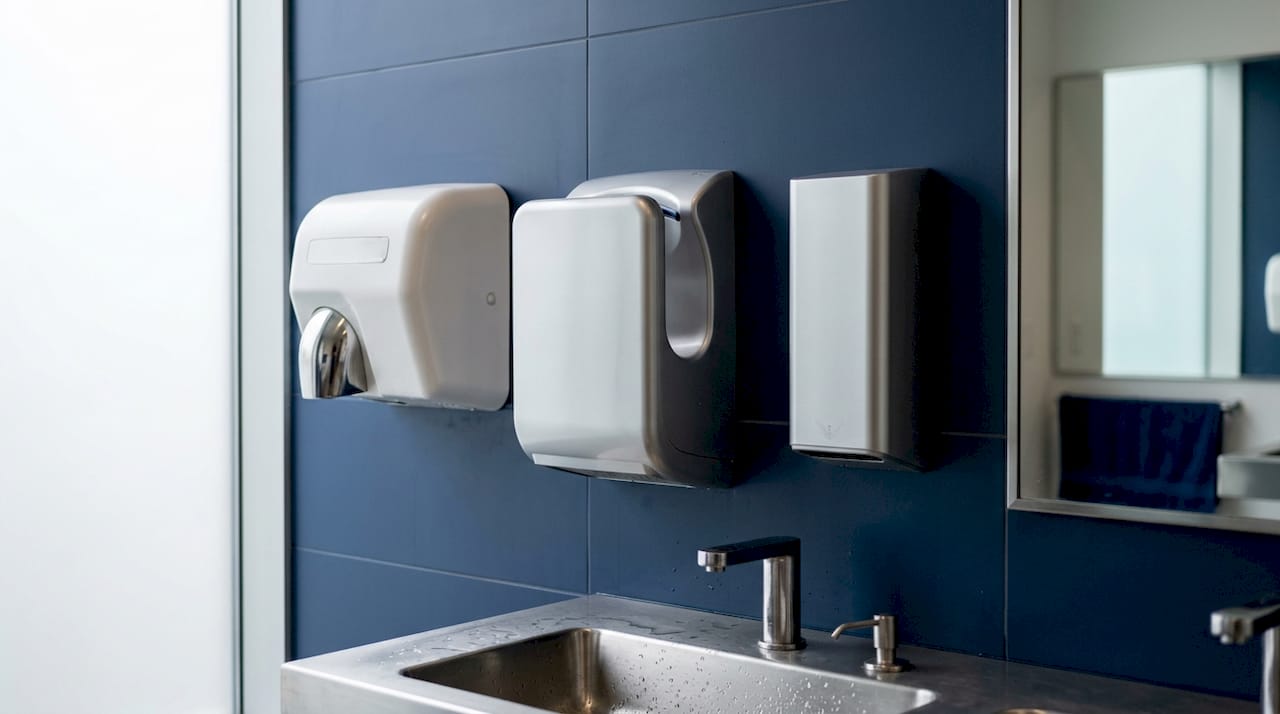
Warm air dryers heat air to around 60°C and blow it across the hands at moderate speed. They are quiet, affordable to purchase, and well suited to low-traffic settings such as small offices or hospitality venues. Their main drawback is drying time, which typically runs to 30–45 seconds. Users in a hurry often walk away with damp hands, which increases microbial transfer risk.
Jet and blade dryers use high-speed, unheated or lightly heated airflow to physically scrape water from the skin. They dry hands in roughly 10–12 seconds. The trade-off is noise: many units exceed 80 decibels, which makes them unsuitable for libraries, healthcare wards, or spaces used by children and elderly visitors.
Hypervelocity dryers combine high airspeed with HEPA filtration and touchless sensors. They represent the current performance ceiling for commercial washrooms. Units like the Biodrier Executive Hand Dryer Silver from Simcodirect offer fast drying alongside air filtration, making them a strong fit for high-footfall or hygiene-critical sites.
Key features to evaluate across all types:
- Touchless activation: Infrared sensors eliminate contact points, reducing cross-contamination.
- Noise output: Measured in decibels; critical for user-sensitive environments.
- Drying speed: Faster units improve compliance and reduce damp-hand exits.
- HEPA filtration: Captures airborne particles before they reach the user’s hands.
- IP rating: Indicates resistance to moisture ingress, relevant for wet washroom environments.
Pro Tip: Match the noise level of your dryer to your user group before you order. A unit exceeding 80 decibels in a school or care home will cause users to leave before their hands are fully dry, which defeats the hygiene purpose entirely.
How do hand dryers affect washroom hygiene and infection control?
Thorough hand drying is not optional in infection control. Wet hands transfer bacteria far more readily than dry ones, which means the drying step is as important as the washing step. A dryer that fails to dry hands completely is a hygiene liability, not an asset.
The design of the unit also matters. Traditional ‘hands-under’ dryers are more hygienic than trough-style units, which collect standing water and debris over time. In healthcare settings especially, trough designs create a contamination risk that is difficult to manage through routine cleaning alone.
“Modern touchless hand dryers equipped with electrostatic HEPA filtration provide added air quality control while supporting fast, effective drying without paper waste. In high-risk environments, filtration technology is no longer a premium feature. It is a baseline hygiene requirement.”
The economic stakes are significant. The median estimated avoidable cost attributable to jet air dryer presence in UK NHS clinical areas is £58 million per year, representing 2.1% of total healthcare-associated infection expenditure. That figure reflects a 50% certainty interval of £33–84 million annually. The implication is clear: dryer selection in clinical environments carries a measurable financial consequence, not just a theoretical hygiene one.
For non-clinical settings, the risk calculus is different but still present. Offices, leisure centres, and food service facilities all host users who may be immunocompromised or vulnerable. HEPA-filtered, touchless units reduce the aerosol load in the washroom air, which benefits every person who enters the space.
What operational and maintenance factors should you consider?
Selecting the right unit is only half the job. How you operate and maintain it determines whether it delivers on its hygiene promise over time.
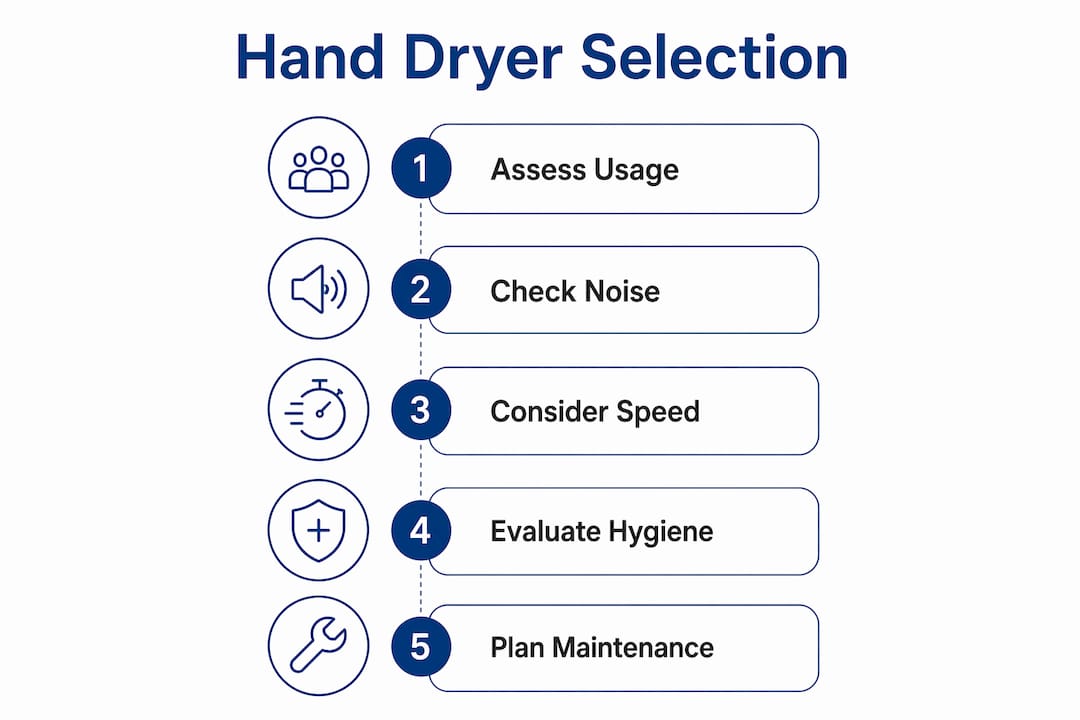
User behaviour directly affects outcomes. Slow or loud units cause people to leave with damp hands, which increases microbial transfer risk. This is not a minor inconvenience. It is a measurable failure in your washroom hygiene system. Matching dryer speed and noise level to your user demographics is therefore a functional requirement, not a preference.
Maintenance is equally non-negotiable. Under the Workplace (Health, Safety and Welfare) Regulations 1992, UK businesses must provide clean and functional drying facilities, with compliance audits and scheduled maintenance. Reactive repair is not sufficient. Scheduled maintenance and cleaning prevent hygiene lapses and avoid costs related to infection outbreaks and staff absenteeism.
A practical maintenance schedule for commercial hand dryers should include:
- Weekly: Wipe down the exterior casing with a suitable disinfectant. Check for visible debris around the air intake and outlet.
- Monthly: Inspect and clean the HEPA filter if fitted. Check sensor responsiveness and activation range.
- Quarterly: Test motor performance and drying speed against the manufacturer’s specification. Log results for compliance records.
- Annually: Full service by a qualified engineer. Replace filters and worn components. Review energy consumption data.
Running costs also deserve attention. High-speed electric hand dryers consume more power per cycle than warm air units, but they complete each cycle faster. Over a full day in a busy washroom, total energy consumption is often comparable or lower. High-speed dryers reduce waste disposal issues and maintenance time in busy facilities compared to paper towels. Northwestern Memorial Hospital achieved over £20,000 in annual savings in an initial phase after switching to high-speed dryers, which illustrates the scale of operational savings available.
Pro Tip: Keep a maintenance log for every dryer unit in your facility. If an inspection reveals a pattern of sensor failures or filter blockages, that data justifies a unit replacement before a hygiene incident forces your hand.
How to choose the best hand dryer for your commercial facility?
The best electric hand dryer for your site is the one that matches your specific risk profile, user group, and operational constraints. There is no universal answer. Research does not conclusively show one drying method as universally superior; the right choice depends on risk assessment, user group, and environmental conditions.
Start with a risk-based assessment. Ask three questions: How many people use the washroom daily? Are any users particularly vulnerable to infection? How well ventilated is the space? High footfall, vulnerable users, and poor ventilation all push the specification upward toward HEPA-filtered, touchless, hypervelocity units.
Matching dryer type to site
Different sites have genuinely different requirements:
- Healthcare and care homes: Prioritise HEPA filtration and touchless operation. Avoid trough-style designs. Consider hands-under models for easier cleaning compliance.
- Offices and corporate facilities: Jet or blade dryers work well. Noise is less critical. Speed and energy efficiency are the primary drivers.
- Schools and educational settings: Noise output is a key constraint. Warm air or quieter blade models are preferable. Vandal-resistant casings add durability.
- Leisure centres and gyms: High footfall demands fast drying. Moisture resistance (IP rating) is critical. Stainless steel or brushed satin finishes withstand humid conditions.
- Hospitality and retail: Aesthetics matter alongside performance. Units like the UltraDry Pro 1 Hand Dryer Brushed Satin from Simcodirect combine a clean finish with commercial-grade performance.
Key selection criteria at a glance
| Criterion | What to assess |
|---|---|
| Drying speed | Target under 15 seconds for high-traffic washrooms |
| Noise level | Under 70 decibels for schools, healthcare, and hospitality |
| Filtration | HEPA filter required for clinical or high-risk environments |
| Touchless operation | Infrared sensor activation reduces contact points |
| IP rating | IP24 minimum for wet or humid washroom environments |
| Energy consumption | Compare wattage and cycle duration, not wattage alone |
| Maintenance access | Filter and sensor access without specialist tools preferred |
HSE guidance recognises both paper towels and hot-air dryers as suitable for workplace hand drying. This gives facilities genuine flexibility. In complex sites with multiple washroom types, a mixed approach, using automatic hand dryers in high-traffic areas and paper towels in clinical or vulnerable-user zones, is a legitimate and well-supported strategy.
For a deeper technical breakdown of commercial options, the electric hand dryers guide from Simcodirect covers specifications and installation considerations in detail.
Key takeaways
The most effective commercial hand dryer is one selected through a risk-based assessment that accounts for user group, footfall, ventilation, and scheduled maintenance requirements.
| Point | Details |
|---|---|
| Drying completeness matters | Wet hands transfer bacteria readily; choose a unit fast enough to ensure full drying. |
| Match dryer type to environment | Healthcare needs HEPA filtration; schools need low noise; gyms need high IP ratings. |
| Maintenance must be scheduled | Reactive repair is not compliant; log inspections quarterly and annually. |
| User behaviour drives outcomes | Slow or loud units cause users to leave with damp hands, undermining hygiene. |
| Cost savings are measurable | High-speed dryers reduce consumable and waste costs significantly in busy facilities. |
What I have learned from watching facilities get this wrong
Most facility managers I speak with focus almost entirely on purchase price when specifying a hand dryer. That is the wrong starting point. The unit that costs the least upfront often costs the most over three years, once you factor in energy consumption, filter replacements, and the hidden cost of users who simply do not bother finishing the drying cycle because the machine is too slow or too loud.
The hygiene consequence of that last point is underappreciated. A washroom that looks clean and smells clean but consistently sends users out with damp hands is failing at its core function. I have seen this in offices, schools, and leisure centres alike. The dryer is technically working. The hygiene outcome is not.
The other oversight I see regularly is treating hand dryer maintenance as a reactive task. A unit that stops working gets reported and fixed. A unit that is working but has a blocked filter, a degraded sensor, or a motor running below specification does not get reported. It just quietly fails to dry hands properly. Scheduled maintenance, not just reactive repair, is what separates a compliant washroom from one that merely looks compliant.
My honest recommendation: spend the extra budget on a touchless, HEPA-filtered unit in any environment where user vulnerability or footfall is above average. The running cost difference is modest. The hygiene difference is not.
— Carl
Quality hand dryers for commercial washrooms from Simcodirect
Simcodirect stocks a range of commercial-grade automatic and electric hand dryers suited to offices, healthcare facilities, schools, and leisure centres. Whether you need a fast-drying hypervelocity unit or a quieter model for a sensitive environment, the range covers the full spectrum of commercial requirements.
The Vent Axia Prepdry Automatic Hand Dryer is a strong choice for facilities prioritising energy efficiency and reliable touchless operation. For sites where hygiene specification is higher, the Biodrier Executive Hand Dryer Silver delivers filtration-enhanced performance in a commercial-grade casing. Simcodirect offers fast delivery, a 30-day returns policy, and a product range backed by genuine customer reviews. Browse the full selection at simcodirect.co.uk to find the right unit for your site.
FAQ
What is a hand dryer and how does it work?
A hand dryer is an electric device that uses heated or high-speed air to evaporate or physically remove water from freshly washed hands. Most modern commercial units activate automatically via an infrared sensor when hands are placed beneath the outlet.
Are hand dryers hygienic enough for healthcare settings?
Touchless units with HEPA filtration are suitable for many healthcare environments, but trough-style designs should be avoided as they collect standing water and debris. The specific risk level of the clinical area should determine the specification.
How often should commercial hand dryers be serviced?
Exterior cleaning should happen weekly, filter inspection monthly, and a full performance check quarterly. An annual service by a qualified engineer is required to maintain compliance under the Workplace (Health, Safety and Welfare) Regulations 1992.
Do hand dryers save money compared to paper towels?
High-speed hand dryers reduce consumable costs and waste disposal demands significantly in busy facilities. The scale of savings depends on footfall, but the operational case for electric dryers in high-traffic washrooms is well established.
What wattage should a commercial hand dryer be?
Wattage alone is not the right metric. A high-wattage unit that dries hands in 10 seconds may consume less total energy per day than a low-wattage unit running for 45 seconds per cycle. Evaluate energy consumption per cycle alongside drying speed when comparing models.