


Facilities teams: hand dryer hygiene, paper towels work better, study
Paper towels generally outperform hand dryers on hygiene, reducing bacteria on hands more reliably and dispersing fewer microbes into the air. Warm-air dryers tend to fare worst; jet air dryers sit in between, with mixed results depending on the study. In clinical or food-prep settings, paper towels remain the safer default. Everywhere else, a well-maintained, correctly used dryer is a reasonable choice.
TL;DR:
Paper towels reliably reduce microbial presence on hands and surface contamination, especially in clinical or food-prep environments.
Jet air dryers can disperse droplets further, increasing aerosolization risks when hands are not thoroughly washed beforehand.
Warm-air dryers are generally the weakest for microbial reduction and tend to take longer to dry hands.
Proper maintenance, including filter cleaning and correct siting, significantly improves the hygiene performance of hand dryers.
In sensitive settings, paper towels remain the safest option, while well-maintained, filtered dryers are acceptable elsewhere.
Table of Contents
-
Paper towels vs warm-air dryers vs jet dryers: how they actually work
-
How to dry your hands more hygienically, whichever method you use
-
Do HEPA filters and maintenance actually make dryers more hygienic?
What does the evidence say about hand dryer hygiene?
The strongest data point comes from a multi-centre hospital study led by Best and colleagues, which sampled washroom surfaces and floors across several NHS trust sites. Washrooms fitted with jet air dryers showed significantly higher bacterial recovery than those using paper towels, including greater recovery of MSSA and ESBL-producing organisms. That is not a fringe finding. It has shaped clinical infection-control thinking in the UK for years.
A separate comparison of drying methods, reviewing efficacy across paper towels, warm-air dryers and jet dryers, found paper towels consistently reduced residual microbial counts on hands more than warm-air dryers. Jet dryers performed variably: sometimes close to paper towels, sometimes worse, largely depending on how well people had washed beforehand.
Aerosolisation is where things get genuinely unsettling for some readers. A pilot study using viral surrogates found higher contamination on masks and surrounding surfaces after jet dryer use compared with paper towels, particularly when hands weren’t washed thoroughly first. Yet a separate chamber study on aerosols and bacteria from washing and drying found no statistically significant difference in airborne bacteria between the two methods under some conditions, noting that the act of washing itself raises aerosol counts regardless of how you dry afterwards.
The pattern across the evidence:
-
Paper towels reduce microbial load on hands most reliably.
-
Jet dryers can disperse droplets further than paper towels, but results depend heavily on wash quality.
-
Warm-air dryers are the weakest performer for microbial reduction.
-
Room ventilation and washing technique often matter as much as the drying method itself.
Key finding: Hospital washrooms using jet air dryers recorded significantly higher bacterial recovery from surfaces and floors than paper-towel washrooms, according to the Journal of Hospital Infection multi-centre study.
NHS Scotland’s clinical guidance reflects this nuance directly: paper towels are preferred in clinical and sensitive care areas specifically to avoid even a small aerosolisation risk, while acknowledging dryers can be appropriate elsewhere.
Paper towels vs warm-air dryers vs jet dryers: how they actually work
Each method removes moisture, and by extension microbes, through a different mechanism, and that mechanism explains most of the disagreement in the research.
Paper towels work by absorption and friction. Rubbing hands against fibrous material physically lifts bacteria and moisture away, and the towel then leaves the room in a bin rather than recirculating anything. Warm-air dryers rely on evaporation, which is slow, and slow drying gives lingering bacteria more time on the skin and encourages people to give up early with hands still damp. Jet air dryers use high-velocity air to shear water off the skin in seconds, which dries hands fast but can also fling droplets and any microbes riding on them further into the room.
That mechanical difference drives the practical trade-offs:
-
Drying time: jet dryers typically finish in 10 to 15 seconds, warm-air units often take 30 seconds or more.
-
Aerosol potential: high-velocity air movement can propel droplets further than the gentle airflow of warm-air units, per the Frontiers pilot aerosol study.
-
User behaviour: people frequently walk away from slow dryers before hands are fully dry, which undermines any hygiene benefit either method offers.
-
Operational cost: dryers cut paper waste and restocking labour but draw more electricity and generate more noise; paper towels create bin waste but sidestep both issues.
None of this makes one method universally correct. It makes the choice depend on where the washroom sits and how carefully people wash beforehand, which is exactly the point NHS guidance makes.
How to dry your hands more hygienically, whichever method you use
Drying is not an afterthought to handwashing; it’s part of the same process. Damp hands transfer far more bacteria on contact with door handles, taps and other people than dry ones, so skipping this step undoes much of the point of washing at all.
-
Wash properly first. Use soap and water for a full 20 seconds, covering fingertips, thumbs and between fingers, before you even reach for a dryer or towel.
-
Dry until hands feel completely dry, not just cooler. With warm-air dryers, that usually means holding on longer than feels natural.
-
Stand centrally under jet dryers rather than at an angle, and avoid leaning in close to the nozzle.
-
Avoid touching taps, door handles or your face immediately after drying if hands still feel even slightly damp.
-
In healthcare settings, food preparation areas, or when caring for anyone immunocompromised, choose paper towels where available.
Pro Tip: If a washroom only has a slow warm-air dryer and you’re pressed for time, finish by wiping hands briefly on clean clothing rather than leaving them damp. Damp skin picks up and sheds bacteria far more easily than dry skin.
Do HEPA filters and maintenance actually make dryers more hygienic?
Filtration and upkeep matter more than most buyers assume, and they matter far more than the marketing on the box. HEPA filters capture 99.97% of particles at their rated size, which meaningfully cuts particulate deposition around the unit. That is not the same as sterilising the air. A HEPA-fitted dryer still needs the same cleaning discipline as any other fixture, because filters trap particles rather than destroying them, and a clogged or unreplaced filter stops helping fairly quickly.
Facilities teams get the most benefit from a straightforward routine:
-
Wipe down the exterior casing and nozzle daily in high-traffic washrooms.
-
Check and clean or replace filters on the manufacturer’s stated schedule, not just when airflow visibly drops.
-
Site dryers away from cubicle doors and toilet areas to reduce cross-contamination from splash and flush aerosols.
-
Pair dryers with decent extraction; a well-ventilated room disperses any residual aerosol far faster than a stagnant one, a point echoed in HVAC-focused infection control guidance.
When choosing a dryer for a hygiene-conscious space, look for touchless activation, an accessible filter housing that staff will actually clean, a fast rated drying time, and a decent IP rating if it’s going into a heavily used or vandal-prone washroom.
Where Simcodirect fits in the hygiene picture
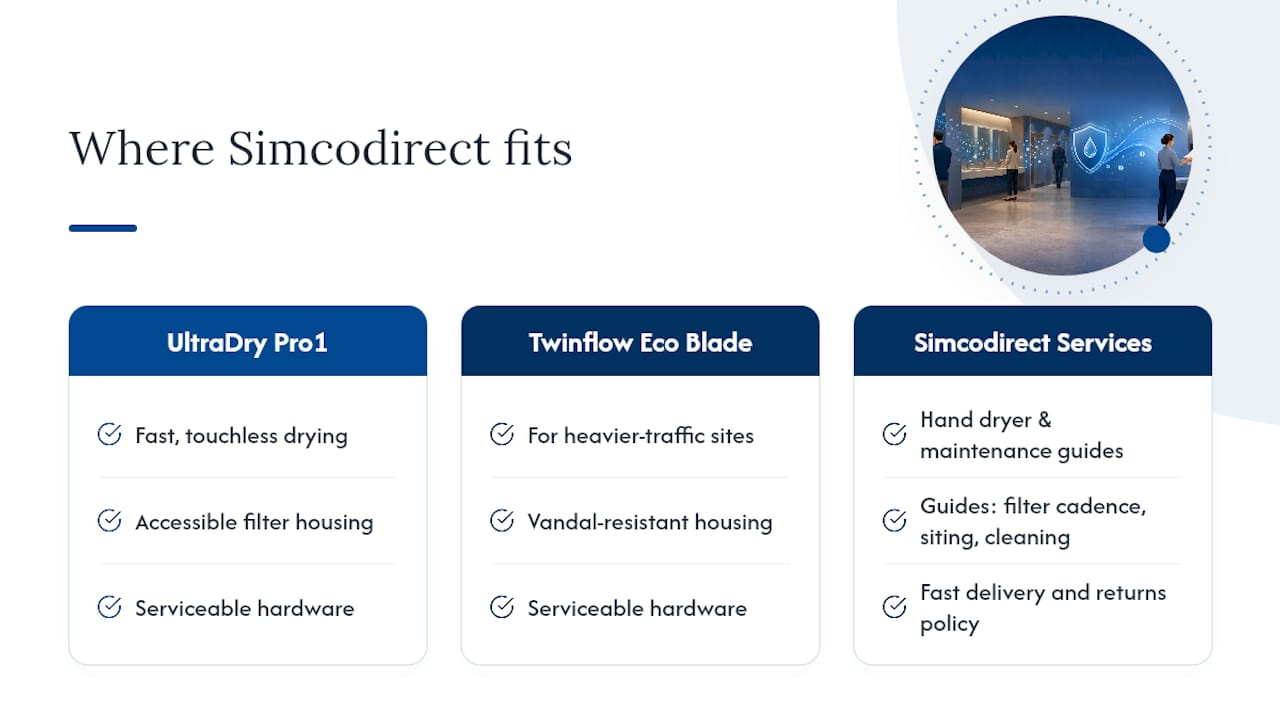
Simcodirect’s hand dryer guide for commercial washrooms and maintenance guide walk facility managers through exactly the checks covered above, filter cadence, siting and cleaning included. Among the units stocked, the UltraDry Pro 1 offers fast, touchless drying with an accessible filter housing, while the Twinflow Eco Blade suits heavier-traffic sites needing vandal-resistant housing. Both back up the maintenance advice with genuinely serviceable hardware, backed by fast delivery and a straightforward returns policy for buyers who want reassurance before committing.
Choosing between hygiene, cost and sustainability
There’s no single right answer here, and anyone claiming otherwise is oversimplifying. Clinical and food-prep settings should default to paper towels, full stop. Everywhere else, the calculation shifts towards a filtered, well-sited, properly maintained dryer, weighed against paper waste and running costs. Facilities that get this right treat maintenance as non-optional, not an afterthought bolted onto the purchase decision.
— Carl
Upgrade your washroom hygiene setup with Simcodirect
Simcodirect is the practical alternative to guessing which hand dryer will hold up under daily commercial use: every unit in the range comes with clear specs on filtration, drying speed and build quality, so facility managers can match the device to the risk level of the space rather than picking on price alone. Browse the UltraDry Pro 1 hand dryer for a touchless, fast-drying option suited to general commercial washrooms, or work through the maintenance guide to set a cleaning schedule before installation. If you’re weighing up heating upgrades for the same facility, the thermostatic heating element range is worth a look too. Fast UK delivery and a 30-day returns policy mean you can order with confidence and adjust if the spec doesn’t quite fit your washroom.
Sources
-
Multi-centre hospital study on environmental contamination by hand-drying method (Best et al.)
-
NIPCM / NHS Scotland hand hygiene indications and techniques (2025)