


Heated towel rail running costs: what UK homeowners need to know
Most electric towel rails cost between 8p and 24p per hour to run at the current Ofgem price-cap rate of 26.11p per kWh. Used for towel drying alone, a 300W rail costs roughly £1.57 a month. Push that to a 900W rail running as a primary room heater and the figure climbs to around £4.70 a month. Central-heating and dual-fuel rails are cheaper per unit of heat when you have gas, but electric-only rails are perfectly reasonable when the job is simply warming towels for an hour or two a day.
Typical running costs at a glance (26.11p/kWh baseline):
- 300W rail, 2 hours/day: roughly 1.6p per hour, about £1.57 per month
- 500W rail, 2 hours/day: roughly 13p per hour, about £2.61/month
- 700W rail, 2 hours/day: roughly 18p per hour, about £3.66/month
- 900W rail, 2 hours/day: roughly 24p per hour, about £4.70/month
If the rail is your only source of bathroom heat, a dual-fuel model on a gas circuit will almost always cost less over a full heating season. For towel drying only, a modest-wattage electric rail on a timer is the most cost-effective choice for most UK homes.
Key takeaways
A 300W electric towel rail used for towel drying costs under £2 a month; a dual-fuel rail on a gas circuit is the cheapest option for larger bathrooms where the rail also heats the room.
| Point | Details |
|---|---|
| Use the formula | Cost (p) = kW × hours × 26.11p; divide watts by 1,000 first to get kW. |
| Thermostat and timer save most | A thermostat cuts real energy use by 30–50% compared with constant-on running. |
| Dual-fuel wins for space heating | Gas-fed rails cost roughly a third of electric per unit of heat over a heating season. |
| Electric rails suit towel drying | A 300W–500W electric rail on a timer is cost-effective for towel drying only. |
| Simcodirect’s range | Dimplex TTR, Dimplex BR, and the Platinum Chrome Dual-Fuel Curved Towel Radiator cover most UK bathroom needs. |
A practical view on choosing the right rail
For most UK homes, the answer is simpler than the numbers suggest: choose a rail with a wattage matched to the job (300W–500W for towel drying, higher only if the rail is also heating the room), add a timer or thermostat, and go dual-fuel if you have gas central heating. That combination covers the vast majority of bathrooms without overspending on running costs or installation.
If you want help choosing the right model or need guidance on compatible controls and installation, the team at Simcodirect is available to help, and the 30-day returns policy means you can buy with confidence.
Table of Contents
- How to calculate heated towel rail running costs yourself
- Running costs by wattage: a ready-to-use reference
- Electric-only vs central-heating vs dual-fuel: which costs less?
- How thermostats, timers and smart controls change real running costs
- Non-energy costs to factor in: installation, parts and lifespan
- Using the Ofgem price cap to get precise UK costs
- Practical ways to cut your towel rail running costs
- Simcodirect’s towel rails: models worth considering
- Sources
How to calculate heated towel rail running costs yourself
The formula is straightforward:
Cost (pence) = kW × hours × pence per kWh
The only conversion you need is watts to kilowatts: divide the wattage by 1,000. A 600W rail is 0.6 kW. Multiply that by the hours it runs, then by your unit rate.
Single-day example for a 600W rail running 2 hours:
0.6 kW × 2 hours = 1.2 kWh. At 26.11p per kWh, that is 1.2 × 26.11 = 31.3p per day.
Monthly cost for the same rail:
31.3p × 30 days = £9.40 per month in energy use alone.
Standing charges are separate. At the current cap, the electricity standing charge is 57.19p per day, which adds roughly £17.16 to your monthly electricity bill regardless of how much you use. As Free Price Compare explains, the standing charge is a fixed connection cost, not a per-appliance cost, so it does not change based on whether the rail runs for one hour or four. It does, however, affect your total monthly bill, so factor it in when comparing your bill against these worked examples.
Running costs by wattage: a ready-to-use reference
The table below uses 26.11p/kWh and assumes the rail runs at full rated power for the periods shown. Real-world use with a thermostat will be lower.
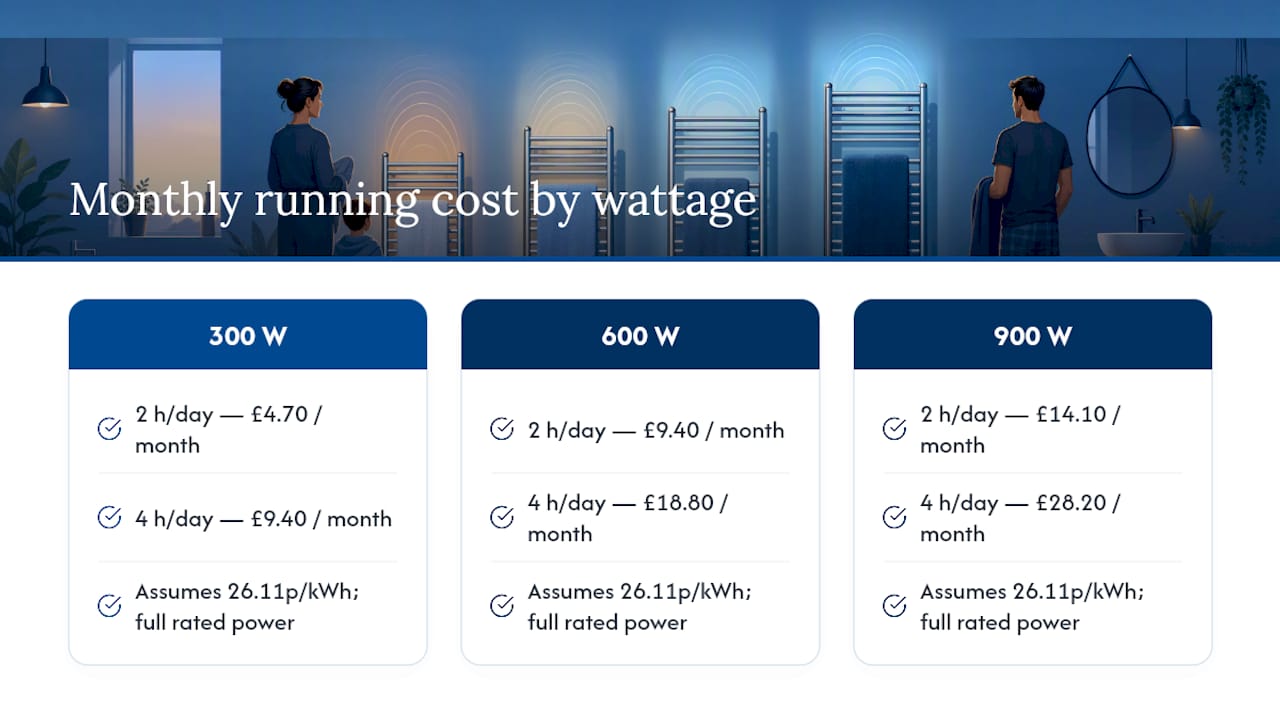
*Assumptions: Ofgem price-cap unit rate of 26.11p/kWh (July–September 2026); rail runs at full rated wattage for the stated period; 30-day month.
To adapt these figures to your own tariff: replace 26.11p with your actual unit rate from your energy bill or supplier account. If you are on Economy 7, use your off-peak rate (typically 7p–11p/kWh overnight) for any rail you schedule to run during those hours, and your peak rate for daytime use.
Pro Tip: If you are on a smart tariff such as Octopus Agile, the unit rate changes by the half-hour. Running a towel rail during the cheapest slots (often between midnight and 6 AM) can cut the per-hour cost to a fraction of the cap rate, though you will need a timer or smart plug to automate it.
Electric-only vs central-heating vs dual-fuel: which costs less?
The answer depends on what you are using the rail for and what fuel your boiler runs on.
Electricity vs gas: the unit-cost gap
At the Ofgem cap, electricity costs 26.11p/kWh, while gas costs significantly less per kWh after accounting for boiler efficiency. That is less than a third of the electricity rate. For space heating, the difference is significant over a full winter.
Where it gets more nuanced is towel drying. A heated towel rail is less efficient than a similarly sized radiator for space heating, but for drying towels it does not need to be efficient at heating a room. A 300W electric rail running for 45 minutes after a shower uses about 0.22 kWh, costing under 6p. That is a reasonable price for dry towels, regardless of fuel type.
Pros and cons at a glance:
- Electric-only rails: no plumbing required, work year-round independently of the boiler, easy to control with a timer or thermostat, but cost more per kWh than gas
- Central-heating (plumbed) rails: cheapest to run when the boiler is already on, but provide no heat in summer unless you fire up the boiler just for the rail
- Dual-fuel rails: the pragmatic middle ground; run on the central-heating circuit in winter and switch to the electric element for towel drying in summer, combining low running costs with year-round function
Scenario: small bathroom (300W electric vs plumbed rail on gas)
A 300W electric rail running 2 hours daily costs under £2 a month. A plumbed rail drawing equivalent heat from a gas boiler costs less per month in fuel, accounting for boiler standing losses. For towel drying only, the electric option is simple and the cost difference is small enough that most homeowners will not notice it on their bill.
Scenario: larger bathroom used as a primary heat source
A 900W electric rail running 4 hours daily costs several times more per month than a gas-fed equivalent. Over a heating season, the difference can be substantial. If your bathroom is large and the rail is doing real heating work, a dual-fuel curved towel radiator on a gas circuit is worth the extra installation cost.
How thermostats, timers and smart controls change real running costs
Controls are where most of the savings actually live. A rail left on all day at full power costs several times more than one running on a sensible schedule.
Control options and what they do:
- Mechanical plug-in timer: sets fixed on/off windows; no thermostat, so the rail runs at full power within those windows; cheap and simple
- Digital timer: allows multiple on/off periods per day; better for households with variable shower schedules
- Integral thermostat: the rail cycles on and off to maintain a set temperature; typically cuts energy use by 30–50% compared with constant-on
- Smart plug or smart controller: allows remote scheduling and monitoring via an app; pairs well with smart-meter data to identify the cheapest run times
Thermostat cycling is the single biggest lever. When a rail reaches its set temperature, the element switches off. In a well-insulated bathroom, the rail may only need to run for 15–20 minutes out of every hour to hold temperature, which means the effective energy use is a fraction of the rated wattage. A 700W rail with a thermostat set to a moderate temperature might average only 250–350W of actual consumption over a two-hour period.
Leaving a rail on all day is almost never cheaper than using a timer, even accounting for the small energy cost of reheating from cold. The “cheaper to leave it on” argument applies to systems with very long thermal mass (like underfloor heating), not to towel rails, which heat up in under 10 minutes.
Pro Tip: Set a minimum run period of at least 10–15 minutes when programming a digital timer. Very short bursts (under 5 minutes) cause the element to cycle rapidly between cold and hot, which accelerates wear on the element and the thermostat contacts. A 30-minute morning run and a 30-minute evening run covers most households’ needs without short-cycling.
Non-energy costs to factor in: installation, parts and lifespan
Energy is the ongoing cost, but installation and maintenance are part of the real picture.
Typical installation costs (UK, 2026):
- Electric-only rail: a qualified electrician will typically charge £80–£150 for a straightforward installation to a fused spur; no plumbing required
- Plumbed (central-heating) rail: a plumber plus electrician (for the pump or valve wiring) typically costs £150–£300 depending on pipework complexity
- Dual-fuel rail: combines both trades; expect £200–£400 for a standard installation, more if the pipework needs extending
Lifespan and maintenance:
- Electric elements in quality rails typically last 5–10 years; replacement elements cost £20–£60 depending on the model
- Plumbed rails need periodic bleeding (a bleed nipple and radiator key, under £5) and may need a valve replacement every 10–15 years
- Dual-fuel rails share both maintenance profiles; the electric element is the more likely replacement item
When buying, check the electric-element warranty specifically. Some manufacturers warrant the element separately from the body. Simcodirect’s 30-day returns policy gives you a clear window to identify any early faults, and checking the element warranty at purchase avoids surprises later. For guidance on choosing towel rails for UK bathrooms, including sizing and finish options, the Simcodirect blog covers the key decisions in detail.
Using the Ofgem price cap to get precise UK costs
The figures in this article use the Ofgem price-cap electricity unit rate of 26.11p/kWh, with a daily standing charge of 57.19p, applicable from 1 July to 30 September 2026 for a typical standard variable tariff paid by Direct Debit.
Worked monthly example (500W rail, 2 hours/day):
- Daily energy use: 0.5 kW × 2 hours = 1.0 kWh
- Daily energy cost: 1.0 × 26.11p = 26.11p
- Monthly energy cost (30 days): 26.11p × 30 = £7.83
- Monthly standing charge: 57.19p × 30 = £17.16
- Combined monthly electricity bill contribution: £25.00
The standing charge dominates for low-use households, which is why the energy price cap is reviewed quarterly and why your actual bill can differ from these examples based on region, payment method, and meter type. Prepayment meter customers pay slightly different rates; Economy 7 customers have two unit rates. Your exact rate appears on your energy bill or in your online supplier account, and that is the number to plug into the formula above.
Practical ways to cut your towel rail running costs
Small changes to how you use a rail make a bigger difference than switching models.
Highest-value actions:
- Fit a plug-in timer or use the rail’s integral timer to limit run time to 30–60 minutes around shower times
- Lower the thermostat setpoint; most towels dry adequately at 45–55°C rather than the maximum setting
- If you have gas central heating, switch to a dual-fuel rail and use the electric element only in summer
- Dry towels promptly after use; a damp towel left on a warm rail extends the run time needed to dry it fully
- Improve bathroom ventilation; a well-ventilated bathroom loses heat faster, so the rail works harder; a good extractor fan reduces humidity without requiring the rail to compensate
For most UK homes, a timer set to 30 minutes after each shower and a thermostat at around 50°C is the right starting point. Adjust based on your bathroom size and how quickly towels dry.
Pro Tip: Rotate two towels rather than leaving one permanently on the rail. A fresh towel placed on a warm rail for 20 minutes dries faster than a single towel left on a cool rail for an hour. Short, high-temperature bursts dry towels more efficiently than long, low-temperature runs, and your smart meter data will confirm the difference within a week.
Simcodirect’s towel rails: models worth considering
Simcodirect stocks a focused range of electric and dual-fuel towel rails suited to the cost profiles covered in this article. The Dimplex TTR Electric Towel Radiator is a reliable electric-only option for smaller bathrooms where towel drying is the primary job. The Dimplex BR Electric Towel Radiator suits slightly larger spaces and pairs well with a plug-in timer for controlled running costs.
For homes with gas central heating, the Platinum Chrome Dual-Fuel Curved Towel Radiator is the standout choice: run it on the central-heating circuit through winter, switch to the electric element for summer towel drying, and keep running costs as low as the fuel type allows. The Platinum Chrome Electric Curved Towel Radiator is the electric-only equivalent for bathrooms without accessible pipework.
All orders come with fast UK delivery and a 30-day returns policy. Browse the full range and product specifications at Simcodirect.
Sources
For the most current unit rates and standing charges, go directly to Ofgem’s price-cap page, which is updated every quarter and lists rates by payment method and region. The Energy Saving Trust’s price-cap explainer is the clearest plain-English guide to what the cap does and does not cover, and it is worth reading if your bill looks different from the cap figures.
Your exact unit rate is printed on every energy bill, usually labelled “unit rate” in pence per kWh. It also appears in your online supplier account under tariff details. If you are on a fixed tariff, your rate may be above or below the cap, so always use your own figure rather than the Ofgem headline number when calculating your specific costs.
- Energy price cap unit rates and standing charges | Ofgem
- Ofgem’s energy price cap explained - Energy Saving Trust
- Heated Towel Rail vs Radiator Efficiency | Axiom Eco Homes
- Energy Price Cap Per kWh: July 2026 Rates | FPC
- Average gas and electricity bills in the UK | Uswitch