


Electrician checklist: heated towel rail timers for UK homes
For most homeowners, a fused-spur timer or a towel rail with a built-in programmable timer gives the best balance of safety, cost and convenience. Both let you preheat the rail before a shower and cut the power once towels are dry, without babysitting a plug. Hardwired work should always go to a qualified electrician. If you want the full shortlist of options, running-cost figures and an installation checklist, they follow below.
TL;DR:
- Using a fused-spur timer or built-in timer on a hardwired towel rail provides a neat, permanent solution that avoids visible clutter and requires professional installation.
- Confirm the rail’s wattage and wiring type before buying a timer, and ensure the device’s IP and load ratings match the bathroom zone and your specific heater.
- Programming a schedule to preheat the rail 30 to 60 minutes before use and running it briefly afterward can significantly reduce electricity costs compared to leaving it on constantly.
- A plug-in timed socket offers a reversible, low-cost option suitable for renters or occasional use, but a fused-spur timer is a cleaner, more integrated long-term fix.
- For rails that both heat towels and warm the room, consider thermostatic or smart control options to balance comfort and efficiency, especially if integrating with existing smart home systems.
Table of Contents
- What are the best heated towel rail timer options?
- How do I choose the right timer or timed rail?
- Which installation route suits your bathroom?
- How much does timed use actually save on running costs?
- Is a heated towel rail timer actually worth fitting?
- Where to buy compatible timed and thermostatic elements
- Sources
- FAQ
What are the best heated towel rail timer options?
Not every bathroom needs the same fix. Some rails already come with a timer built in; others need a retrofit that ranges from a five-minute plug swap to a proper rewire.
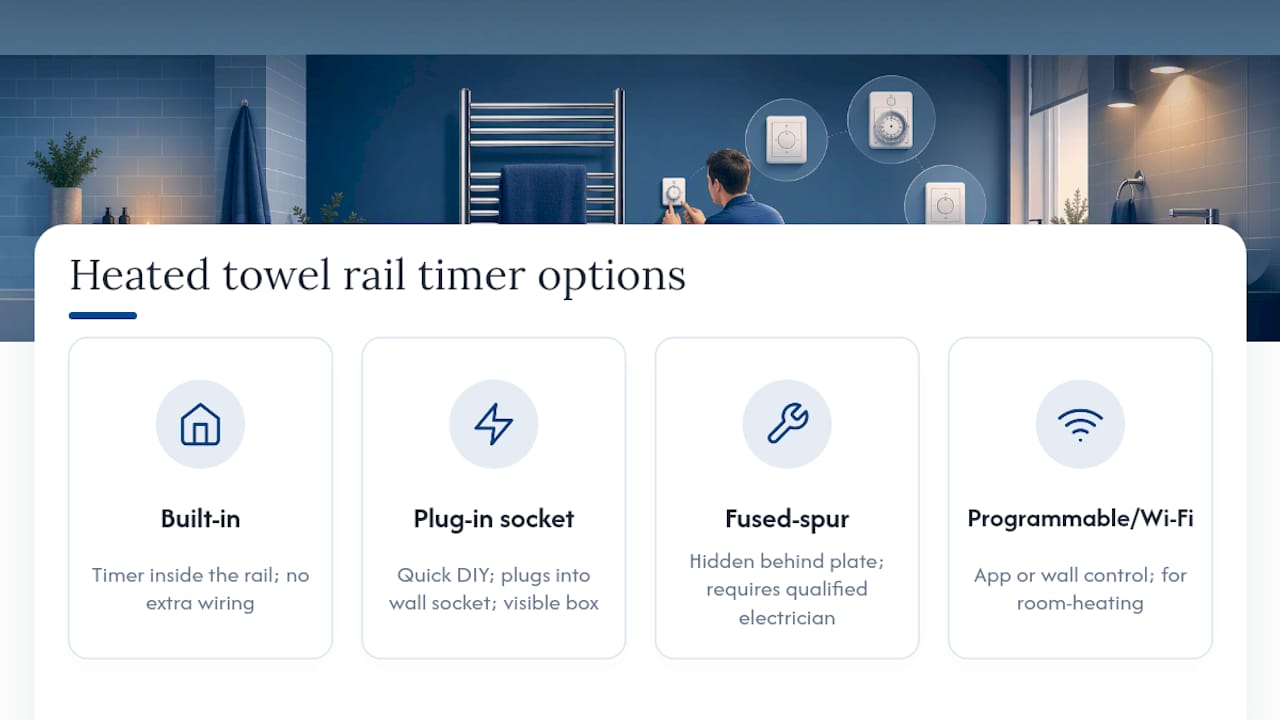
Built-in timer rails are towel radiators sold with the timer or thermostat already fitted inside the element housing. You get a tidy control panel on the rail itself, no extra wiring, and usually a simple dial or digital display for hours or a weekly schedule. Buy one when you’re replacing an old rail anyway, since fitting the electronics later costs more than buying them integrated.
Plug-in timed sockets are the cheapest way to add scheduling to a rail that’s already wired to a normal plug. You screw the rail’s plug into a mechanical or digital timer, which then goes into the wall socket. It works in minutes and needs no electrician, but a chunky timer box hanging off the wall next to a bathroom sink rarely looks good.
Fused-spur timers replace a switched fused connection point with a timed version, keeping the installation invisible behind the wall plate. This is the neatest permanent retrofit for a hardwired rail, and it’s the route recommended when fitting a timer to an electric heated towel rail with a hard wire plug comes up on DIY forums. It does need a qualified electrician.
Programmable wall controllers and Wi-Fi thermostats suit rails that also heat the room, not just towels, where you want finer control over temperature and schedule than a basic timer offers. Smart control makes sense if you already run a smart heating system or want app access; for a simple towel-drying rail, it’s often more complexity than the job needs.
How do I choose the right timer or timed rail?
Getting this right at the buying stage saves a second trip to the shop and, more importantly, avoids fitting the wrong device to the wrong circuit.
- Check the rail’s power rating and wiring type. Confirm whether it runs from a standard 13-amp plug, a fused connection point, or a hardwired spur, since that decides which timer category you can even fit.
- Check the IP rating for bathroom zones. Any control gear near a bath or shower must carry the correct ingress protection rating for its zone; ask the supplier to confirm this before you buy.
- Decide on programmability. A basic on/off timer suits predictable routines, a 7-day timer suits households with different weekday and weekend patterns, and smart/Wi-Fi control suits anyone who wants remote access or integration with existing heating.
- Think about where the controller sits. A wall controller needs a sensible, dry mounting spot; an element-integrated timer avoids that question entirely.
- Budget for the installer, not just the part. A fused-spur swap or hardwiring job is a short call-out for most electricians, but it’s still a cost on top of the timer itself.
- Ask your supplier or electrician about compatibility. Confirm the timer’s load rating matches your rail’s wattage and that the element itself supports timer control, rather than needing swapping out separately.
Pro Tip: Keep the datasheet for your rail’s heating element handy when you call an electrician. Quoting the exact wattage and element type on the phone often saves a wasted first visit.
Which installation route suits your bathroom?
The right method depends entirely on whether your rail is plugged in or hardwired, and how permanent you want the solution to be.
- A plug-in timed socket suits rented homes or anyone who wants a reversible, no-tools fix; plug the rail into the timer, plug the timer into the wall.
- A fused-spur timer, such as the Timeguard FST24, replaces the existing switched fused connection point and hides the schedule control behind a standard-looking plate.
- Hardwired rails sometimes need the heating element itself swapped for a timer-capable or thermostatic version, rather than adding an external timer, particularly on older installations.
- Thermostatic elements differ from plain heating elements in that they hold a set temperature as well as switching off, which matters if the rail also warms the room rather than just the towels.
- RCD protection and the correct IP rating for the bathroom zone are not optional extras. Fused-spur and element manuals, including the CB Timer fused spur manual, specify the wiring diagram and load limits for a reason.
Manuals for these devices often state a maximum load and required fused connection point, and not every heating element is compatible with every timer. It’s a small check that avoids buying the wrong part twice. Any hardwired change, including a fused-spur swap, should go to a qualified, Part P aware electrician rather than a confident weekend attempt.
How much does timed use actually save on running costs?
Running cost comes down to two numbers multiplied together: wattage and hours run. A rail rated at roughly 85W left on continuously all month still adds up to only a modest sum on the electricity bill, and switching to timed use for just the hours you actually need cuts that to pennies a day, according to a towel rail running-cost guide. The full breakdown of heated towel rail running costs covers the maths in more detail for different wattages.
Sensible schedules make the biggest practical difference:
- Preheat the rail 30 to 60 minutes before your usual shower or bath time, rather than running it constantly.
- Add a short post-shower cycle, say 45 to 90 minutes, so towels finish drying without the element idling all day.
- If your unit is a 1kW-class model that heats the room as well as towels, treat it more like a radiator on the running-cost front, since the jump in cost comes from heating the space, not just the towel rail.
Choosing the right towel rail size for your bathroom up front avoids overspecifying wattage you don’t need and paying for it every month afterwards.
Is a heated towel rail timer actually worth fitting?
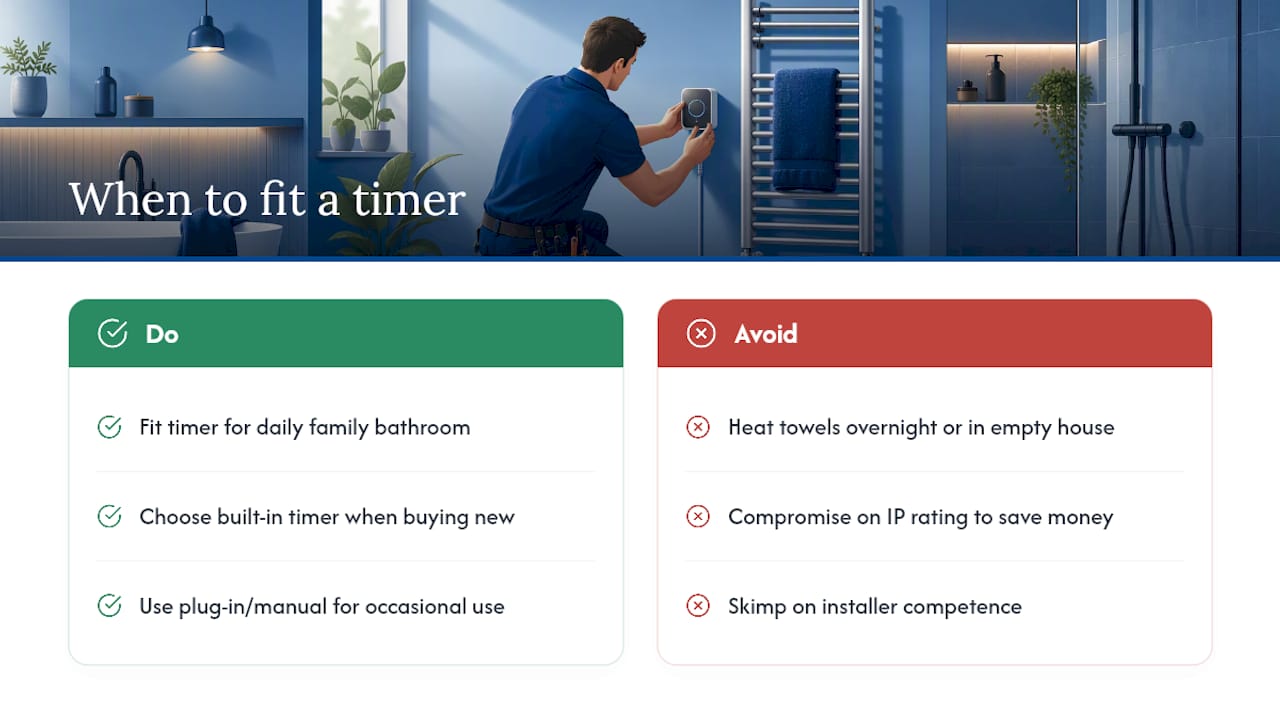
For a family bathroom used daily, a timer earns its keep quickly. You’re not paying to heat towels overnight or through an empty house, and the convenience of a warm towel exactly when you want one, without remembering to flick a switch, is hard to give up once you have it.
For a guest bathroom or a rail used a few times a week, the case is weaker. A simple plug-in timer or just switching it on manually before guests arrive probably covers it without the cost of a fused-spur retrofit. If you’re buying a new rail anyway, choosing one with a built-in timer usually beats retrofitting later. Whatever route you pick, don’t compromise on IP rating or installer competence to save a few pounds.
— Carl
Where to buy compatible timed and thermostatic elements
If your rail needs a new element rather than an external timer, some suppliers stock timed and thermostatic heating elements built to slot into existing towel radiators, alongside electric towel radiators that come with element options suited to timer control.
Orders typically have a returns window and delivery options, so if an element turns out to be the wrong fit for your rail, returning it should be manageable. The heating element timed thermostatic page lists the current options and specifications, and the team can talk you through compatibility with your existing rail before you buy. If you’re still choosing between a full radiator swap and a simple element replacement, the guide to choosing towel rails for UK bathrooms is worth a read first. Once you know what fits, ordering takes a few minutes and delivery is typically quick enough to have the job done at the weekend.
Sources
- Fitting a timer to a an electric heated towel rail, with a hard wire plug. - MyBuilder
- Electric towel rails: costs, sizing & buying guide | Heathfield LED
- CB Timer fused spur manual (PDF)
FAQ
Can you put a timer on a heated towel rail?
Yes. You can add a plug-in timed socket, fit a fused-spur timer in place of the existing connection point, or replace the heating element with a timer-capable one, as confirmed in this discussion on fitting a timer to a hardwired rail. Any hardwired option should be assessed by a qualified electrician first.
Should you leave a heated towel rail on all the time?
No. Guidance on heated towel rail use recommends a timer or thermostat over leaving a rail on permanently, both for running costs and for safety. A scheduled preheat before use and a short drying cycle afterwards covers most households’ actual needs.
How do you control a heated towel rail?
Control comes from either a built-in timer or thermostat on the rail itself, or an external device such as a plug-in timer, fused-spur timer, or wall-mounted programmable controller. Which one suits you depends on whether the rail is plugged in or hardwired, and how much scheduling flexibility you want.
Do towel warmers turn off automatically?
Only if they’re fitted with a timer or thermostat; a basic rail with no timer stays on until someone switches it off manually. Models sold with built-in timers, like some Bellerby and Radialight rails on the market, cut power automatically once the set period ends or the target temperature is reached.