


Heating system controls explained: a homeowner's guide
Heating system controls are devices that regulate when and how your boiler or heating system operates, directly managing temperature, timing, and energy output across your home. Understanding heating system controls explained in plain terms means knowing that these devices sit between your boiler and your living spaces, deciding when heat is needed and when it is not. Heating accounts for 55% of a typical UK household’s total energy bill. That single figure makes the case for getting your controls right before spending money on anything else.
What are the main types of heating system controls?
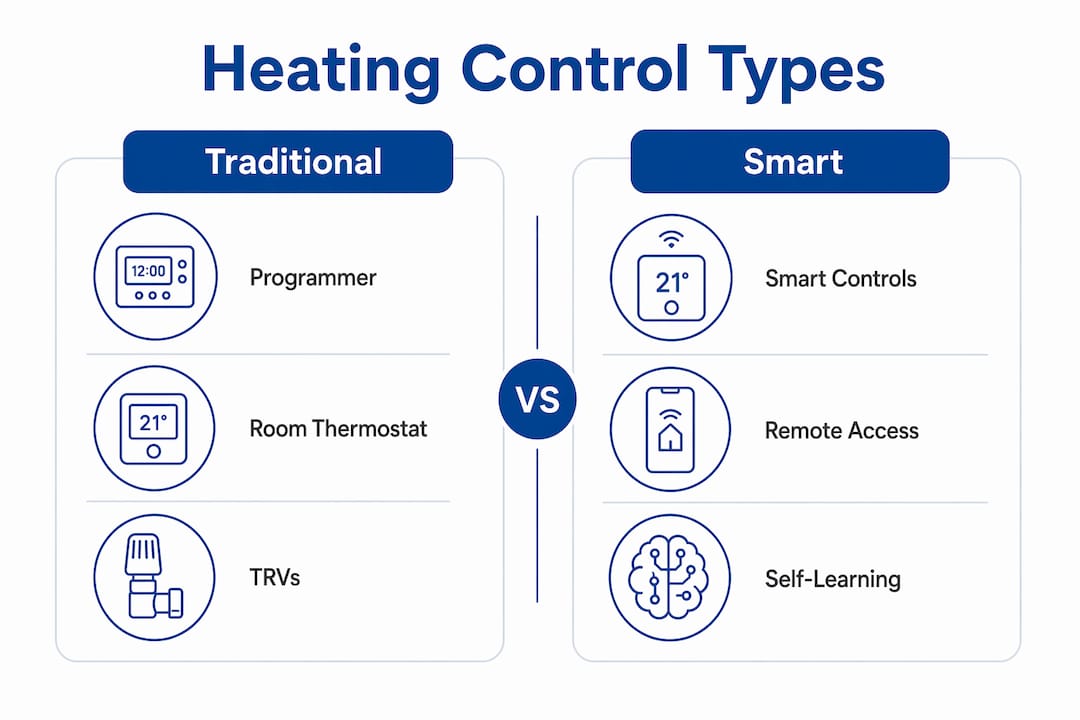
Heating controls fall into four main categories. Each one serves a different function, and most homes benefit from using several together rather than relying on just one.

Programmers and timers
A programmer sets the on and off times for your heating and hot water. Basic models offer one or two time periods per day. More advanced seven-day programmers let you set different schedules for weekdays and weekends, which suits property managers running buildings with variable occupancy patterns.
Room thermostats
A room thermostat measures the air temperature in one location and switches the boiler off once that target temperature is reached. Optimal thermostat settings in UK homes sit between 18°C and 21°C for living areas. Setting the thermostat even one degree lower than you normally would can reduce your heating energy use noticeably over a full winter.
Thermostatic radiator valves (TRVs)
TRVs fit onto individual radiators and control the flow of hot water into each one. They do not control the boiler directly. Instead, they allow different rooms to reach different temperatures, so a spare bedroom can stay cooler than a living room. TRVs set to maximum in every room defeat their purpose entirely. The correct approach is to set them lower in rarely used rooms and higher in the spaces where you spend the most time.
Smart heating controls
Smart controls combine scheduling, remote access via a smartphone app, and in many cases self-learning algorithms that adapt to your routine. Weather compensation and zoning features can improve efficiency by 5–10% compared with standard controls. Zoning divides your home into separate heating areas, each with its own temperature target and schedule.
Pro Tip: A wireless thermostat, such as the Consort wireless thermostat system, removes the need for new wiring and suits retrofits in older properties where running cables is disruptive.
The table below summarises the four control types, their key features, and typical installed costs.
| Control type | Key function | Typical installed cost |
|---|---|---|
| Programmer/timer | Sets heating on/off schedule | £50–£150 |
| Room thermostat | Maintains target air temperature | £80–£200 |
| Thermostatic radiator valve | Controls individual radiator output | £15–£40 per valve |
| Smart heating system | Remote control, scheduling, learning, zoning | £150–£400 |
How can heating controls reduce your energy bills?
The evidence for heating controls saving money is clear. Properly used controls can reduce heating energy consumption by 10–30%, translating to annual savings of £110–£620. That range is wide because the actual saving depends heavily on how you use the controls, not just which type you install.
The biggest gains come from three behavioural shifts that good controls make easier:
- Avoiding heating empty rooms. Zoning and TRVs stop you warming spaces nobody is using.
- Reducing overnight temperatures. A programmer drops the temperature while you sleep, then raises it before you wake.
- Cutting heating during work hours. Smart controls with presence detection switch off when the house is empty and restart before you return.
Smart controls save money by changing user behaviour rather than increasing boiler combustion efficiency. This is a point many homeowners miss. The boiler burns gas or uses electricity at the same rate when it fires. The saving comes from firing it less often and for shorter periods.
Government support is available for eligible households. ECO4 and GBIS schemes provide free heating control upgrades for those receiving Universal Credit, Pension Credit, or other qualifying benefits. Property managers overseeing social housing or privately rented properties in lower energy efficiency bands should check eligibility, as the schemes cover a broad range of tenures.
Pro Tip: Correct use of controls matters far more than the brand or model you choose. A basic programmer used well will outperform an expensive smart system left on its factory default settings.
What advanced features do modern smart heating controls offer?
Smart heating controls go well beyond a simple timer. The features below represent what current systems offer, and understanding them helps you decide whether the investment is justified for your property.
- Remote app control. Adjust your heating from anywhere using a smartphone. Useful for property managers overseeing multiple sites or homeowners returning from holiday.
- Presence detection. The system uses your phone’s location or motion sensors to detect when the home is empty and reduces heating automatically.
- Self-learning algorithms. The control observes your routine over several days and begins anticipating when you need heat, without you adjusting it manually.
- Weather compensation. The system reads outdoor temperature data and lowers the boiler’s flow temperature on milder days. This is particularly effective with condensing boilers.
- Room-by-room zoning. Individual room controllers communicate wirelessly with the boiler, giving each space its own schedule and target temperature.
Smart controls primarily benefit larger homes with variable occupancy and rooms that sit unused during the day. A four-bedroom house where two rooms are empty from Monday to Friday gains far more from zoning than a two-bedroom flat where both rooms are occupied most of the time.
The payback period for a smart control installation typically runs 2–4 years, depending on your current energy use and how actively you engage with the system. Homeowners who check the app regularly and adjust schedules seasonally see the fastest returns. Those who install the system and never revisit the settings see much slower payback.
Pro Tip: The Dimplex Q-Rad RF panel radiator includes built-in smart controls with scheduling and remote management, making it a practical choice for rooms where extending a wet central heating system is not feasible.
Ecodesign regulations are shifting towards controls that deliver heat only when and where it is needed. New products entering the UK market increasingly include weather compensation and load compensation as standard, rather than optional extras.
How to choose, install, and maintain heating controls effectively
Getting the right controls for your home requires matching the system to your boiler type, your property layout, and your daily routine. Follow these steps to make a sound decision.
-
Check boiler compatibility. Most boilers under 15 years old can be retrofitted with modern controls including smart systems without replacing the boiler itself. An installer may need to add a wiring centre or relay box for full compatibility. OpenTherm-compatible boilers support modulating controls, which adjust the boiler’s output rather than simply switching it on and off.
-
Use a registered engineer. Professional installation must comply with Gas Safe or OFTEC registration requirements and building regulations. Electrical work on heating controls falls under Part P regulations. Using an unregistered installer risks voiding your boiler warranty and creating a safety hazard.
-
Set the thermostat correctly from day one. The target range of 18–21°C covers most households. Set the boiler’s flow temperature to 60–65°C for a condensing boiler. Higher flow temperatures than necessary increase fuel use and reduce the boiler’s condensing efficiency.
-
Balance your TRVs by room use. Living rooms and bedrooms where you spend time warrant higher TRV settings. Hallways, utility rooms, and guest bedrooms should be set lower. Never set all TRVs to maximum. Doing so forces the boiler to run longer than needed and removes the energy-saving benefit of the valves entirely.
-
Schedule an annual service. A heating engineer can check that controls are communicating correctly with the boiler, verify flow temperatures, and update firmware on smart systems. Controls that drift out of calibration can quietly add cost to your bills without any visible sign of failure.
A timed thermostatic heating element is worth considering for supplementary heating in rooms where the main system is oversized or difficult to zone separately. These units combine a timer and thermostat in a single device, removing the need for additional wiring or a separate controller.
Key takeaways
Heating system controls deliver the greatest savings when chosen to match your property type and used actively, not left on factory defaults.
| Point | Details |
|---|---|
| Controls cut energy costs significantly | Properly used controls reduce heating consumption by 10–30%, saving £110–£620 per year. |
| Behaviour drives the saving | Smart controls work by helping you heat less, not by making the boiler burn more efficiently. |
| TRVs need balanced settings | Set TRVs lower in unused rooms and higher in living areas to get real energy savings. |
| Installation must be compliant | Use a Gas Safe or OFTEC registered engineer and ensure electrical work meets Part P regulations. |
| Smart controls suit larger homes | Homes with variable occupancy and unused rooms during the day gain the most from zoning and presence detection. |
Why the controls matter more than the boiler
Most homeowners I speak with focus their energy-saving attention on the boiler itself. They ask about efficiency ratings, output capacity, and brand reputation. Rarely does anyone ask about the controls first. That order of priority is back to front.
A high-efficiency condensing boiler running on a factory-default timer, set to heat the house from 6:00 AM to 10:00 PM seven days a week, will cost far more to run than a ten-year-old boiler paired with a well-configured programmer, a calibrated room thermostat, and balanced TRVs throughout. The controls determine how often the boiler fires. The boiler’s efficiency rating only matters when it is actually running.
What I have also noticed is that property managers tend to underestimate how much occupancy patterns vary across their portfolio. A flat occupied by a shift worker needs a completely different heating schedule to a family home. Applying a single default programme across multiple properties wastes money on every property where the schedule does not match the occupants’ routine.
The honest advice is this: before spending money on a new boiler or a premium smart system, spend an hour reviewing your current controls. Check what temperature your thermostat is actually set to. Check whether your programmer reflects your real daily routine. Check whether your TRVs are all turned to maximum. In most homes I have seen, those three checks alone reveal enough waste to justify the time.
— Carl
Heating products and controls at Simcodirect
Simcodirect stocks a range of heating controls and electric heating products suited to both residential and commercial properties.
The range includes smart electric panel radiators with built-in scheduling and remote control, wireless thermostat systems for straightforward retrofits, and timed thermostatic heating elements for supplementary room heating. Each product comes with full specification details on the Simcodirect website, along with a 30-day returns policy and fast UK delivery. Whether you are upgrading a single room or fitting out a managed property, the Simcodirect catalogue covers the controls and heating products you need to get the job done properly.
FAQ
What is the difference between a programmer and a smart thermostat?
A programmer sets fixed on and off times for your heating. A smart thermostat adds remote control via an app, presence detection, and in many cases self-learning, giving you far more flexibility to match heating to your actual routine.
Can I add smart controls to my existing boiler?
Most boilers under 15 years old can be retrofitted with smart controls without replacement. An installer may need to add a wiring centre or relay box, and OpenTherm compatibility determines whether modulating control is possible.
What temperature should I set my room thermostat to?
The recommended range for UK homes is 18–21°C. Setting the thermostat one degree lower than your usual setting reduces heating energy use without a noticeable drop in comfort for most households.
Do TRVs replace a room thermostat?
TRVs do not replace a room thermostat. TRVs control individual radiators, while a room thermostat controls the boiler itself. Both are needed for a fully balanced heating control system.
What government support is available for heating controls?
The ECO4 and GBIS schemes offer free heating control upgrades for eligible households, including those receiving Universal Credit or Pension Credit. Property managers with eligible tenants should check current scheme criteria directly with an approved installer.