


HEPA air purifier benefits for UK homes: what the science says
HEPA air purifiers substantially reduce indoor particulate concentrations and can meaningfully lower your exposure to allergens, dust mite fragments, pet dander, and aerosolised pathogens when sized and operated correctly. Studies across UK homes report typical PM2.5 reductions of around 40–50% in occupied rooms during continuous use, though the range across different settings runs from 29% to over 80%. The important caveat: HEPA filtration does not remove gases, volatile organic compounds (VOCs), or CO2, and it cannot substitute for proper ventilation.
Two things to act on immediately:
- Place the device in the room where you spend the most time (usually the bedroom) and run it continuously or on auto mode.
- HEPA alone will not control odours or humidity — pair it with adequate ventilation for a complete indoor air strategy.
Key takeaways
| Point | Details |
|---|---|
| Typical PM2.5 reduction | Around 40–50% in occupied rooms; UCL field data shows ~45% after 90 minutes of continuous use. |
| HEPA does not replace ventilation | Filtration removes particles but cannot dilute CO2 or control humidity; ventilation remains essential. |
| Match CADR to room size | Aim for 4–5 air changes per hour; an undersized device delivers a fraction of the measured benefit. |
| Run continuously or on auto | PM2.5 reductions build over 30–90 minutes; intermittent use substantially reduces real-world benefit. |
| Simcodirect for UK supply | Simcodirect stocks air purification systems and replacement HEPA filters with fast UK delivery and a 30-day returns policy. |
Table of Contents
- How HEPA filtration works and what H13 vs H14 actually means
- What a HEPA purifier removes — and what it cannot
- What peer-reviewed research says about health outcomes
- Who benefits most from a HEPA purifier?
- How to size and operate a purifier to get the research-level results
- Maintenance, running costs, and noise
- What HEPA purifiers cannot do — and the risks of misplaced trust
- Should you buy a HEPA purifier?
- UK-specific evidence and NHS guidance
- An editorial perspective on HEPA purifiers and realistic expectations
- Simcodirect’s air purification range for UK homes and commercial spaces
- Sources
How HEPA filtration works and what H13 vs H14 actually means
The core mechanism is mechanical capture. As air passes through densely packed glass fibres, particles are trapped by three physical processes: impaction (larger particles collide with fibres and stick), interception (mid-sized particles follow airflow but graze a fibre), and diffusion (the smallest particles move erratically and contact fibres by chance). No chemistry, no ionisation — just physics.
The hardest particle size to capture is around 0.3 µm, known as the most penetrating particle size (MPPS). Filter classes are rated at this benchmark. Under BS EN 1822 and ISO 29463, the two classes relevant to home and healthcare use are:
- H13 (true HEPA): captures at least 99.95% of particles at the MPPS in a single pass.
- H14: captures at least 99.995% — ten times fewer particles escape per pass.
For most UK homes, H13 is sufficient. H14 becomes relevant in clinical or immunocompromised-household settings where the marginal gain justifies the higher cost and airflow resistance. When comparing true HEPA vs HEPA type products, “HEPA type” or “HEPA-like” filters carry no standardised efficiency rating and should be treated with scepticism.
HEPA traps particles; it does not neutralise gases or odours. Activated carbon stages adsorb many VOCs and cooking smells, which is why quality purifiers combine both media.
Pro Tip: *Check the filter’s certification marking. A genuine H13 or H14 device should state compliance with BS EN 1822 or ISO 29463.
What a HEPA purifier removes — and what it cannot
HEPA is highly effective for particles. It has limited or no effect on gases and humidity.
| Pollutant category | HEPA removal effectiveness |
|---|---|
| PM2.5 (fine particulate matter) | High |
| Pollen | High |
| Pet dander | High |
| Dust mite allergen fragments | High |
| Tobacco and wildfire smoke particles | High |
| Aerosolised bacteria and viruses (as particles) | Moderate to high |
| VOCs and chemical odours | None (requires activated carbon) |
| CO2 and metabolic gases | None (requires ventilation) |
| Humidity | None (requires dehumidifier or ventilation) |
A few practical points on expanding usefulness:
- Combining HEPA with an activated carbon stage handles both particles and many odours from cooking, cleaning products, and off-gassing furniture.
- Source control remains the most effective first step: reducing the source of pollution (vacuuming with a HEPA-rated vacuum, grooming pets regularly, not smoking indoors) reduces the load the purifier must handle.
- For CO2 and humidity, bathroom and room ventilation is the correct intervention — a purifier recirculates the same air without diluting it.
What peer-reviewed research says about health outcomes
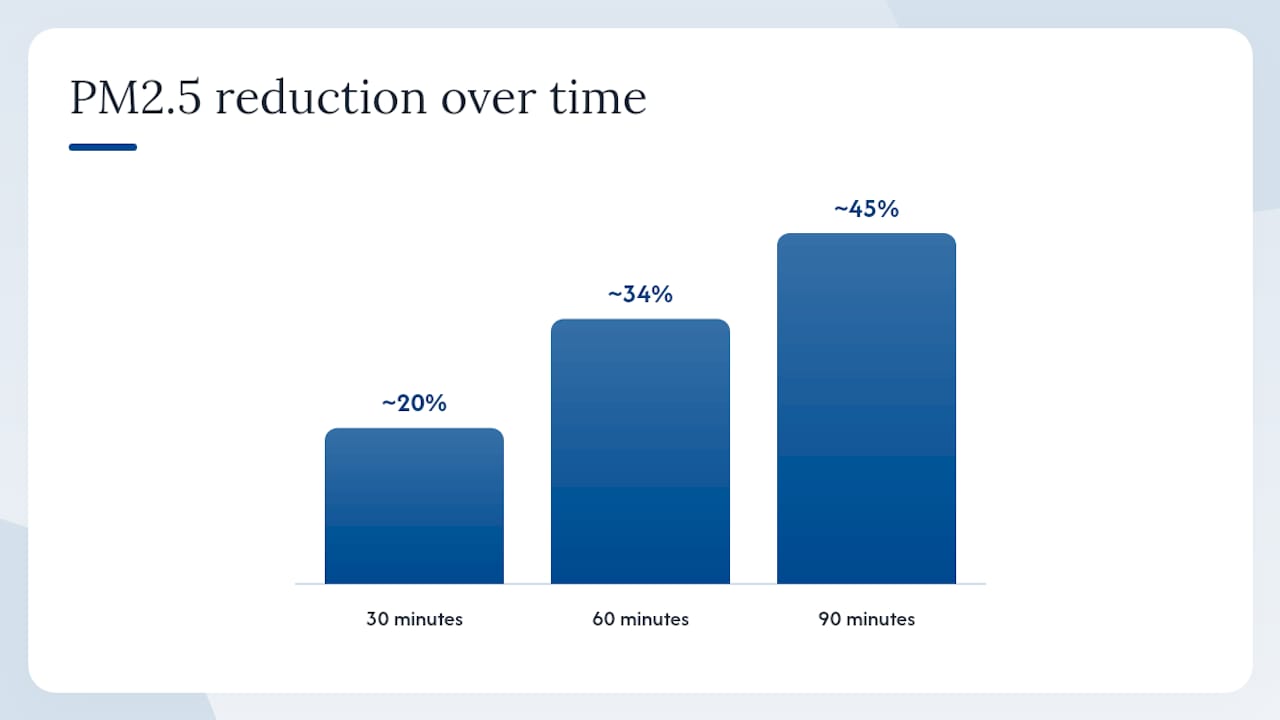
Statistic: UCL field measurements in London homes found a mean PM2.5 reduction of approximately 45% in bedrooms after 90 minutes of purifier use. The reduction built progressively: roughly 20% after 30 minutes, 34% after 60 minutes, and 45% after 90 minutes.
A hospital ward natural experiment recorded PM1 reductions of 65–78% when air-cleaning units were properly deployed, illustrating what well-matched, continuously operated devices can achieve.
Key health findings from the trial evidence:
- An 18-month randomised placebo-controlled trial found active HEPA purifiers reduced annual mean PM2.5 (intervention group: 5 µg/m³ vs placebo: 8.15 µg/m³) and showed post-hoc improvements in rhinitis quality of life and some sleep measures, though not all primary endpoints reached statistical significance.
- UCL modelling estimated that sustained indoor PM2.5 reductions from portable purifiers could produce population-level health gains in the UK, with central scenarios suggesting around 138 days of life expectancy gain for males and approximately 120 days for females in a birth-cohort model — results that depend heavily on assumptions about usage and exposure.
- Research also suggests that improved indoor air quality may support cognitive function, with Harvard T.H. Chan School of Public Health research linking better air quality to improved cognition and productivity.
The honest summary: the evidence for particle reduction is solid. The evidence for clinical symptom improvement is promising but more variable, and population-level benefit estimates are modelled projections rather than measured outcomes.
Who benefits most from a HEPA purifier?
The clearest gains go to allergy sufferers, households with pets, people with asthma or respiratory sensitivities, and homes exposed to outdoor pollution or smoke.
Practical scenarios:
- Bedroom overnight (allergy sufferers): Running an H13 purifier continuously in a correctly sized bedroom reduces overnight pollen and dust mite allergen exposure, which is when symptoms often peak. Fewer nighttime awakenings and reduced morning sneezing are the most commonly reported improvements.
- Living room during cooking or smoke events: Cooking generates significant PM2.5 spikes. A purifier on auto mode near the cooking area (alongside an extractor hood) can blunt those peaks before they spread to the rest of the home.
- Child’s room during pollen season: Keeping windows closed and running a purifier during high-pollen periods can reduce indoor pollen counts substantially, particularly relevant for children with hay fever or mild asthma.
- Homes near busy roads: Urban UK homes near high-traffic roads face elevated outdoor PM2.5 that infiltrates indoors. Continuous purifier operation in main living spaces provides a meaningful buffer.
- Pet owners: Pet dander is a persistent allergen that settles and resuspends. Regular purifier operation in rooms where pets spend time reduces airborne dander load between cleaning sessions.
Pro Tip: Prioritise the room where you spend the most consecutive hours — typically the bedroom. Eight hours of reduced allergen exposure overnight has more cumulative effect than occasional use in a living room. Use auto or sensor mode so the device responds to real-time air quality rather than running at a fixed speed.
How to size and operate a purifier to get the research-level results
The single most important decision is matching the device’s Clean Air Delivery Rate (CADR) to your room’s volume.
- Calculate room volume: multiply floor area (m²) by ceiling height (typically 2.4 m in UK homes). A 15 m² bedroom has a volume of roughly 36 m³.
- Choose a device with appropriate CADR: aim for at least 4–5 air changes per hour (ACH) for allergy or health-focused use. Divide room volume by 12 (for 5 ACH) to find the minimum CADR in m³/hour.
- Position centrally and unobstructed: placing a device in a corner reduces effective air distribution. Near the bed or main seating area, with clear space around the intake and outlet, is preferable.
- Run continuously or on auto mode: the UCL data shows reductions build over 30–90 minutes. Switching the device off overnight or only running it for short periods substantially reduces the realised benefit.
- Manage doors and windows: keeping the room reasonably closed during operation concentrates the purifier’s effect. Opening windows during high-pollen or high-pollution periods resets progress quickly.
The table below shows approximate PM2.5 reduction milestones from UCL field data, assuming a correctly sized device running continuously in a bedroom:
| Time elapsed | Approximate PM2.5 reduction |
|---|---|
| 30 minutes | ~20% |
| 60 minutes | ~34% |
| 90 minutes | ~45% |
Pro Tip: Integrated air quality sensors and auto modes increase the probability of correct, continuous operation — especially for users who forget to adjust fan speed. A device that responds to a cooking event or an open window is more likely to deliver the reductions the research measures.
Maintenance, running costs, and noise
Expect periodic filter replacement, modest energy costs for continuous operation, and noise levels that vary significantly by fan speed.
Maintenance essentials:
- Pre-filter: clean every 2–4 weeks by vacuuming or rinsing (check manufacturer guidance). A clogged pre-filter reduces airflow and shortens HEPA cartridge life.
- HEPA cartridge replacement: typically every 6–12 months for continuous domestic use, though heavily polluted environments or homes with pets may require more frequent changes. Most devices signal when replacement is due via an indicator light.
- Replacement filter cost: varies by model and filter class; H13/H14 cartridges for quality devices generally cost more than basic filters, so factor this into total cost of ownership. Simcodirect stocks replacement HEPA filters for compatible units.
- Energy use: most domestic purifiers draw 20–60 W on medium settings. Running continuously at 40 W costs roughly £50–£70 per year at typical UK electricity rates, though this varies with tariff and usage pattern.
- Noise: low fan speeds are typically 25–35 dB (quiet enough for sleep); high speeds can reach 50–60 dB. For bedroom use, choose a model with a dedicated sleep or night mode.
Pro Tip: Before buying, check that genuine replacement filters are available from the manufacturer or a UK retailer. Some budget devices use proprietary cartridges that become unavailable within a few years, effectively making the unit disposable.
What HEPA purifiers cannot do — and the risks of misplaced trust
HEPA does not dilute CO2, control humidity, or reliably remove gases and odours without an activated carbon stage. Treating it as a complete indoor air solution creates real risks.
Key limitations and safety points:
- Not a substitute for ventilation: NHS England guidance is explicit that filtration supplements ventilation rather than replacing it. CO2 accumulates in occupied, sealed rooms regardless of how good the filter is. UK Building Regulations Part F sets minimum ventilation requirements for a reason.
- No effect on surface contamination: HEPA captures airborne particles. Allergens already settled on surfaces, bedding, or carpets are unaffected until they resuspend.
- Ozone-generating devices: some air purifiers use UV-C, ionisers, or plasma technology that can produce ozone as a by-product. Ozone is a respiratory irritant. Stick to purifiers confirmed free from harmful secondary pollutants — mechanical HEPA filtration does not generate ozone.
- Clogged filters underperform: a saturated HEPA cartridge can restrict airflow enough to reduce effective CADR by a significant margin. Ignoring replacement schedules defeats the purpose.
- Incorrect sizing: a device rated for 15 m² placed in a 40 m² open-plan living space will not achieve the air change rates needed for meaningful reduction. Room size matching is not optional.
The overall effectiveness of a HEPA cartridge depends not only on its filter efficiency but also on how well the device distributes air in the room; a high-efficiency filter in a poorly designed device may underperform compared with a lower-rated filter in a better-designed unit.
Should you buy a HEPA purifier?
Buy one if: your household has allergy sufferers, asthma, or respiratory sensitivities; you have pets; you live near a busy road or in an area with elevated outdoor PM2.5; you experience wildfire or bonfire smoke events; or you have vulnerable household members (young children, elderly adults, immunocompromised individuals).
It adds less value if: your home has good mechanical ventilation with filtration already built in, you have no allergy or respiratory symptoms, and your local outdoor air quality is consistently low.
High-value indicators for purchase:
- Frequent sneezing, itchy eyes, or worsened asthma symptoms indoors.
- Living within 150 metres of a major road.
- Pets that shed dander regularly.
- Household members with diagnosed allergic rhinitis or mild-to-moderate asthma.
- Visible smoke infiltration from outdoor sources.
Where ventilation is inadequate, prioritise fixing that first. A ventilation upgrade addresses CO2, humidity, and particle dilution simultaneously. A purifier then adds a further layer of particle control on top of that foundation.
UK-specific evidence and NHS guidance
NHS England endorses HEPA filtration as a supplementary option in healthcare spaces and sets H13/H14 efficiency expectations; UCL research quantifies typical PM2.5 reductions and models population health benefits in UK homes.
Key UK evidence:
- NHS England guidance recommends H13/H14 HEPA standards for air-cleaning devices in healthcare spaces, describing filtration as an established technology for reducing airborne pathogens and particulate matter — while being clear it supplements, not replaces, ventilation.
- UCL field measurements in London homes recorded a mean PM2.5 reduction of approximately 45% in bedrooms after 90 minutes, with occupant behaviour identified as a strong determinant of realised benefit.
- UCL modelling estimated that sustained reductions in indoor PM2.5 could produce measurable population health gains, with central scenarios suggesting around 138 days of life expectancy gain for males in a birth-cohort model — a figure that depends on assumptions about how consistently devices are used across the population.
- A UK hospital ward natural experiment recorded PM1 reductions of 65–78% when portable air-cleaning units were properly deployed, demonstrating what well-matched devices achieve in real clinical spaces.
Statistic: UCL field data from London homes shows a median PM2.5 reduction of approximately 45% in bedrooms after 90 minutes of continuous purifier operation.
Filtration supplements — it does not replace — ventilation under UK Building Regulations Part F. The two work together: ventilation dilutes CO2 and controls humidity; HEPA removes the fine particles that ventilation alone cannot adequately address.
An editorial perspective on HEPA purifiers and realistic expectations
The evidence for HEPA air purifiers is genuinely encouraging, but the gap between what the research measures and what most people actually experience at home is wider than the marketing suggests. Most people run their purifier intermittently, in a room that is too large for the device, with the filter overdue for replacement. The result is a fraction of the measured benefit.
The more interesting insight from the UCL work is that occupant behaviour is the dominant variable. A mid-range H13 device used correctly outperforms a premium H14 unit switched on only when someone remembers. That shifts the purchasing decision: rather than spending more on filter class, spend on a device with reliable auto mode and sensor integration that removes the behavioural burden entirely.
The NHS guidance on H13/H14 for healthcare spaces is also worth reading carefully. It does not say HEPA purifiers are sufficient for infection control — it says they are a useful supplement to ventilation. That framing applies equally to homes. If your indoor air quality problem is fundamentally a ventilation problem (high CO2, condensation, persistent odours), a purifier will not solve it. Fix the ventilation first, then add filtration for the particle layer it cannot address.
Simcodirect’s air purification range for UK homes and commercial spaces
Simcodirect supplies air-treatment products for UK residential and commercial clients, with stock available for fast delivery and a 30-day returns policy.
If you are ready to act on the guidance above, here is what to look for when ordering through Simcodirect:
- Air purification systems stocked for both domestic and commercial use, with guidance on matching device output to room size.
- Replacement HEPA filters available for compatible units — check the replacement filter page to confirm availability for your model before purchasing a device.
- Buying tip: confirm the CADR rating and spare-part availability before committing. A device without a reliable UK supply of replacement filters is a short-term purchase.
- After-sales support: 30-day returns and fast UK delivery mean you are not locked in if the device does not suit your space.
For a broader view of air-treatment and related products, visit the Simcodirect air purifier guide or browse the full range at Simcodirect.
Sources
The findings in this article draw on the following authoritative sources:
- Application of high efficiency particulate air (HEPA) filter devices for air cleaning in healthcare spaces: guidance and standards
- The use of portable air purifiers for the reduction of PM2.5 in residences: Effects on indoor pollutant concentrations, perceived air quality, and mortality - UCL Discovery
- Natural experiment measuring aerosol transport and ACU impact in a hospital ward — Cambridge repository
- Randomised placebo‑controlled trial of a HEPA air purifier and respiratory outcomes (Dyson trial) — DOI:10.1111/cea.14459
- NCBI PMC review article on air purifiers and indoor air quality