Horizontal water heaters: UK guide for space-constrained homes
Horizontal water heaters are unvented cylinders designed to lie on their side, delivering full mains-pressure hot water in spaces where a standard upright cylinder simply will not fit. Think loft eaves, under-stair cupboards, low-ceiling basements, and barn conversions where headroom runs out before your hot water needs do. They are not a general-purpose alternative to vertical units; they are a specialist fix for a specific architectural problem.
Key facts at a glance:
- Capacity varies in purpose-built UK models to suit different household sizes
- Compatible with gas or oil boilers, heat pumps, and solar thermal systems
- Must be installed by a G3-qualified plumber under UK Building Regulations
- Energy efficiency ratings are available across the main UK ranges
- Vertical cylinders outperform horizontal ones on stratification and servicing ease; horizontal units are the right call only when vertical clearance is genuinely unavailable
Why horizontal water heaters are rare in the UK market
Vertical cylinders dominate UK installations, and for good reason. The physics of hot water storage naturally favour an upright vessel, and the entire supply chain, from manufacturers to training bodies, is built around that assumption.
Several factors keep horizontal units a niche product:
- Thermal stratification. Hot water rises; cold water sinks. A vertical cylinder exploits this naturally, keeping a usable hot layer at the top. A horizontal vessel disrupts that separation, which can reduce the effective volume of hot water you draw before temperatures drop.
- Installation complexity. Confined loft spaces make pipework, safety device routing, and future servicing genuinely awkward. Positioning pressure relief valves and tundish discharge pipes correctly in a low-ceiling eaves space takes more planning than a straightforward airing-cupboard fit.
- Structural load. A 250L cylinder filled with water can exceed 300kg. Loft joists are not automatically rated for that, and many installations require a structural engineer’s sign-off before work begins.
- Limited model range. Fewer manufacturers produce purpose-built horizontal cylinders, so choice is narrower and prices tend to be higher than equivalent vertical units.
- Specialist installer pool. G3-qualified engineers with hands-on horizontal experience are less common, which can affect both availability and cost of installation.
- Industry preference. Experienced plumbers consistently advise treating horizontal cylinders as a last resort; vertical units offer more consistent output, easier servicing, and simpler commissioning.
One point worth stressing: never lay a vertical cylinder on its side. Internal components, including the thermostat, anode, and coil geometry, are orientation-specific. Doing so creates thermostat errors, voids warranties, and introduces safety hazards.
Heat stratification and legionella control: what you need to know
Thermal stratification is the natural separation of hot water at the top of a storage vessel and cooler water at the bottom. In a vertical cylinder, convection maintains this layering with minimal effort. In a horizontal tank, that separation weakens because the geometry reduces the vertical distance between hot and cold zones, leading to more mixing and a less predictable draw temperature.
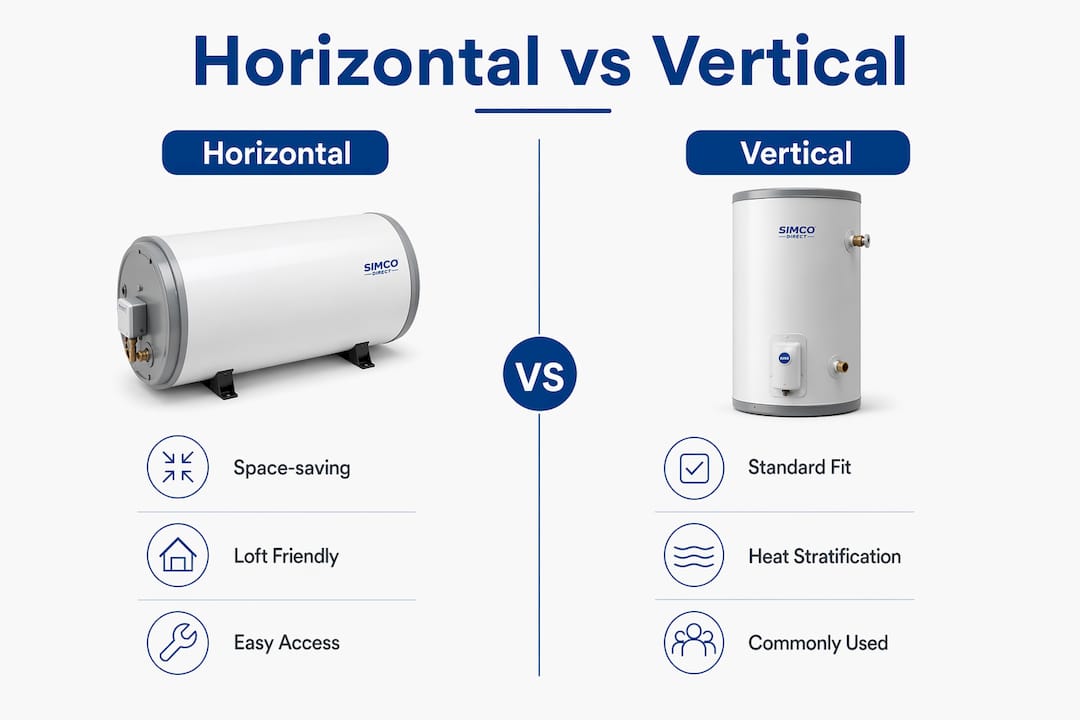
Manufacturers address this with internal baffles and diffusers that slow cold-water ingress at the inlet. Without proper baffling, cold water entering the vessel mixes with the stored hot water, producing tepid discharge earlier than expected and effectively shrinking your usable hot water volume. In high-demand systems, a shunt or destratification pump can circulate water from the top of the vessel to the base during low-demand periods, compensating for weaker natural layering.
Legionella is the more serious concern. The bacterium thrives in stored water held between 20°C and 45°C. Per HSE guidelines, hot water cylinders must store water at 60°C or higher, and distribution must remain at 50°C or higher throughout the pipework. Horizontal cylinders can develop cooler zones near the base of the vessel if circulation is poor, making temperature monitoring more critical than in a standard vertical installation.
Identify sentinel outlets for regular temperature checks to ensure safety and compliance. The cylinder storage temperature also needs a monthly check. Cold water storage and distribution should stay below 20°C.
Pro Tip: Set your cylinder thermostat to 60°C and run a full heat cycle at least once daily. Check your sentinel outlets monthly with a calibrated thermometer and log the readings. A written record is not just good practice; it demonstrates compliance if an HSE inspection occurs.
Available horizontal water heater models for UK homes
Purpose-built horizontal cylinders for the UK market are manufactured in duplex stainless steel, rated to a maximum of 95°C and 6 bar pressure, and carry ErP ‘A’ energy efficiency ratings. The main models worth knowing about are:
- UK Cylinders Elite Cyl. A well-regarded indirect horizontal cylinder available across multiple capacities, designed for loft and eaves installations with a full unvented kit included.
- Gledhill Stainless Lite Plus. Gledhill’s horizontal range uses stainless steel construction and suits properties where a standard copper cylinder would be impractical. Compatible with conventional boilers and solar thermal systems.
- Telford Tempest Stainless Steel Indirect. Telford’s Tempest range covers horizontal configurations with a focus on durability in both soft and hard water areas, using stainless steel throughout.
Capacity sizing by household, based on published guidance:
| Capacity | Actual volume | Suitable for |
|---|---|---|
| 180L | 180L | 2-bedroom, 1 bathroom |
| — | — | 3-bedroom, 2 bathrooms |
| 300L | — | large household |
| 500L | 500L | Large properties or light commercial |
Coil surface areas range from 2m² on the 180L model up to 6.5m² on the 500L, making the larger units well suited as a horizontal hot water tank for heat pump systems where lower flow temperatures require more heat exchanger area. All models accept indirect heating via a 1-inch flow and return connection, with a 1½-inch immersion heater port as a backup heat source.
Pro Tip: Size up by one capacity band when installing in a loft with restricted access. Oversizing slightly reduces recovery frequency and means fewer heat cycles, which eases the load on both the cylinder and the boiler.
Installation and maintenance best practices for horizontal cylinders
Getting a horizontal cylinder installed correctly is more involved than a standard vertical fit, and the consequences of cutting corners are serious.
Key installation requirements:
- G3 qualification is mandatory. Under UK Building Regulations, unvented cylinders must be installed by a G3-competent engineer in England, Wales, and Scotland. This is not optional; an unqualified installation voids the warranty and may invalidate your home insurance.
- Structural assessment for loft installations. A filled 250L cylinder can exceed 300kg. For capacities above 250L in loft or eaves positions, commission a structural engineer’s report before the cylinder goes in.
- Correct orientation and handedness. Many horizontal cylinders are handed, meaning the cold inlet is specified as left or right. Fitting the wrong way round disrupts internal flow paths and undermines the baffling design. Always follow the manufacturer’s orientation instructions precisely.
- Drain valve positioning. Fully draining a horizontal cylinder without a low-level drain valve is difficult. Confirm drain-off arrangements at the design stage, not after the cylinder is fixed in place.
- Pressure relief valve and tundish routing. The temperature and pressure relief valve discharge must route to a visible, safe tundish and then to a suitable drain. In a low-ceiling loft, planning this route before installation avoids expensive remedial pipework later.
- Electrical compliance. Immersion heater connections must comply with Part P of the Building Regulations. Use a dedicated fused spur and confirm earthing is correct.
For ongoing maintenance, a home plumbing maintenance checklist covering monthly sentinel outlet checks, six-monthly cold tank temperature readings, and annual pressure relief valve tests will keep the system compliant and extend cylinder life. Showerheads and hoses on the same system should be descaled and cleaned at least quarterly to reduce biofilm risk.
Pro Tip: Before the cylinder goes in, photograph the space and mark the positions of all service access points. In a cramped loft, that record saves hours when a plumber needs to locate the immersion port or drain valve two years later.
Key takeaways
Horizontal water heaters solve a genuine problem for UK homes with height restrictions, but they demand careful sizing, specialist installation, and disciplined maintenance to perform safely.
| Point | Details |
|---|---|
| Space-specific solution | Horizontal cylinders suit lofts, eaves, and low-ceiling spaces where vertical clearance is unavailable. |
| G3 installation is mandatory | UK Building Regulations require a G3-qualified engineer for all unvented cylinder installations. |
| Legionella temperature thresholds | Store at 60°C or higher; distribute at 50°C or higher; check sentinel outlets monthly. |
| Structural load assessment | A filled cylinder of this size can be very heavy and necessitates structural assessment for loft or eaves installations, requiring engineering sign-off for loft positions. |
| Size up for loft installations | Choosing one capacity band larger reduces recovery cycles and eases long-term system load. |
Simcodirect stocks a range of heating and bathroom products to complement your home’s hot water setup. If you are upgrading a bathroom or utility space alongside a cylinder installation, browse the Titan Chrome Straight Towel Radiator and the full radiator range for wall-mounted heating solutions that work alongside your new system.