


Best low profile radiators for compact and awkward rooms
For most compact rooms, a slimline double-panel radiator (a Type 21 or Type 22) rated at Watts at ΔT50 gives the best balance of low height and real heat output, and an electric panel model like the Dimplex Q-Rad works well where there’s no wet system to tap into. Both fit under shallow windowsills and beside doorways without eating into floor space. The output figures on the box are tested to EN 442 at ΔT50, and CIBSE’s guidance on lower system temperatures explains why some homes need to size up rather than down.
Before you buy anything, measure your room’s heat loss (a BTU calculator does this in minutes) and check the radiator’s Watts at ΔT50 against it. If you’re running a heat pump or a condensing boiler at lower flow temperatures, that figure needs correcting downward, not taking at face value.
- Measure room dimensions and calculate heat loss in Watts or BTU
- Check the radiator’s Watts output at ΔT50 on the spec sheet
- Correct that figure if your system runs below 75/65°C flow/return
- Shortlist models from Simcodirect’s in-stock low-profile range and confirm delivery lead time
Pro Tip: If your calculated heat loss sits close to a radiator’s rated output, round up to the next size rather than the next size down. An undersized radiator never catches up on a cold January morning.
Key Takeaways
Choosing the right low profile radiator comes down to matching the rated Watts at ΔT50 to your room’s actual heat loss and correcting that figure for your system’s real operating temperature.
| Point | Details |
|---|---|
| Define low profile correctly | Most low-profile radiators sit below 600mm, with ultra-low skirting styles under 300mm. |
| Size by heat loss, not guesswork | Calculate room heat loss in Watts, then match or exceed it at your system’s ΔT. |
| Correct for low-temperature systems | Heat pump or condensing systems running 45 to 55°C can reduce radiator output significantly versus ΔT50 ratings. |
| Check installation details early | Confirm pipe centres, valve compatibility and finished floor height before fitting. |
| Buy from Simcodirect’s in-stock range | The Dimplex Q-Rad, Consort Toweldry and four Heating Element variants cover most compact-room needs, backed by a 30-day returns policy. |
Table of Contents
- What counts as a low profile radiator?
- Which rooms actually need a low profile radiator?
- How do you size a low profile radiator correctly?
- Installation checklist: mounting, plumbing and bathroom rules
- Materials and finishes: what actually changes the output
- Low profile radiators you can order from Simcodirect
- Why does system temperature change what radiator you need?
- Order your low profile radiator with confidence
- Sources
What counts as a low profile radiator?
A low profile radiator, sometimes labelled “low level” or “low height” by manufacturers, is typically anything below around 600mm tall, with many popular models sitting between 300mm and 500mm. Models shorter than that tend to be marketed as “ultra low” or “skirting style” units, often below 300mm, designed to slot beneath a windowsill or run along a wall like a plinth heater.
Manufacturers publish these dimensions alongside output figures tested to EN 442, the European standard that rates radiator performance at ΔT50 (a 50°C average difference between the radiator and the room). Spec sheets list height, depth and Watts per metre at that standard test condition, so two radiators of different lengths can be compared fairly once you know their output per metre.
Typical heights you’ll come across when browsing:
- 300 to 400mm: cloakrooms, under-sill runs, kitchens with worktop obstructions
- 400 to 500mm: general low-profile living spaces, hallways, landings
- 500 to 600mm: still classed as low profile but with more panel area for higher output
- Below 300mm: skirting-style or plinth heaters for the tightest spaces
Slim doesn’t automatically mean low output, either. A double-panel low radiator can outperform a single-panel taller one, depending on depth and panel count. That’s the trade-off worth understanding before you shop on height alone.
Which rooms actually need a low profile radiator?
Cloakrooms and downstairs WCs are the classic case: there’s rarely enough wall height for a standard radiator once you account for a mirror, a shelf, or a window that sits low. Bathrooms follow a similar pattern, particularly where a bath panel or vanity unit eats into the available wall space beneath a windowsill.
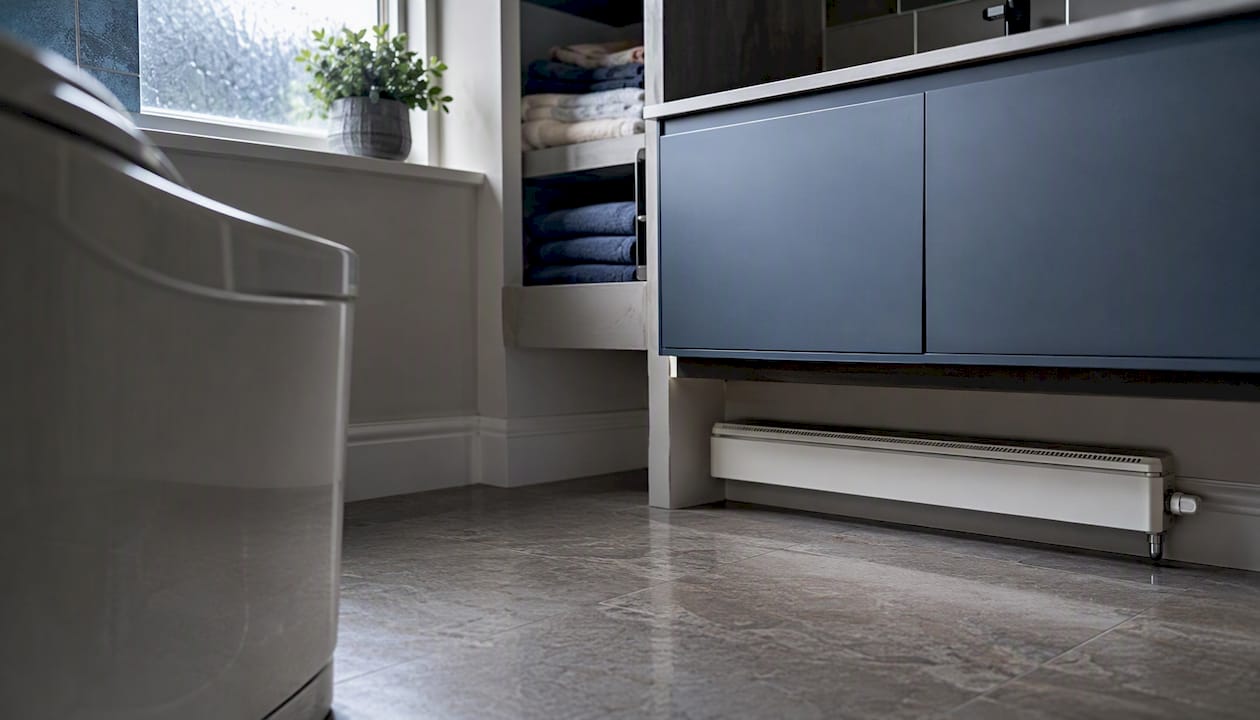
Kitchens present a different problem. Worktops, splashbacks and appliances often rule out anything but a low-level or plinth-mounted unit, and a slim radiator can be the only option if there’s no free wall at all above skirting height. Hallways and landings with dado rails or low windows benefit too, especially in period properties where original sill heights sit lower than modern building standards would allow.
A few placement patterns come up again and again:
- Horizontal low-profile units fitted directly under a shallow windowsill
- Slim vertical radiators for narrow gaps between doors or built-in furniture
- Floor-mounted low-level radiators running along a kitchen or utility wall at bench height
If a room has generous wall space and no obstructions, a wider or multi-panel radiator will usually heat it more efficiently for less money, so low profile isn’t always the default choice. It earns its place when height genuinely is the constraint, not the styling preference.
How do you size a low profile radiator correctly?
Work out your room’s heat loss in Watts first, then choose a radiator rated at or above that figure at your system’s actual working temperature. That’s the entire method in one sentence, and skipping it is the single most common reason people end up with a radiator that never quite warms the room.
Here’s the practical sequence:
- Measure the room and calculate heat loss using a BTU calculator, factoring in wall type, window area and insulation.
- Pick a radiator type. Type 11 is a single panel with a single set of fins (slim, lower output). Type 21 adds a second panel. Type 22 and Type 33 stack panels and fins for much higher output at greater depth.
- Read the Watts figure at ΔT50 on the manufacturer’s spec sheet, which is how TradeCalcs’ guidance recommends comparing radiators on a level footing.
- Apply a correction factor if your boiler or heat pump runs cooler than the ΔT50 test condition, and add roughly 25% extra allowance for bathrooms, per TradeCalcs.
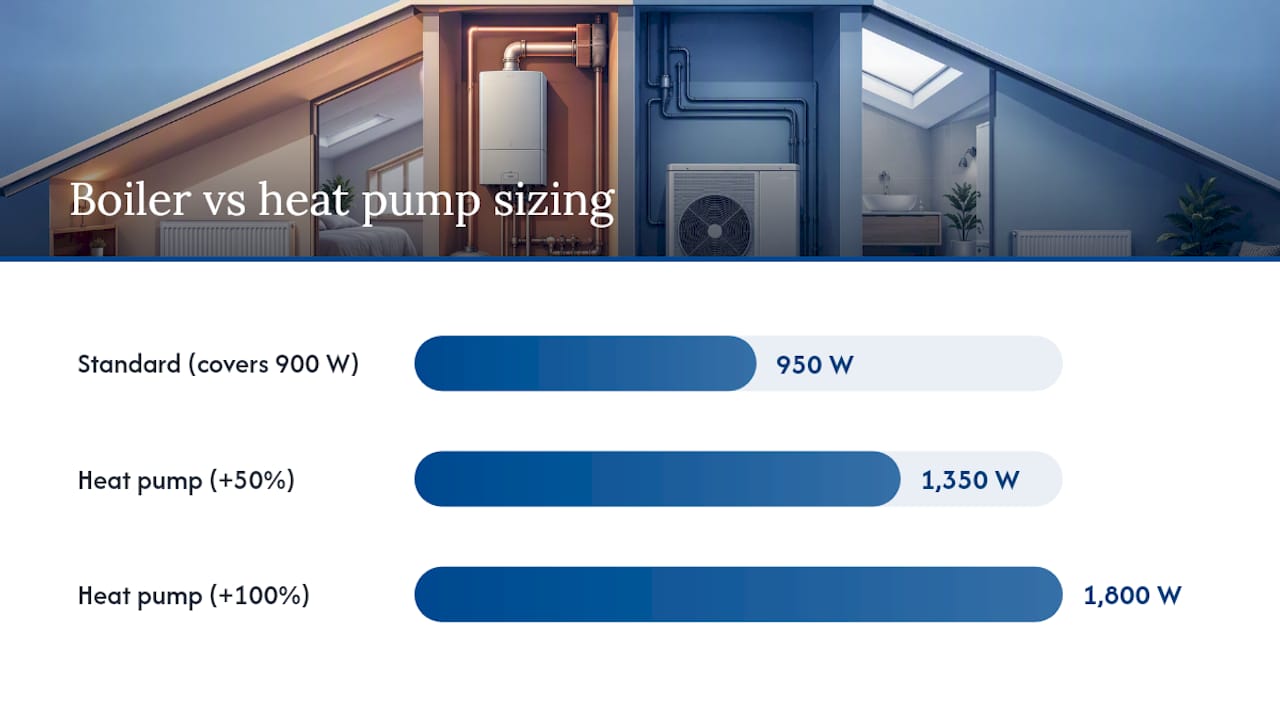
A worked example: say a small bathroom has a calculated heat loss of 900 Watts. A 500mm high, 1,200mm long Type 22 radiator rated at around 950 Watts at ΔT50 would cover that, assuming a standard 75/65/20°C system. Running the same room on a heat pump at 55/45°C flow and return changes that calculation considerably, which the next section covers in detail.
Enginist’s selection methodology recommends oversizing by 50 to 100% when a heat pump is involved, precisely because the output drop at lower flow temperatures is so steep.
Pro Tip: When a room sits between two radiator sizes, always round up. The cost difference between adjacent sizes is usually small, and an oversized radiator just runs at a lower temperature to hold the room steady, which is more efficient anyway.
Installation checklist: mounting, plumbing and bathroom rules
Wall-hung low-profile radiators need solid fixing points, and if you’re switching from a taller unit, the new bracket positions rarely line up with the old ones, so expect some redecorating around the wall. Floor-mounted or low-level units bring a different problem: finished floor height. Fitting one before flooring goes down is a common mistake, since carpet, tile or engineered wood can add anywhere from a few millimetres to over a centimetre, throwing off your clearance.
Pipe centres matter more with low profile models than tall ones, because there’s less vertical room to hide pipework behind the radiator. Check the valve and pipe centre spacing against your existing pipework before ordering, and confirm TRV (thermostatic radiator valve) compatibility if you’re keeping your current valves. Electric models sidestep plumbing altogether, but you’ll still need to match the element type (thermostatic, timed thermostatic, or standard) to how you want to control it.
Bathroom installations carry an extra layer of rules. Any electric radiator or heated towel rail within a bathroom’s zoned areas needs appropriate IP ratings, and areas with vulnerable users often require a low-surface-temperature (LST) element to prevent burns on contact. Our guide to radiator placement in bathrooms covers zoning in more depth.
Before your installer arrives, confirm:
- Finished floor height for any floor-mounted or low-level unit
- Pipe centres and valve compatibility with existing pipework
- IP rating and LST requirement for bathroom locations
- Whether the radiator needs bleeding and pressure-testing before final fitting
Pro Tip: Send your installer the radiator’s full spec sheet before the visit, not just the box photo. Pipe centres and valve type are the two details most likely to cause a delay on installation day.
Materials and finishes: what actually changes the output
Steel panel radiators dominate the low-profile market because they heat up quickly and hold a moderate amount of water, which suits homes with a standard combi boiler. Aluminium radiators heat up faster still and weigh less, useful where wall fixing points are limited, though they typically cost more per Watt of output. Cast iron rarely appears in low-profile ranges at all, since its bulk works against the whole point of a slim design.
Panel type has a bigger effect on output than material choice. As TradeCalcs’ type guide sets out, Type 11 gives the slimmest depth but the lowest output per metre, Type 21 sits in the middle, and Type 22 or Type 33 deliver considerably more heat from the same length, at the cost of extra depth off the wall. If you’re squeezed on height but have a little more room front to back, stepping up a panel type is often smarter than lengthening the radiator.
Finish choices run from matte powder-coated whites and greys through to anthracite and polished chrome towel rails. Design-led buyers increasingly treat radiators as a visible feature rather than something to hide, and manufacturers have responded with wider colour ranges while keeping declared outputs consistent with BS EN 442 testing. Powder-coated finishes generally carry longer warranties against corrosion than chrome-plated towel rails, which is worth checking if the radiator sits somewhere permanently damp.
- Steel: fast heat-up, moderate cost, widest range of low-profile options
- Aluminium: lighter, faster response, usually a higher price point
- Powder-coated finishes: better warranty coverage in damp rooms than polished chrome
Low profile radiators you can order from Simcodirect
Every model below has been selected for compact rooms: low enough to sit under a typical sill, rated with a clear Watts-at-ΔT50 figure, and suitable for correction if you’re running a lower-temperature system. Electric options are included for rooms with no wet heating run, and one dedicated towel radiator covers bathroom needs specifically.
The Dimplex Q-Rad RF Panel Radiator is a slim electric panel radiator with smart RF control, well suited to a small bedroom, home office, or any room without existing pipework. It’s plumbing-free, so installation is largely a case of mounting and wiring rather than involving a plumber.
The Consort Toweldry Towel Radiator is built specifically for bathrooms, combining a slim towel-rail profile with a heating element rather than needing a separate wet system. It’s the straightforward option if you want warm towels and background heat from a single unit without extra pipework.
For customers converting an existing wet radiator to electric, or replacing a faulty element, Simcodirect stocks four Heating Element variants: Thermostatic, Timed Thermostatic, Standard, and Low Surface Temperature. The Low Surface Temperature element is worth flagging for bathrooms or any household with young children or vulnerable users, since it limits the element’s surface heat to reduce burn risk.
Exact height, depth and wattage figures for each unit are confirmed on the individual product pages, since Dimplex and Consort periodically update dimensions across their ranges. Check the listed spec sheet before ordering if your clearance is tight to the millimetre.
Budget-wise, expect small low-height panel radiators to start around £100, rising toward £250 and beyond for designer finishes or dual-fuel towel rails. Electric elements typically add a modest amount to a standard radiator’s cost but remove the need for plumbing labour entirely.
- Check pipe centres against your existing valves before ordering a wet radiator
- Confirm whether your bathroom location needs a Low Surface Temperature element
- Ask about current lead times, since electric models with RF controls can carry longer dispatch windows than standard steel panels
Why does system temperature change what radiator you need?
Every radiator’s headline Watts figure is tested at ΔT50 under EN 442, a fixed 50°C average temperature difference between the radiator and the room. Run your system cooler than that test condition, which is exactly what happens with a heat pump or a well-tuned condensing boiler, and the real-world output drops. CIBSE’s domestic heating design guidance puts the reduction at around 40 to 50% when moving from a 75/65°C system down to 45 to 55°C flow and return temperatures.
That drop isn’t a straight-line relationship, either. Because the correction follows a radiator exponent (n is roughly 1.3 for panel radiators), halving the ΔT does considerably more than halve the output. Halving your flow temperature can cut delivered heat by well over half, which is why simply moving to a heat pump on the same radiators often leaves rooms noticeably cooler.
To correct for this in practice:
- Note the radiator’s rated Watts at ΔT50 from the spec sheet.
- Calculate your system’s actual ΔT (average radiator temperature minus room temperature).
- Apply the manufacturer’s or an online tool’s correction factor for that ΔT, rather than estimating.
Say a radiator rated at 1,000 Watts at ΔT50 (75/65/20°C) is fitted to a heat pump system running 45/35°C flow and return. The corrected output could fall to somewhere in the region of 500 to 600 Watts, depending on the exact exponent used, which is why Enginist recommends oversizing heat pump radiators by 50 to 100% at the design stage. NCM-PCDB’s definition of a low-temperature system, flow not exceeding 45°C on the coldest design day, makes this correction a formal requirement for compliant installations, not just good practice.
Pro Tip: Ask your installer to commission the system properly for low-temperature operation, not just fit the radiators and walk away. Correct commissioning is what actually delivers the promised output at the lower flow temperature.
Retailer perspective: quick guidance from the seller
For most compact rooms, I’d point buyers toward a Type 21 or Type 22 low-profile panel radiator over anything slimmer. It gives you room to correct for a heat pump later without swapping the unit entirely. Check the warranty terms and returns window before ordering, and if you’re unsure about pipe centres or valve compatibility, our customer service team can talk you through the spec sheet before you commit.
Order your low profile radiator with confidence
Ordering is straightforward: pick your model, check the spec sheet against your calculated heat loss, and place the order online. Most in-stock radiators and electric elements dispatch within a few working days, though RF-controlled models like the Dimplex Q-Rad can occasionally carry a slightly longer lead time during high-demand periods, so it’s worth checking current availability on the product page before you commit to a fitting date.
If you’re converting an existing wet radiator to electric, browse the full Heating Element range, including the Thermostatic, Timed Thermostatic, Standard, and Low Surface Temperature variants, and match the element to your room’s control needs. For bathrooms specifically, the Consort Toweldry Towel Radiator covers both towel warming and background heat in one purchase, while the Dimplex Q-Rad RF Panel Radiator suits any plumbing-free room needing smart control.
Every order comes with a 30-day returns policy and manufacturer warranty cover, so if a measurement turns out wrong once the radiator arrives, you’re not stuck with it. If you’d rather talk through sizing or pipe centres before ordering, our customer service team is on hand to check the spec against your room.
Sources
- CIBSE domestic heating design guide 2026
- Radiator BTU Calculator UK 2025 | Room Heat Loss | Heating Size Guide | TradeCalcs
- Radiator selection calculator | Enginist
- Building energy performance assessment - low-temperature domestic heating systems