


Role of bathroom extractor fans: UK homeowner's guide
A bathroom extractor fan is a mechanical ventilation device designed to remove moisture-laden air from wet rooms and vent it directly outside. The role of bathroom extractor fans is to prevent condensation, mould growth, and structural damage by replacing humid air with drier air from the rest of the property. Without proper extraction, a single shower can raise relative humidity to levels that cause lasting harm to plaster, grout, and timber. UK Building Regulations, specifically Approved Document F, set minimum airflow standards that every bathroom must meet. Understanding these rules protects your home and keeps it compliant.
What are the regulatory requirements for bathroom extractor fans in the UK?
UK Building Regulations set clear, enforceable standards for bathroom ventilation. Approved Document F requires a minimum extraction rate of 15 litres per second for intermittent fans, or 8 litres per second for continuous operation with a boost function. That distinction matters because a fan running only during a shower needs more power to clear moisture quickly, while a fan running constantly can work at a lower rate.
Every intermittent fan must include an overrun timer set to run for at least 15 minutes after the bathroom is vacated. This ensures residual steam clears fully rather than settling on cold surfaces. Fans must also duct extracted air directly to the outside. Venting into roof voids causes condensation and timber rot in loft spaces, and building inspectors require external termination without exception.
Electrical compliance falls under BS 7671 and Approved Document P. Fans installed near baths or showers must carry the correct IP rating for their zone, and circuits require RCD protection. Non-compliance creates problems at property inspections and can invalidate home insurance. For a thorough overview of what compliance involves, the washroom ventilation requirements guide from Simcodirect covers the key standards in plain language.
| Requirement | Standard |
|---|---|
| Intermittent extraction rate | 15 L/s minimum |
| Continuous extraction rate | 8 L/s with boost |
| Overrun timer minimum | 15 minutes |
| Ducting termination | External only |
| Electrical standard | BS 7671, Approved Document P |
Pro Tip: If you are selling or letting a property, ask your electrician to provide a Minor Electrical Installation Works Certificate for any fan installation. It confirms compliance and removes doubt during conveyancing.
How do bathroom extractor fans work to reduce humidity?
A bathroom fan draws moist air through a grille, pushes it along a duct, and expels it outside through an external wall or roof terminal. As that humid air leaves, drier air from the rest of the property enters through gaps under doors or trickle vents in windows. Without this make-up air, the fan motor runs but extraction fails. Condensation then forms on mirrors and tiles despite the fan being switched on.
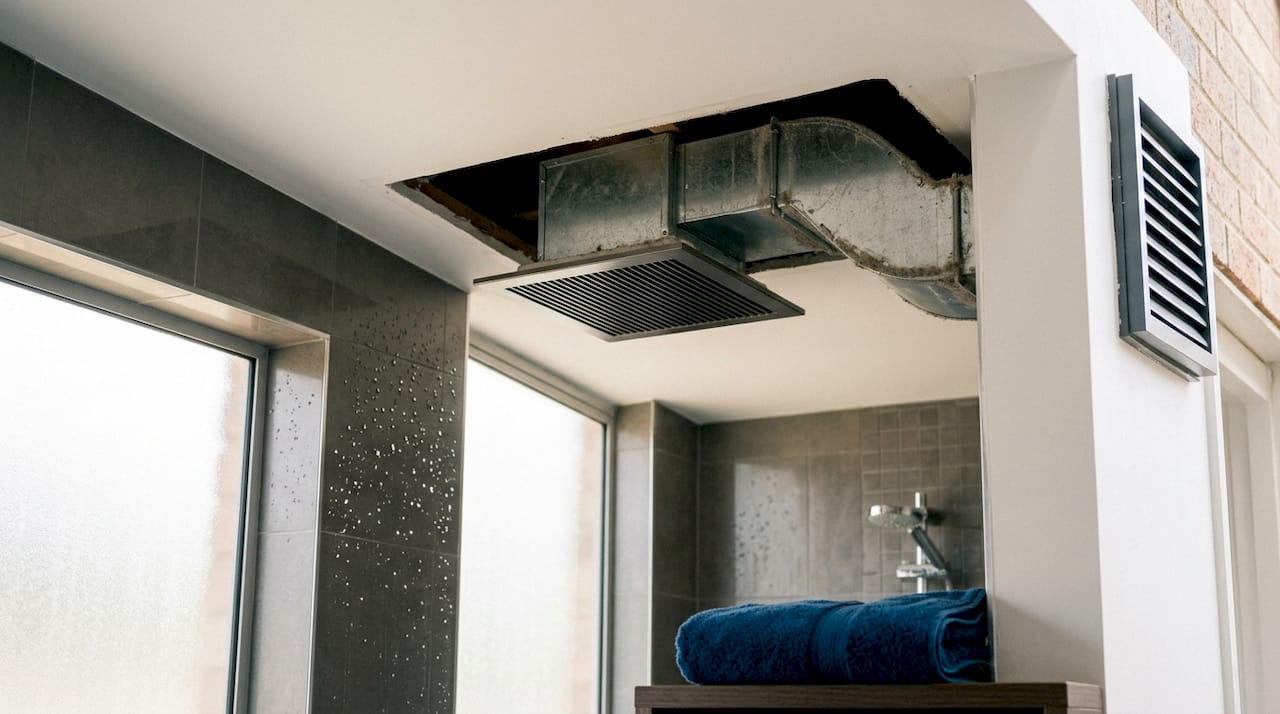
Placement is the factor most homeowners underestimate. Fan placement near the steam source is more important than simply fitting a fan in a convenient location. A fan positioned directly above or adjacent to the shower enclosure captures moisture before it spreads across the room. A fan mounted on the opposite wall from the shower is far less effective.
Controls determine how reliably the fan performs in practice:
- Timer controls run the fan for a set period after the light is switched off, covering the overrun requirement.
- Humidistat controls detect relative humidity and activate the fan automatically, regardless of whether the occupant remembers to switch it on.
- PIR sensors trigger the fan when someone enters the room, useful in shared or rental properties.
- Pull cord switches provide manual control independent of the lighting circuit.
Anti-mould paints address surface symptoms only. Correcting moisture at source through proper ventilation is the only lasting solution. Paint cannot stop condensation forming behind tiles or inside wall cavities.
Pro Tip: Check for make-up air by holding a tissue near the bottom of the bathroom door while the fan runs. If the tissue does not move toward the gap, the room is too sealed for the fan to extract effectively.
What installation and maintenance practices keep extractor fans effective?
Correct installation determines whether a fan performs to its rated specification or falls short from day one. The single most common failure is poor duct design. Long ducts, multiple bends, and flexible hose can reduce actual airflow by 30% or more compared to the fan’s nominal rating. A fan specified at 15 L/s may deliver only 10 L/s if the duct run is poorly planned.
- Plan the duct route first. Keep runs short and straight. Use rigid ducting where possible and limit bends to two or fewer.
- Fit a backdraught shutter. Fans without backdraught shutters allow outside air to flow back in when the fan is off, increasing condensation risk and wasting heat.
- Verify electrical zoning. Confirm the fan’s IP rating matches its distance from the bath or shower. Zone 1 requires IP45 minimum; Zone 2 requires IP44 minimum.
- Commission the installation. Airflow measurement after installation confirms the fan delivers the required extraction rate. Without this check, you cannot know whether the duct design has compromised performance.
- Clean the fan regularly. Dust and grime on grilles and blades reduce airflow quietly over months. By the time a fan sounds laboured, extraction capacity may already be severely reduced.
- Replace ageing fans proactively. A fan that runs noisily or intermittently is already failing. Waiting for complete failure allows mould to return before a replacement is fitted.
Regular maintenance is not optional upkeep. A clogged fan grille can cut airflow by a third, turning a compliant installation into an ineffective one within a single year. Cleaning takes minutes; remedying the mould that follows neglect takes considerably longer and costs considerably more.
For homeowners planning a broader bathroom update, the UK bathroom renovation guide from Simcodirect covers ventilation alongside other key considerations.
What types of bathroom extractor fans should you consider?
Choosing the right fan type depends on bathroom size, usage pattern, duct length, and budget. The different fan types each suit different situations, and selecting the wrong category is a common and costly mistake.
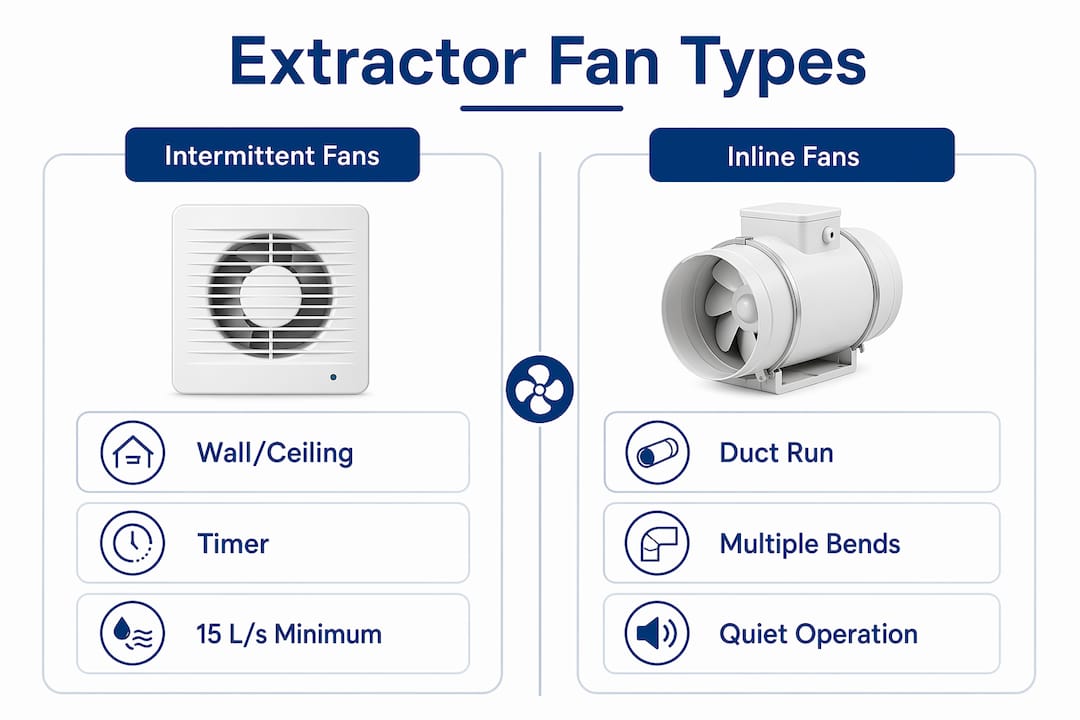
Intermittent axial fans are the most common choice for standard bathrooms. They mount directly on the wall or ceiling, connect to a short duct run, and switch on with the light or a pull cord. They suit bathrooms used occasionally and with straightforward duct access.
Inline fans sit within the duct run rather than at the extraction point. They handle longer duct runs and multiple bends more effectively than axial fans, and they are quieter at the grille because the motor sits away from the room.
Continuous mechanical extract ventilation (dMEV) runs at a low background rate at all times, boosting when humidity rises. Humidistat-controlled fans automatically adjust runtime based on actual humidity, providing more dependable ventilation than timer-based units. This type suits rental properties and households where occupants are unlikely to manage fan controls consistently.
Key selection criteria:
- Noise level: Fan power ranges from 5 to 30 watts, and noisy fans often get disabled by occupants, which defeats the purpose entirely. Aim for models rated below 35 dB(A) for bedrooms adjacent to bathrooms.
- IP rating: Match the rating to the installation zone. Never fit a standard domestic fan in Zone 1.
- Duct diameter: Match the fan outlet to the duct size. Reducers add resistance and reduce airflow.
- Cost: Installed costs run from £100–£400 for standard intermittent fans and £400–£900 for continuous or heat-recovery units.
For broader context on how ventilation fits into a healthy home, the homeowner’s ventilation guide from KC Air Control provides useful background on whole-house air quality strategies.
Key takeaways
A bathroom extractor fan is the single most effective tool for preventing condensation, mould, and structural moisture damage in UK homes.
| Point | Details |
|---|---|
| Regulatory minimum rates | Intermittent fans must achieve 15 L/s; continuous fans require 8 L/s with boost. |
| Overrun timer requirement | Set the timer to run for at least 15 minutes after the bathroom is vacated. |
| Duct directly outside | Venting into roof voids causes timber rot and fails building inspection. |
| Make-up air is critical | Gaps under doors or trickle vents must allow replacement air to enter the room. |
| Humidistat fans outperform timers | Automatic humidity control removes reliance on occupant behaviour. |
Why I always recommend specifying up, not down
The most common mistake I see homeowners and property managers make is choosing the cheapest fan that technically meets the minimum specification. A fan rated at exactly 15 L/s, fitted at the end of a long flexible duct run with three bends, will almost certainly deliver less than the legal minimum in practice. You have spent money on a compliant product that performs below compliance.
My advice is always to specify one size up. If the calculation says 15 L/s, buy a fan rated at 20 L/s. The duct losses will bring it back to where it needs to be, and you have a margin for the inevitable dust build-up over the years. The cost difference between a 15 L/s and a 20 L/s fan is usually under £30. The cost of treating mould, repainting, and regrouting is rarely under £300.
Humidistat fans are the other upgrade I push consistently. In rental properties especially, you cannot rely on tenants to switch fans on and off correctly. A humidistat fan removes that variable entirely. It runs when the room needs it and stops when it does not. For property managers dealing with damp complaints, fitting humidistat fans is the most cost-effective preventive measure available.
Finally, commission every installation. Measure the airflow after fitting. It takes 20 minutes and costs very little. It is the only way to know whether the installation actually works.
— Carl
Bathroom heating and ventilation from Simcodirect
A well-specified extractor fan controls moisture at the source. Pairing it with effective bathroom heating keeps surfaces warmer, which reduces condensation further and dries the room faster after use.
Simcodirect stocks a range of bathroom heating solutions that complement proper ventilation. The Consort Toweldry towel radiator keeps towels dry and raises ambient temperature, reducing the cold surfaces that attract condensation. For bathrooms needing flexible dual-fuel heating, the Platinum Chrome Dual Fuel Curved Towel Radiator works on the central heating circuit or independently via an electric element. Simcodirect offers fast delivery, a 30-day returns policy, and a product range selected for quality and compliance. Browse the full collection at simcodirect.co.uk.
FAQ
What extraction rate does a bathroom fan need in the UK?
Under 2026 UK Building Regulations (Approved Document F), an intermittent bathroom fan must achieve at least 15 L/s. A continuously running fan requires a minimum of 8 L/s with a boost function.
Do bathroom fans actually reduce humidity?
Yes, provided the installation is correct. A fan extracts moist air and replaces it with drier air, directly lowering relative humidity. Performance depends on correct airflow rate, duct design, and make-up air access.
Can I vent a bathroom fan into the loft?
No. Venting into a roof void causes condensation and timber rot, and it fails building inspection. Extracted air must terminate directly outside through an external wall or roof terminal.
How often should I clean my bathroom extractor fan?
Clean the grille and blades at least every six months. Dust build-up reduces airflow quietly over time and can cut extraction capacity significantly before any visible sign of failure appears.
What is a humidistat fan and is it worth fitting?
A humidistat fan detects relative humidity and activates automatically, running at a low background rate and boosting when moisture rises. It is particularly worth fitting in rental properties or any bathroom where occupants are unlikely to manage manual controls reliably.