


Radiator placement in bathrooms: your practical guide
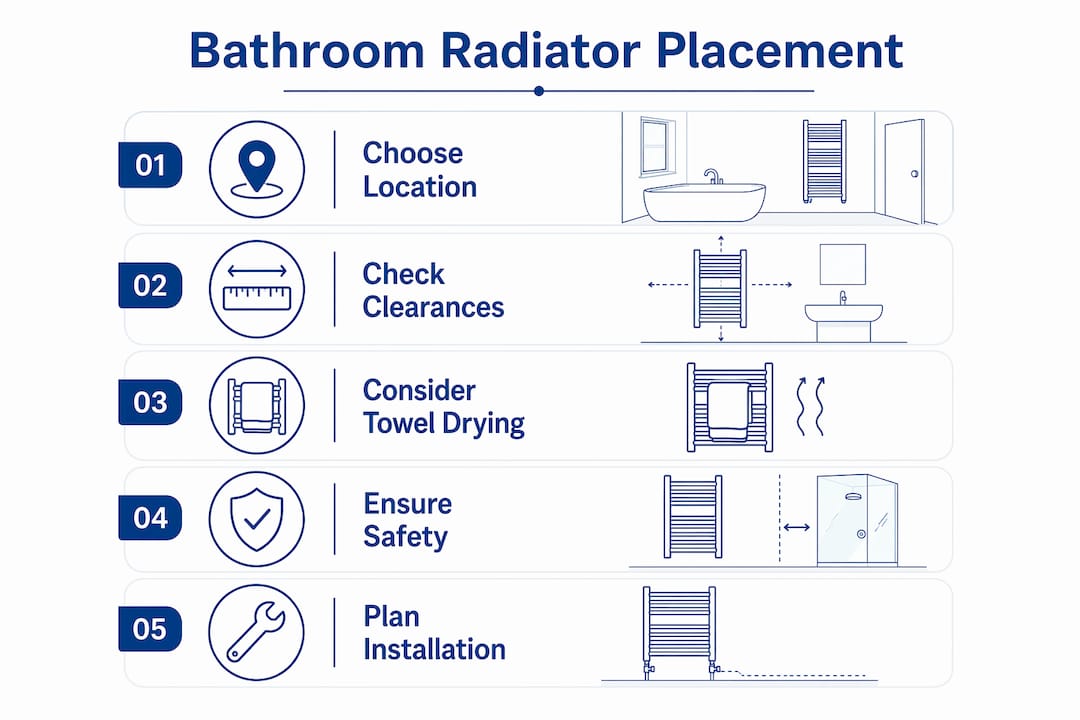
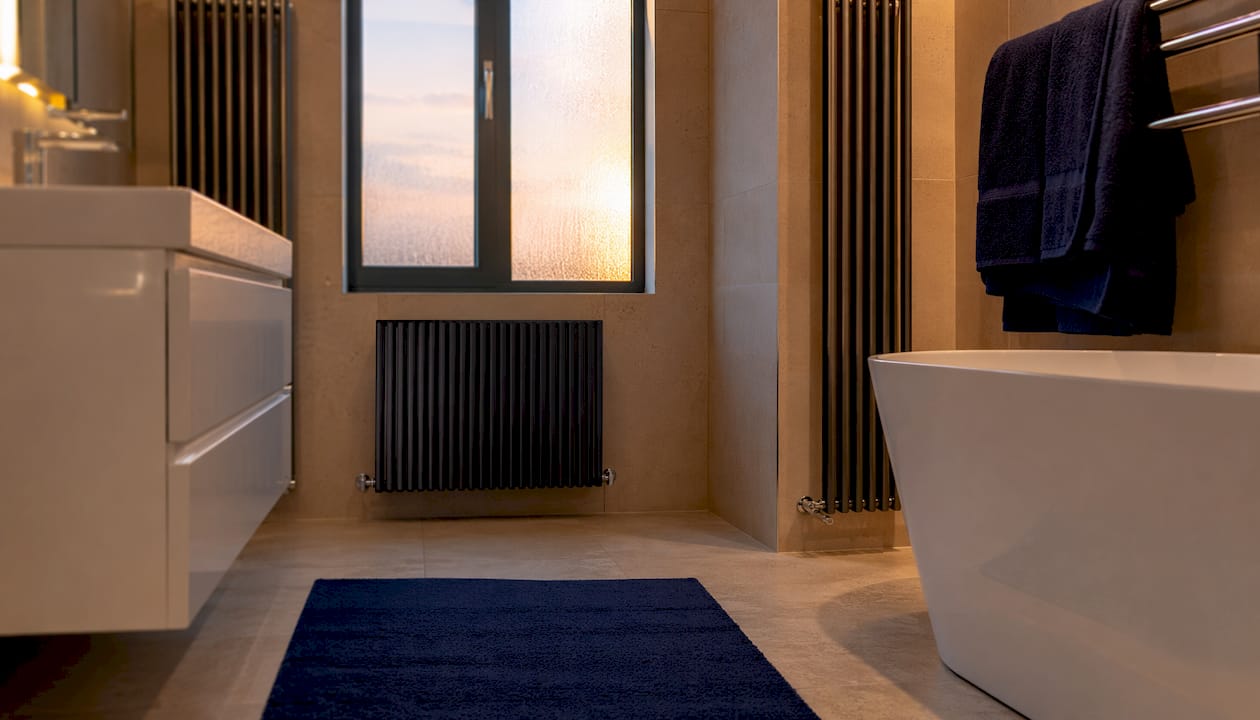
Put the radiator where the room loses the most heat. In most bathrooms, that means an external wall, and ideally directly beneath the window. The warm air rising off the radiator creates a curtain that offsets cold glass and stops draughts tracking across the floor. Approved Document L on conservation of fuel and power supports under-window positioning as an effective way to counter cold-glass heat loss and improve air circulation.
Quick do/avoid rules before you go further:
- Place the radiator on an external wall wherever the layout allows
- Keep it clear of curtains, tall furniture, and anything that traps heat against the wall
- Plumbed radiators must sit at least 20 cm from showers or washbasins; electric heaters need a minimum of 60 cm
- Never position a radiator directly behind a door — it blocks airflow and the heat goes nowhere useful
- Pair correct placement with working mechanical ventilation to prevent condensation
Simcodirect stocks a full range of bathroom heating options, from electric towel rails to dual-fuel panel heaters, and the product pages carry the IP ratings and dimensions you need to confirm compatibility before buying.
Table of Contents
- Why radiator position affects heating, condensation and towel drying
- The best locations for a bathroom radiator
- Common radiator placement mistakes to avoid
- Mounting heights and clearances: what to check before installation
- Which radiator types work best in bathrooms?
- UK safety and regulatory requirements every homeowner must check
- Practical installation and cost considerations
- How Simcodirect supports homeowners choosing bathroom heating
- Key takeaways
- The placement decision most homeowners get wrong
- Simcodirect bathroom heating: products worth looking at
- Useful sources and further reading
Why radiator position affects heating, condensation and towel drying
The role of radiator placement in a bathroom goes well beyond comfort. A radiator in the wrong spot creates cold surfaces elsewhere in the room, and cold surfaces are where condensation forms. That moisture, left unchecked, leads to mould. GOV.UK guidance on damp and mould links inadequate heating and poor ventilation directly to increased health risks from mould growth, and recommends routine checks of ventilation systems alongside heating.
Key insight: The most effective defence against bathroom condensation is correct radiator placement combined with reliable mechanical ventilation — neither alone is sufficient.
Heat distribution matters too. A radiator tucked into a corner heats that corner well and leaves the rest of the room cold. One positioned to push warm air across the floor and up the walls gives you even, usable heat. For towel drying specifically, a heated towel rail mounted where you actually hang towels after a shower does the job; one hidden behind a door does not. Stelrad’s guidance notes that obstructed thermostatic valves also cause premature shut-off, meaning the room never reaches the set temperature and energy is wasted.
The best locations for a bathroom radiator
Not every bathroom offers a choice of positions, but when you do have options, some are clearly better than others.
| Location | Pros | Cons |
|---|---|---|
| External wall, under window | Counters cold-glass heat loss; best air circulation | May conflict with window sill depth or pipework run |
| Opposite the door | Warm air greets you on entry; good circulation | Often an internal wall; less effective against cold spots |
| Beside the basin (with clearances) | Convenient for hand-drying; keeps wet zone warm | Must respect 20 cm (plumbed) or 60 cm (electric) minimum distance |
| Vertical on a narrow wall | Space-efficient; frees floor area | Lower heat output per unit height than wide panel radiators |
| Near the doorway | Creates a warm barrier; reduces draughts | Risk of blocking door swing; check door type before fixing |
The external wall under the window remains the first choice for most UK bathrooms. When that position is genuinely impossible — perhaps because the window sits above a bath — the wall opposite the door is the next best option for even heat distribution.
Pro Tip: If you are renovating, consider moving the pipework to reach the optimal position rather than accepting wherever the pipes already run. Industry guidance consistently shows that the extra cost of repositioning pipework pays back in comfort, better room layout, and lower long-term energy use. Agree the radiator location before tiling, not after.
For tight bathrooms where wall space is genuinely scarce, a vertical radiator on a narrow section of wall or a small bathroom modernisation approach that rethinks the whole layout can free up the right spot.
Common radiator placement mistakes to avoid
-
Hiding it behind the door. A radiator behind an open door heats the door, not the room. The door also blocks airflow, so the thermostatic valve reads a false temperature and cuts out early. This is one of the most common installation pitfalls in small bathrooms.
-
Blocking it with tall furniture or a laundry basket. Any object within 15–20 cm of the radiator face traps heat and creates a cold zone on the other side of the room.
-
Draping curtains over it. Long curtains that fall in front of a radiator push heat straight into the window reveal and out through the glass. If the window sill is too low to clear the radiator, fit a sill extender or choose a lower-profile model.
-
Placing it too high on the wall. Heat rises naturally, so a radiator mounted high warms the ceiling first. The occupied zone — where you are actually standing or bathing — stays cold. Standard mounting height keeps the radiator low enough to heat the room from the floor up.
-
Positioning an electric heater inside a restricted bathroom zone. UK electrical regulations define zones around baths and showers with strict rules on what equipment may be installed. An electric heater placed inside Zone 1 or Zone 2 without the correct IP rating is a safety hazard and a building regulations failure.
-
Clustering two radiators in one corner. Two radiators side by side heat one area excessively while the rest of the room stays cold. Spread heat sources to cover the room’s full footprint.
-
Locating a plumbed radiator directly behind a toilet or shower tray. Splash and debris accelerate corrosion on the back of the radiator and on the pipework. A simple repositioning, or switching to a vertical model on an adjacent wall, solves the problem.
Mounting heights and clearances: what to check before installation
Getting the measurements right before drilling saves expensive remedial work. These are the figures to confirm on site.
| Measurement | Guidance |
|---|---|
| Floor clearance (panel radiator) | Minimum ~10 cm to allow airflow and avoid dust build-up |
| Distance from shower or washbasin (plumbed) | At least 20 cm |
| Distance from shower or washbasin (electric) | At least 60 cm |
| Window sill clearance | Radiator top should sit below the sill, or sill extended to clear |
| Valve access | Minimum 5 cm clear space around thermostatic valve head |
Termaheat’s installation guidance specifies the 10 cm floor clearance as a minimum for airflow and dust management, and confirms the 20 cm and 60 cm water-point distances for plumbed and electric units respectively.
Before the installer arrives, check these on site:
- Wall construction: solid brick or blockwork holds fixings well; stud walls need noggins or a spreader plate for heavier radiators
- Pipe run flexibility: can the pipework reach the preferred position without chasing through structural elements?
- Valve position: thermostatic valves must sit in free air, not behind a panel or inside a cabinet
- Window sill depth: measure the projection before ordering a radiator with a deep body
- Electrical supply route: for electric or dual-fuel models, confirm the cable route and whether a fused spur is already in place
Which radiator types work best in bathrooms?
The right choice depends on whether the radiator is the room’s primary heat source or a secondary one, and on what your pipework and wiring allow.
Heated towel rails are the most popular bathroom choice in the UK, and for good reason. They dry towels efficiently, look good in a range of finishes, and take up relatively little wall space. Their heat output is generally lower than a panel radiator of similar size, so in a larger or poorly insulated bathroom they may not be sufficient as the sole heat source. Simcodirect’s towel rail selection guide covers sizing, wiring options and mounting considerations in detail.
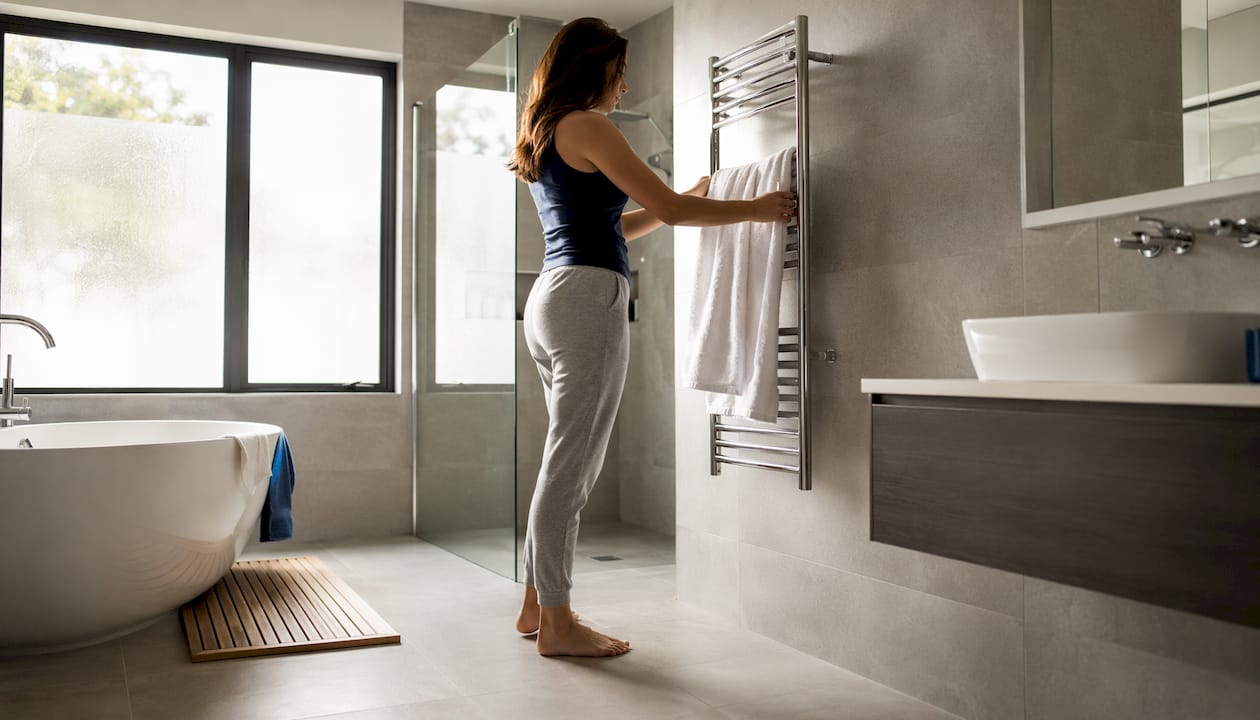
Panel radiators deliver stronger room heating for their footprint. If your bathroom is above average in size, has a high ceiling, or loses heat quickly through an older external wall, a panel radiator will heat the space faster and more evenly than a towel rail alone. The trade-off is that they offer no drying function.
Electric towel rails are the practical answer when central heating pipework does not reach the bathroom, or when you want independent control outside the heating season. The Dimplex BR Electric Towel Radiator is a well-regarded example: check the IP rating on the product page to confirm it suits your bathroom zone before ordering.
Dual-fuel towel rails run from the central heating circuit in winter and switch to an electric element in summer. The Platinum Chrome Dual Fuel Curved Towel Radiator is a good illustration of this format: one product, two operating modes, no compromise on drying performance year-round.
Vertical radiators solve the narrow-wall problem. Where a standard horizontal panel would not fit, a tall vertical model delivers comparable output in a fraction of the width. For a designer radiator that doubles as a visual feature, vertical formats are worth considering.
For bathrooms where neither pipework nor wiring is practical, infrared heating is a separate option worth investigating — Simcodirect’s infrared bathroom heater guide explains how these work and where they fit.
UK safety and regulatory requirements every homeowner must check
Bathrooms are classified locations under UK wiring regulations, and the rules are not optional.
Bathroom electrical zones: Zone 0 is inside the bath or shower itself. Zone 1 covers the area directly above the bath or shower tray up to 2.25 m. Zone 2 extends 60 cm horizontally beyond the bath or shower and up to 2.25 m high. Electric heaters must carry an IP rating appropriate to the zone in which they are installed — and in most cases, electric heaters belong outside Zone 2 entirely.
Any electric towel rail or panel heater must be installed by a qualified electrician who can certify the work under Part P of the Building Regulations. For central heating changes — moving pipework, adding a new radiator to the circuit — use a Gas Safe registered engineer or a competent heating engineer. These are not suggestions; they are legal requirements in England and Wales.
Simcodirect’s bathroom heating zones guide explains the zone boundaries clearly and is worth reading before you buy any electric product.
Pro Tip: Condensation management is as much a safety issue as an electrical one. GOV.UK guidance makes clear that mould from persistent damp poses genuine health risks. A correctly positioned radiator reduces cold surfaces, but it must work alongside a functioning extractor fan — not instead of one.
Practical installation and cost considerations
Moving a radiator to the right position costs more than fitting it where the pipes already are. Whether that cost is worth it depends on how long you plan to stay and how much the current position compromises the room.
Factors that raise the cost:
- Chasing walls to reroute central heating pipework
- Upgrading or adding isolation valves
- Adding a new electrical spur for an electric or dual-fuel model
- Reinforcing a stud wall to carry a heavier radiator
- Replastering or retiling after pipe work is concealed
Ways to reduce disruption:
- Agree the radiator position before any tiling begins — repositioning after tiling is expensive
- Use a temporary electric heater during the works rather than rushing the permanent installation
- Ask the installer to run pipework in the floor void where possible to avoid wall chasing
Questions to ask your installer before work starts:
- Can you reach the preferred wall position without chasing through a structural element?
- What is the total cost including materials, labour and any electrical certification?
- Will you provide a Building Regulations completion certificate for electrical work?
- How long will the bathroom be out of use?
- What guarantee do you offer on the installation, separate from the product warranty?
Industry guidance is consistent on one point: moving pipework during a renovation is almost always worth the extra cost when it puts the radiator in the right place. Doing it after the room is finished costs significantly more.
How Simcodirect supports homeowners choosing bathroom heating
Simcodirect carries the product families most relevant to bathroom heating in the UK, with full technical specifications available on each product page.
- Electric towel radiators: the Dimplex BR range includes IP ratings and wiring notes so you can confirm zone compatibility before purchase
- Dual-fuel towel rails: the Platinum Chrome Curved model runs from central heating or an electric element, with dimensions listed for easy clearance checks
- Straight towel radiators: the Titan Chrome Straight Towel Radiator suits straightforward wall positions with clear mounting specifications
- Electric curved options: the Platinum Chrome Electric Curved Towel Radiator offers a stylish finish with the IP rating detail needed for zone compliance
Every order comes with a 30-day returns policy and fast UK delivery. The Simcodirect blog carries detailed guides on bathroom heating zones, designer radiator sizing and towel rail selection — practical reading before you finalise your layout or speak to an installer.
Key takeaways
Correct radiator placement in a bathroom is the single most effective way to balance heating efficiency, damp prevention, and towel drying in one decision.
| Point | Details |
|---|---|
| External wall is the priority | Place the radiator on an external wall, under the window where possible, to create a warm-air curtain against cold glass. |
| Respect safety clearances | Plumbed radiators need at least 20 cm from water points; electric heaters need at least 60 cm. |
| Keep valves in free air | Thermostatic valves blocked by furniture or panels read false temperatures and waste energy. |
| Match the radiator type to the role | Towel rails dry towels and add secondary heat; panel radiators heat the room faster — choose based on your bathroom’s size and insulation. |
| Simcodirect for product and guidance | Simcodirect stocks electric, dual-fuel and straight towel radiators with IP ratings and dimensions confirmed on each product page. |
The placement decision most homeowners get wrong
The most common error I see is not a dramatic one. It is simply accepting wherever the pipes happen to be. A plumber fits the radiator on the internal wall because that is where the pipework runs, and the homeowner never questions it. The result is a room that is warm in one corner, cold everywhere else, and perpetually damp on the external wall opposite.
The second error is treating the heated towel rail as the room’s primary heat source when the bathroom is too large for it to cope. A towel rail is excellent at what it does — keeping towels dry and adding a modest background warmth. Ask it to heat a 6 m² bathroom with a single-glazed window in January and it will struggle. The fix is either a larger output towel rail or a separate panel heater, positioned correctly, to carry the primary heating load.
What I find most useful to tell customers is this: decide where the radiator should go first, then ask the installer how to get the pipework there. That reversal of the usual conversation changes the outcome significantly.
Simcodirect bathroom heating: products worth looking at
If you are ready to choose a radiator or towel rail for your bathroom, Simcodirect’s product range covers the main formats UK homeowners need. The Dimplex BR Electric Towel Radiator is a strong starting point for bathrooms where central heating pipework is not available — the product page lists the IP rating, wattage and dimensions you need to confirm zone compatibility with your electrician.

For homes where the central heating runs in winter but you want drying capability year-round, the dual-fuel curved towel radiator gives you both without compromise. All products come with a 30-day returns policy and UK delivery. If you are unsure which model suits your bathroom zone or wall position, the Simcodirect customer support team can help you check specifications before you order. Browse the full bathroom heating range at simcodirect.co.uk or go directly to the product pages to compare IP ratings and dimensions for your specific layout.
Useful sources and further reading
Regulation and safety:
- Approved Document L: Conservation of Fuel and Power — official building guidance on energy efficiency and heating placement
- GOV.UK: Understanding and addressing the health risks of damp and mould — health risks from condensation and ventilation responsibilities
Practical placement advice:
- Homebuilding: Installing a radiator — what type and where? — trade-offs on pipework repositioning and location choices
- Termaheat: Where to install the radiator in the bathroom — clearance measurements and floor-height guidance
- Stelrad: Where should I install my radiator for the best heat distribution? — thermostatic valve positioning and obstruction avoidance
Product and specification pages (Simcodirect):
- Bathroom heating zones explained: the UK homeowner’s guide — zone boundaries and IP rating requirements
- Choosing designer radiators for bathrooms: 2026 guide — sizing, finishes and placement considerations
- Choosing towel rails for UK bathrooms — wiring, mounting and selection guidance
- Dimplex BR Electric Towel Radiator product page — IP ratings, wattage and dimensions