


60–65% Humidity Breaks 'No Drain' Self Evaporative ACs in UK Homes
Yes, self-evaporative portable ACs eliminate manual draining in normal room conditions, because they route condensate over the hot condenser coils and vent the moisture out through the exhaust hose. The exception is heavy humidity or dehumidifier mode, during which the tank can still fill and trigger a shutdown light. Watch for that tank-full indicator, size the unit correctly using SACC or BTU guidance, and check the “when to drain” section below before you assume yours is exempt.
TL;DR:
- Fully evaporative units are less likely to require manual draining unless the room humidity exceeds 60 to 65 percent or during dehumidifier mode.
- Proper installation of the exhaust hose and sealing the window kit are essential to maintain evaporation efficiency and prevent increased tank filling.
- Dual-hose models draw outdoor condenser air, offering better evaporation and cooling in larger or more humid rooms compared to single-hose units.
- In high humidity conditions, especially above 60 percent, users should monitor the tank-full indicator and use continuous drainage if necessary.
- Correct sizing with appropriate BTU or SACC ratings and focusing on installation quality greatly extend the effectiveness and maintenance interval of self-evaporative ACs.
Table of Contents
- What “self-evaporative” actually means inside the unit
- What you gain, and where the convenience runs out
- When you’ll still need to attach a drain
- How to size and specify a self-evaporative unit without brand comparisons
- Getting the exhaust venting right
- Keeping the evaporation cycle working long term
- Where to get reliable guidance and the right unit
- What the research actually tells us about “no-drain” claims
- Buying a self-evaporative unit through Simcodirect
- Sources
What “self-evaporative” actually means inside the unit
A portable air conditioner cools by pulling warm room air across a refrigerant-filled evaporator coil, which drops the temperature and pulls moisture out of the air as condensation. That water has to go somewhere. In older or more basic units, it drips into an internal tank you empty by hand. Self-evaporative models take a different route entirely.
Most self-evaporating designs use a slinger fan (sometimes described as a splash wheel) that flings the collected condensate onto the hot condenser coil as the unit runs. The water hits the heat, turns to vapour, and rides out through the exhaust hose along with the warm exhaust air, reducing the need to empty a tank during normal use.
Not every unit does this to the same degree, though. Manufacturers describe designs as either fully or partially evaporative:
- Fully evaporative units aim to evaporate essentially all the condensate during normal cooling, so the tank stays dry unless conditions turn extreme.
- Partially evaporative units evaporate most of the water but still route some to a small tank as backup, meaning you will empty it occasionally even in mild weather.
Knowing which type you own changes how often you’ll need to empty or attach a drain, so it’s worth checking the manual rather than assuming every self-evaporative badge means identical behaviour.
What you gain, and where the convenience runs out
The obvious win is fewer interruptions. You’re not draining a tank every few hours during a heatwave, and the unit can run overnight or while you’re at work without flooding a tray. Portability improves too, since there’s less liquid sloshing around inside the housing when you move it between rooms.
The catch is humidity. Evaporation depends on the surrounding air being able to absorb more moisture, and that capacity shrinks as the dew point rises. In very humid conditions, or when the unit is switched to dehumidifier mode, even a self-evaporative model can collect enough water to trigger a tank-full shutdown.
- Reduced manual draining in normal room humidity
- Longer unattended runtime, useful overnight or during work hours
- Trade-off: some fully evaporative units run marginally noisier fans to manage the extra evaporation load
- Single-hose units recycle some room air across the condenser, which can leave more moisture behind than a dual-hose design pulling air from outside
That single-hose versus dual-hose distinction matters more than most buyers realise. Dual-hose units draw condenser air from outdoors rather than from the room, which tends to give steadier evaporation and stronger cooling in larger spaces or during sustained heat. Roughly speaking, once ambient relative humidity climbs into the high 60s and above, expect evaporation efficiency to fall away noticeably, whatever the hose configuration.
When you’ll still need to attach a drain
Three signals tell you a self-evaporative unit has hit its limit and needs help.
- Check a hygrometer if you have one. Above roughly 60 to 65% relative humidity, evaporation slows enough that the internal tank starts filling faster than the coil can burn it off.
- Watch how often the tank-full light appears. One shutdown during a heatwave is normal. Repeated shutdowns within the same day mean the room is too humid for evaporation alone to keep up.
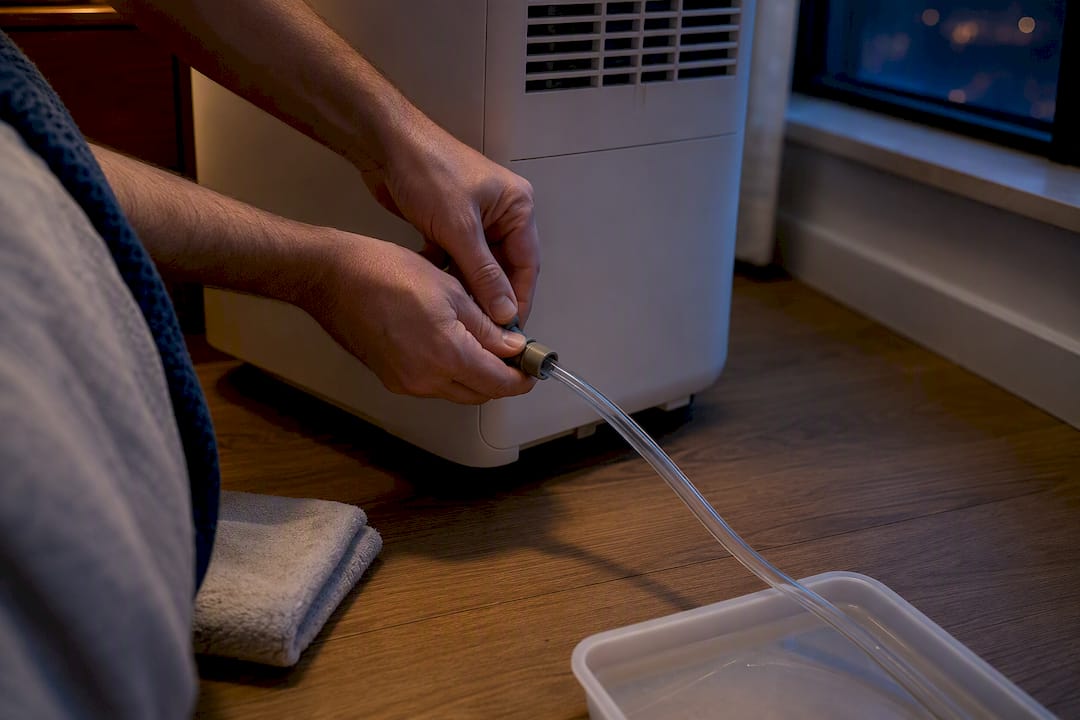
- Check the mode you’re running. Dehumidify or “dry” mode intentionally bypasses the evaporation pathway to strip moisture faster, so the tank fills whether or not the room feels humid. If you use dry mode regularly, plan to use a continuous drain.
Before assuming the unit is faulty, run a quick check: confirm the exhaust hose isn’t kinked or trailing downhill, make sure no vent is blocked by furniture, and inspect the filter for dust buildup that restricts airflow. Any of these can reduce exhaust efficiency and impair moisture evaporation.
Pro Tip: If you run the unit overnight in a bedroom during a UK summer heatwave, connect the continuous-drain hose before bed rather than trusting the evaporation cycle to keep pace with hours of unattended dehumidifying.
How to size and specify a self-evaporative unit without brand comparisons
Getting the capacity right matters more for evaporation performance than most buyers expect. An undersized unit runs constantly trying to cool the room, generating more condensate than its evaporation system can keep up with, so you end up draining more, not less.
- Match BTU or SACC rating to room size and sun exposure, since correct sizing is the single biggest factor in evaporation reliability.
- Favour dual-hose over single-hose for rooms over roughly 20 square metres, where drawing condenser air from outside meaningfully improves evaporation.
- Check for an inverter compressor, which runs more steadily and produces less erratic condensate load than a stop-start compressor.
- Read the energy label (EER or SEER rating) alongside the noise figure in decibels, since quieter units sometimes trade off evaporation-fan speed.
- Look for a continuous-drain port even on a “no-drain” model, so you have a backup route for humid weeks.
Before buying, ask the listing three things: what SACC rating it carries, whether the window kit fits a UK sash or casement window, and whether a continuous-drain hose is included or sold separately.
Getting the exhaust venting right
Self-evaporation only works if the exhaust hose is actually carrying moist air outside efficiently. Get the installation wrong and the whole “no-drain” promise falls apart, because a poorly sealed window kit, a kinked hose, or a blocked vent all reduce the airflow that carries evaporated water out of the room.
- Keep the hose as short and straight as the room allows. Every extra bend adds resistance and cuts the airflow that carries moisture away.
- Seal the window kit properly, whether that’s a standard slider kit or an adapted panel for a UK sash window, so humid outdoor air can’t get pulled back in around the gaps.
- Angle the hose slightly downward from the unit to the window where possible, avoiding a dip that traps condensation partway along.
- For non-standard windows, consider a through-wall vent kit or a door seal panel rather than forcing an ill-fitting standard kit.
Skip any of this and you’ll see faster tank fills, not because the unit’s evaporation system has failed, but because the exhaust simply isn’t clearing moisture the way it’s designed to.
Keeping the evaporation cycle working long term
A short maintenance routine prevents most of the “why is my self-evaporative AC suddenly filling up” complaints.
- Clean or replace the filter every two to four weeks during heavy use, since a clogged filter starves the coil of airflow.
- Inspect the exhaust hose and window seal each season for gaps, kinks, or sagging.
- Check the drain plug is seated fully and the float switch moves freely, since a stuck float can trigger false tank-full warnings.
If a tank-full code appears, work through it in order: check whether you’re in dry mode, then inspect the hose for kinks, then check the filter, then contact support if none of those resolve it.
Pro Tip: A stuck float switch is one of the most common “false” tank-full alerts. Gently tap the base of the unit; if the light clears immediately, the switch was likely jammed rather than genuinely full.
Where to get reliable guidance and the right unit
Simcodirect’s own buying guides cover the practical detail that matters most here, including the single-hose versus dual-hose comparison referenced above and sizing advice for quieter home-office cooling. Every product listing states SACC, noise level, and window-kit compatibility upfront, backed by fast UK delivery and a 30-day returns policy if a unit doesn’t suit your room.
What the research actually tells us about “no-drain” claims
The “no-drain” label gets treated as a binary by most product pages, and that’s the biggest disservice to buyers. It isn’t binary. It’s a threshold problem, tied directly to dew point and how you use the modes on the unit.
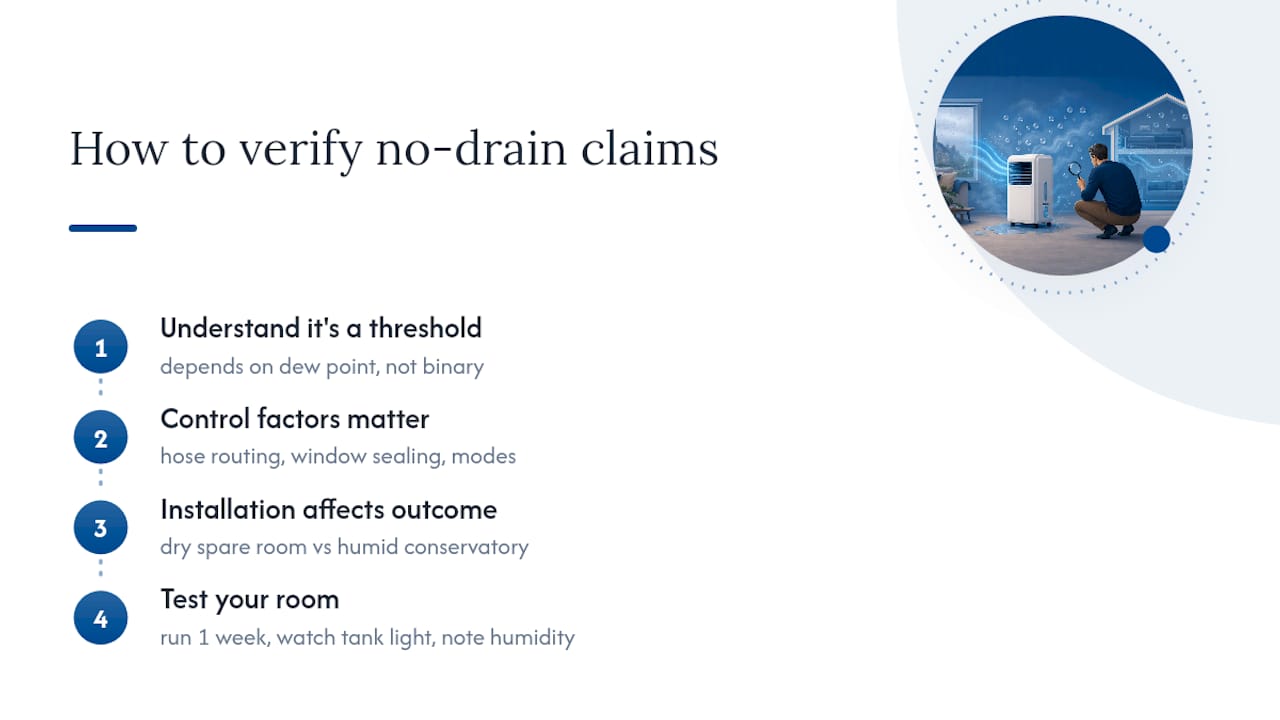
What gets underrated is how much control the buyer actually has here. Most guidance focuses on choosing the “right” unit, as if the model alone determines whether you’ll ever touch a drain hose. In practice, hose routing, window sealing, and whether you leave the unit on dry mode overnight matter just as much as the spec sheet. A well-installed single-hose unit in a dry spare room can outperform a badly vented dual-hose unit in a humid conservatory.
If you take one thing from this guide, test your own room before you trust the marketing. Run the unit for a week, watch the tank-full light, note the humidity on a cheap hygrometer, and you’ll know within days whether your climate and habits fall inside or outside the evaporation ceiling. That’s more useful than any spec comparison.
— Carl
Buying a self-evaporative unit through Simcodirect
Simcodirect gives you straight SACC and BTU figures on every listing, so you’re sizing against your room rather than guessing from marketing copy. Alongside portable air conditioners, the range covers designer radiators, electric heaters, and washroom essentials, all with fast UK delivery and a 30-day returns policy if a unit doesn’t suit your space.
Before you buy, check the product page for the SACC rating, window-kit type, and whether a continuous-drain port is included, since those three details predict how often you’ll actually need to drain the unit in your home. If you’re weighing up hose configurations, the Vent Axia Prepdry hand dryer page shows the same level of product detail and delivery information you’ll find across the air conditioning range. For heating alongside your cooling setup, the Dimplex Q-Rad panel heater is worth a look, or browse the full air treatment range at Simcodirect to compare capacity and features side by side before you order.
Sources
- How to drain portable air conditioner
- Do All Portable AC Units Need to be Drained? Maintenance Myth
- How do portable air conditioners work? - Cooling explained