


60W/m³ plus 15–25%: Size a Towel Rail to Match DT50 (UK)
Use a volumetric rule of thumb: multiply room volume in cubic metres by about 60 watts, then add an allowance if the rail is your only heat source or will regularly be draped in towels. Small ensuites, standard family bathrooms, and larger bathrooms require progressively more wattage as volume increases, but these are estimates only. Always check the product’s DT50 rating against your figure, and get a qualified electrician or plumber to confirm the final installation.
TL;DR:
- Room volume measurements must include ceiling height, especially in older homes where taller ceilings significantly increase required wattage.
- Insulation quality impacts wattage needs, with poorly insulated or single-glazed bathrooms demanding closer to 80W per cubic meter.
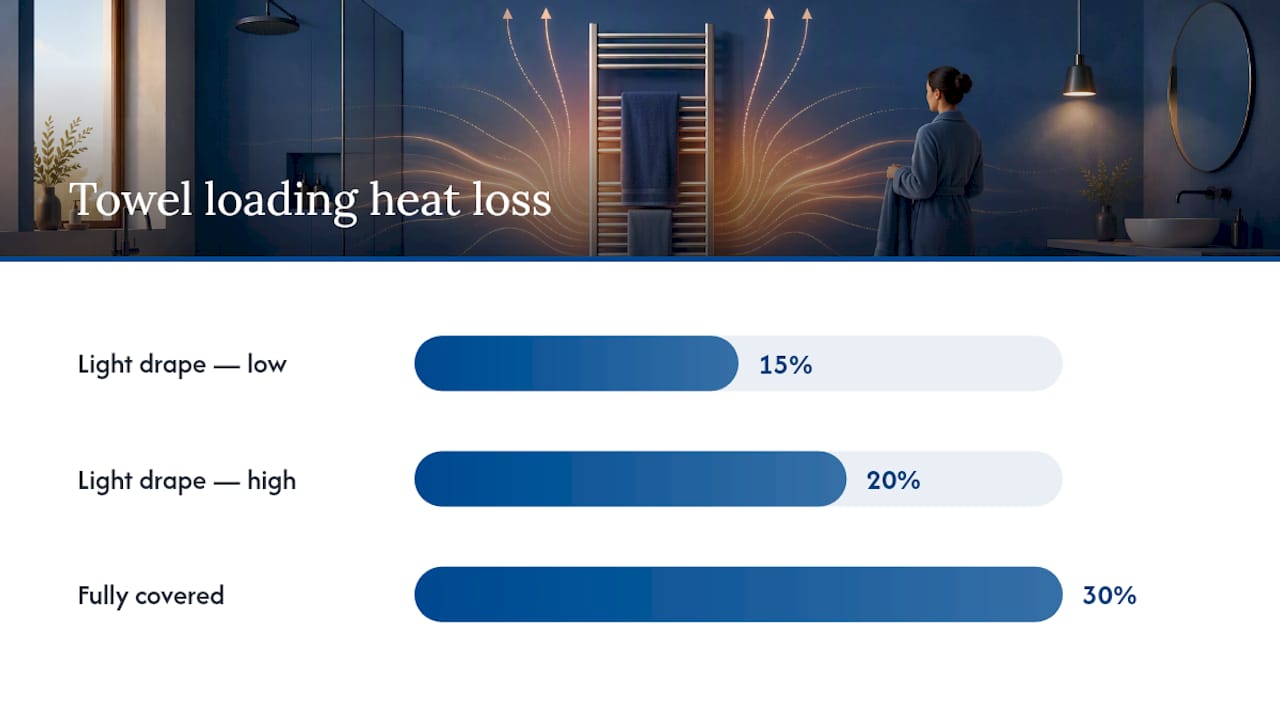
- Towels draped over the rail can reduce effective output by 15 to 30 percent, requiring an oversizing allowance to ensure sufficient warmth.
- The industry-standard DT50 output rating helps compare product capacity, emphasizing the importance of matching wattage calculations precisely.
- Electric or dual-fuel rails should always be installed by qualified electricians to meet safety regulations, including RCD protection and IP zone classifications.
Table of Contents
- What affects how much heat your towel rail needs?
- How do you calculate the required output in watts or BTU?
- What size towel rail suits your bathroom, and what wattage should you expect?
- How do you measure a bathroom for a replacement towel radiator?
- Which fuel type, central, electric or dual-fuel, fits your setup?
- What are the electrical safety and building regulation basics?
- My honest view on getting towel rail sizing right
- Where to buy the right towel radiator once you’ve sized it
- Sources
- FAQ
What affects how much heat your towel rail needs?
Room volume is the starting point, not the whole answer. A bathroom with a high ceiling holds more air than a boxy one with the same floor area, so measure height as carefully as width and length.
Insulation quality changes the sums considerably. A period bathroom with a single external wall, an old sash window, or gaps around pipework loses heat faster than a modern extension with cavity insulation and double glazing, so it needs a higher watt-per-cubic-metre rate to feel warm.
Towel loading matters more than most people expect. Draping towels over the rail cuts effective output by roughly 15–20%, rising to around 30% when the rail is fully covered, according to trade guidance from TradeCalculator’s sizing tool. That is why the oversizing allowance exists: a rail that looks adequate on paper can feel lukewarm once three damp towels are hanging off it.
Ventilation and heating pull against each other if you’re not careful. Positioning a rail directly under a trickle vent or in front of an extract grille can undermine both drying and extraction performance.
Key variables to check before you calculate anything:
- Room volume (length × width × height in metres)
- Number and size of external walls
- Window size, glazing type and draught-proofing
- Whether the rail will be your primary heat source
- How often towels will be left draped across it
Pro Tip: Measure your bathroom’s ceiling height even if it looks standard. Older properties often have taller ceilings than you’d guess, and that extra volume adds up fast in the calculation.
How do you calculate the required output in watts or BTU?
The formula is straightforward:
- Measure room volume in cubic metres (length × width × height).
- Multiply by a base rate of 60W per m³ for a well insulated bathroom, or push closer to 80W per m³ if you have a single external wall, poor insulation or large single glazing.
- Add 15–25% if the rail will be the sole heat source or regularly loaded with towels, following the same oversizing principle recommended by TradeCalculator.
- Compare your figure against the product’s rated output at DT50, the industry standard test condition measuring output at a 50°C difference between the radiator and room temperature.
Here’s a worked example. A bathroom measuring 2.5m by 2m with a 2.4m ceiling has a volume of 12m³. At 60W per m³, that’s 720W as a baseline.
For converting between units, 1kW equals 3,412 BTU/hr, a conversion worth keeping handy if a supplier lists output in BTU rather than watts, as explained in Simco Direct’s BTU versus Watts guide. Online tools such as the BuildMetriclab towel rail BTU calculator can speed up the maths, but treat every result as an estimate.
What size towel rail suits your bathroom, and what wattage should you expect?
Towel rails are usually sold by height and width in millimetres, and dimensions map fairly predictably onto wattage bands once you know what to look for.
- Small rails (around 400 to 600mm wide, 700 to 900mm tall): typically 150 to 350W, suited to small ensuites or cloakrooms with a WC and basin only.
- Medium rails (500 to 600mm wide, 1000 to 1200mm tall): typically 350 to 600W, the most common choice for a standard family bathroom.
- Tall or ladder-style rails (500 to 600mm wide, 1400 to 1800mm tall): typically 600 to 900W, better suited to larger bathrooms or where the rail doubles as the main heat source.
Profile and finish shift the numbers too. Tubular rails with a larger surface area tend to output more heat than flat-panel designs of the same footprint, and a matt finish radiates slightly differently to polished chrome. If you’re relying on the rail to heat the whole room rather than just dry towels, add that same 15–
allowance from your calculation stage, and lean towards the top of whichever bracket you’re shopping in.
How do you measure a bathroom for a replacement towel radiator?
Getting the measurements right before you order avoids the most common installation headache: a rail that doesn’t line up with existing pipework.
- Measure the available wall width and height where the rail will sit, leaving clearance either side.
- Record the pipe centres on your existing rail (the distance between the two water connections) if you’re doing a direct swap.
- Measure the distance from the floor to the bottom of the rail. Most rails sit with the lowest rail around 150 to 200mm above floor level.
- Note the bracket centres so the new rail’s fixings will align with your wall.
- For mounting height generally, aim for the top of the rail at a comfortable reaching height, and keep at least 100mm clearance from any extract fan, window reveal or trickle vent.
- Write these figures down, ideally with a rough sketch, before contacting a supplier or installer.
For guidance on positioning relative to doors and windows, Simco Direct’s radiator placement guide covers the practical layout questions most renovators hit.
Which fuel type, central, electric or dual-fuel, fits your setup?
Central heating rails connect to your existing boiler system and work well when the bathroom already has pipework in place, delivering output tied to your boiler’s flow temperature and the sizing calculation above.
Electric rails run on their own heating element and plug into the mains, which suits bathrooms without easy access to central heating pipework, or where you want the rail warm even when the boiler is off. Sizing an electric rail means matching the element wattage to your calculated requirement rather than relying on boiler flow temperature.
Dual-fuel rails combine both: central heating when the boiler is running, and an electric element for summer use or when you want warm towels without firing up the whole system.
- Central heating: best for bathrooms with existing pipework and predictable boiler schedules.
- Electric: best for ensuites, conversions, or anywhere central heating isn’t practical.
- Dual-fuel: best for mixed-use households or anyone who wants year-round flexibility.
Whichever you choose, check the DT50 rating on the product page rather than assuming two rails of the same size perform identically.
What are the electrical safety and building regulation basics?
Every circuit supplying a bathroom or shower room needs 30 mA RCD protection under BS 7671, a requirement reaffirmed in Amendment 3:2024, so any electric or dual-fuel rail should be wired accordingly by a qualified electrician.
IP zone ratings also apply near baths and showers, meaning fittings closer to water need higher splash protection. Ventilation plays into this too: Approved Document F treats trickle vents and extract rates as part of moisture control, and blocking either with a towel rail undermines both drying and air quality. Bathrooms typically need 6 to 8 air changes per hour and at least 15 litres per second at the extract grille, rising to 20 to 30 l/s in larger rooms, according to BookaBuilderUK’s fan-sizing guidance.
- Use a qualified electrician for any electric or dual-fuel connection.
- Ask for a test certificate confirming RCD protection and IP zone compliance.
- Before signing off, check for leaks, confirm the element sits correctly, and test the thermostat.
My honest view on getting towel rail sizing right
Most sizing mistakes come from skipping the oversizing step, not from getting the calculation wrong. People run the volumetric formula, order the rail that matches exactly, then wonder why it feels cool with two towels on it. Measure the room, calculate the wattage, then choose the type and confirm the DT50 figure. Check product pages for exact specs before you buy.
— Carl
Where to buy the right towel radiator once you’ve sized it
Once you’ve got a wattage figure, the next job is matching it to a real product with a proper spec sheet, not a generic listing that hides its DT50 rating. Retailers that stock towel radiators with published DT50 outputs and fast delivery let you check the exact figure against your calculation before you commit rather than guessing from a box photo.
The Titan Chrome Straight Towel Radiator suits standard central heating installations where you’ve calculated a medium wattage requirement. If you need an electric or dual-fuel option, the Platinum Chrome Electric Curved Towel Radiator gives you element wattage specs upfront, and the Consort Toweldry Towel Radiator is worth a look if you want a straightforward heated rail without extras. Every order comes with Simcodirect’s customer support and a 30-day returns policy if the fit or finish isn’t right once it arrives. Browse the towel radiator range and check the DT50 figure against your own sizing calculation before you order.
Sources
For deeper detail, see Approved Document F on ventilation, the TradeCalculator sizing tool, and Simco Direct’s radiator size guide for further worked examples.
- Towel rail sizing calculator | TradeCalculator
- Ventilation in UK bathrooms and kitchens: fans & ducting | BookaBuilderUK
FAQ
What is the standard size for a towel rail?
There’s no single standard size. Most UK bathrooms use rails between 500 and 600mm wide and 1000 to 1200mm tall, delivering roughly 350 to 600W, though small ensuites and larger bathrooms sit outside that range.
How do I choose the right size towel rail?
Calculate your room volume in cubic metres, multiply by 60 to 80W per m³ depending on insulation, then add 15–25% if the rail is your main heat source or often covered in towels, and match the result to a product’s DT50 rating.
Is a 600mm towel rail too small?
Not necessarily. A 600mm wide rail can output anywhere from 350W to over 900W depending on its height and profile, so width alone doesn’t determine adequacy. Check the full dimensions and DT50 figure against your calculated requirement.
How do I measure for a replacement towel radiator?
Measure the available wall width and height, record the existing pipe centres, note the distance from the floor to the bottom of the rail, and check bracket centres so the new unit’s fixings align with your wall.
How much extra wattage should I add for towel loading?
Add 15 to 25% above your calculated baseline if towels will regularly hang on the rail, since a fully draped rail can lose up to 30% of its effective output.