


Types of designer towel rails: your 2026 style guide
Designer towel rails are specialised heating fixtures that combine decorative appeal with the practical function of warming towels and contributing to bathroom warmth. The three main types of designer towel rails are ladder, vertical, and panel or column radiators, each suited to different bathroom sizes, heating demands, and aesthetic goals. Choosing the right style depends on whether you need a primary heat source or a secondary towel warmer, and how much wall space you have available. This guide covers every major style, finish, and selection factor to help you make a confident decision.
1. What are ladder-style designer towel rails?
Ladder rails are the most recognised towel rail style in British bathrooms. They feature a series of horizontal bars running between two vertical uprights, creating the classic ladder silhouette. The horizontal bars make hanging multiple towels straightforward, and the design suits both traditional and contemporary bathrooms depending on the finish chosen.
Ladder rails work best as secondary heat sources in smaller bathrooms and en suites. Typical towel rails warm towels and reduce moisture effectively, but they are rarely powerful enough to heat a large room on their own. A ladder rail’s practical drying ability contrasts with panel radiators’ better room-heating efficiency, so pairing a ladder rail with a separate radiator in larger spaces makes sense.
Pros and cons of ladder rails:
- Familiar, widely available design in a broad range of sizes
- Easy towel access with multiple horizontal bars
- Suits small bathrooms and en suites as a secondary warmer
- Limited heat output compared to panel radiators
- Larger ladder rails can dominate a small wall
Pro Tip: Mount a ladder rail on the wall opposite the shower or bath to maximise warm air circulation and keep towels within easy reach without crowding the space.
2. How do vertical designer towel rails optimise space and style?
Vertical rails solve a specific problem: narrow walls with limited horizontal run. They are tall and slim, making them the right choice when you have height but not width. Modern geometric and panel variations within the vertical category have pushed this style firmly into contemporary design territory.
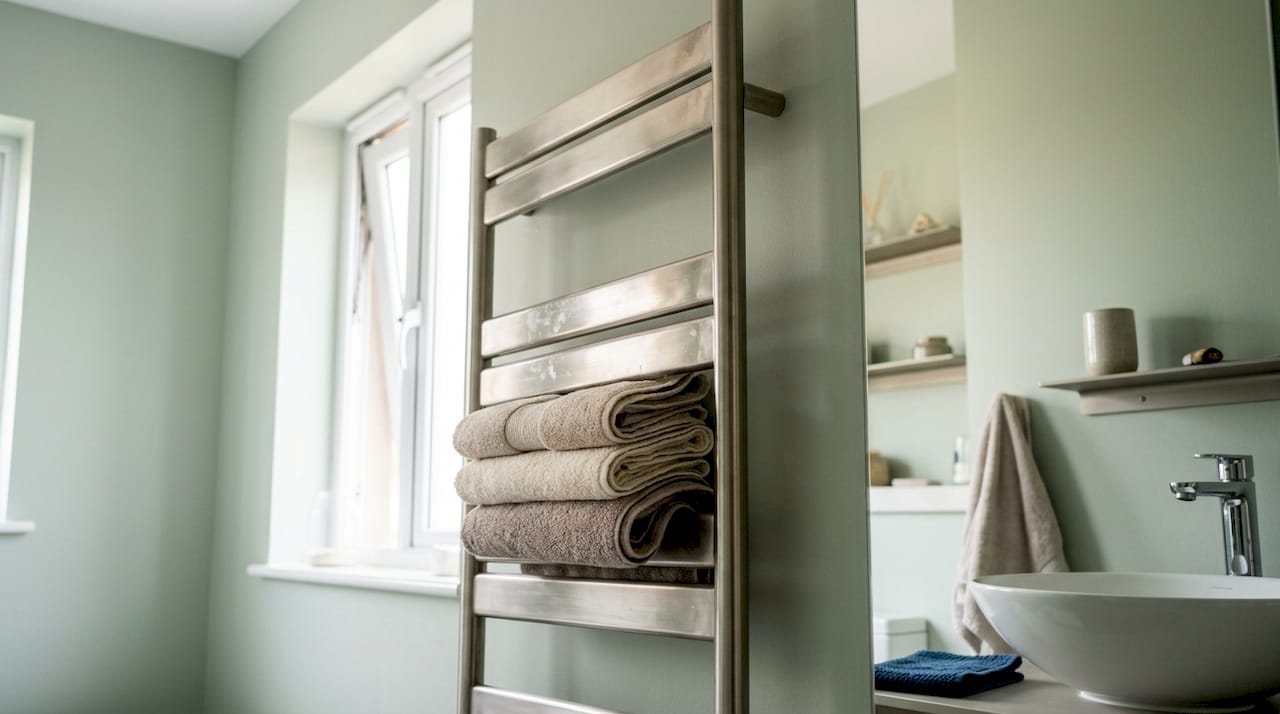
Designers classify towel rails into three main types, with vertical geometric rails representing the most architecturally striking option. A typical vertical geometric rail weighs 11.1kg and holds 6.15 litres of water, which means wall integrity matters before installation. Lightweight stud walls may need additional noggins or a solid backing board to carry the load safely.
Key advantages and considerations for vertical rails:
- Fits narrow alcoves and walls where a ladder rail would not
- Creates a strong visual statement in contemporary bathrooms
- Available in geometric, curved, and straight profiles
- Heavier units require solid wall fixings or additional structural support
- Fewer horizontal bars mean fewer towels can hang at once
Pro Tip: Always check the wall construction before ordering a tall vertical rail. A solid brick or block wall is ideal. If you have a stud partition, fit a plywood backing board behind the plasterboard before mounting.
3. What are panel and column designer towel radiators?
Panel and column radiators are the highest-output category in designer towel rail styles. They function primarily as room heaters, with towel warming as a secondary benefit. If your bathroom is large, poorly insulated, or north-facing, a panel or column radiator is the correct choice rather than a standard ladder rail.
There are hydronic, electric, and dual-fuel designer towel rails, and panel radiators are available in all three energy types. Hydronic models connect to your home’s central heating boiler and run continuously with the heating system. Electric models operate independently but carry a higher running cost. Electric at 24p/kWh versus gas at 6p/kWh makes dual-fuel the preferred option for most UK homes, as it lets you use the boiler in winter and the electric element in summer without running the full central heating system.
| Feature | Hydronic | Electric | Dual-fuel |
|---|---|---|---|
| Heat output | High | Moderate to high | High |
| Running cost | Low (gas rate) | High (electric rate) | Flexible |
| Independence from boiler | No | Yes | Yes |
| Best for | Larger bathrooms | Rental or off-grid | Most UK homes |
| Installation complexity | Plumber required | DIY-friendly | Plumber recommended |
Panel and column radiators come in finishes ranging from anthracite and white to polished chrome, so they can anchor a bathroom’s visual scheme rather than disappear into the background. The Platinum Chrome Dual Fuel Curved Towel Radiator from Simcodirect is a strong example of a unit that delivers primary heating output while adding a sculptural quality to the wall.
4. How to choose the right designer towel rail style for your bathroom
Selecting the right rail starts with one question: is this the primary heat source or a supplement? The answer determines the output you need, which then narrows down the style category.
Oversizing towel rails to match radiator output often wastes money and fails to heat the room effectively. Ladder rails typically output 300–500 watts, which suits small bathrooms. Panel radiators reach significantly higher outputs and are the correct choice for rooms above roughly 4 square metres with poor insulation.
Step-by-step selection checklist:
- Measure your bathroom in cubic metres and calculate the heat loss using a BTU calculator.
- Decide whether the rail is the sole heat source or a secondary warmer.
- Choose the energy type: hydronic if you have a gas boiler, electric if you need independence, dual-fuel for flexibility.
- Measure available wall space, noting both height and width constraints.
- Select the style category: ladder for traditional ease, vertical for narrow walls, panel for maximum output.
- Choose a finish that complements your existing sanitaryware and tiles.
- Confirm pipe centre measurements before placing your order.
Dual-fuel towel rails qualify for 0% VAT on energy-saving materials until march 2027, cutting upfront cost by 20%. That incentive makes dual-fuel models particularly attractive for UK homeowners currently weighing the initial outlay.
Pro Tip: Verify pipe centres before your plumber makes final connections. Many designer rails share similar dimensions but differ in inlet spacing, and correcting a plumbing error after tiling is expensive.
For a thorough overview of sizing and output considerations, Simcodirect’s guide on choosing towel rails for UK bathrooms covers the full calculation process.
5. What are the most popular designer towel rail finishes in 2026?
Finish choice is where function meets personal taste, and the 2026 market reflects a clear shift away from plain chrome towards richer, more characterful options. Popular finishes include chrome, brass, anthracite, white, and stainless steel, each carrying a different visual weight and maintenance requirement.
Anthracite has become the dominant choice in contemporary bathrooms, pairing well with large-format grey or white tiles and matt black sanitaryware. Brass and brushed gold suit warmer, more traditional schemes and work particularly well alongside natural stone surfaces. Chrome remains the most versatile option, complementing virtually any colour palette without competing for attention.
Finish and style considerations:
- Chrome: timeless, easy to clean, suits both modern and traditional bathrooms
- Anthracite: bold, contemporary, pairs with dark grout and matte fixtures
- Brass or brushed gold: warm, on-trend, requires gentle cleaning to avoid tarnishing
- White: discreet, blends with white sanitaryware, shows water marks more readily
- Stainless steel: durable, corrosion-resistant, suits industrial or minimalist schemes
Style profiles range from straight ladder rails and flat panel designs to curved, geometric, and sculptural forms. A curved rail softens a bathroom with hard angular lines, while a geometric vertical rail adds graphic interest to a plain white space. The finish and form together determine whether the rail reads as a background utility or a deliberate design feature.
Key takeaways
The most effective designer towel rail choice combines the correct heat output for your bathroom size with a finish and form that suits your décor, selected before installation to avoid costly plumbing corrections.
| Point | Details |
|---|---|
| Match output to room size | Ladder rails suit small rooms; panel radiators are needed for larger or colder bathrooms. |
| Choose energy type carefully | Dual-fuel is the most cost-effective option for UK homes with gas central heating. |
| Verify pipe centres early | Confirm inlet spacing before tiling to avoid expensive plumbing corrections after fitting. |
| Finish defines the aesthetic | Anthracite and brass lead 2026 trends; chrome remains the most versatile all-rounder. |
| VAT incentive applies now | Dual-fuel rails qualify for 0% VAT on energy-saving materials until march 2027. |
Why I think most homeowners choose the wrong rail first time
The most common mistake I see is choosing a towel rail based on looks alone, then discovering it cannot heat the room adequately. A beautifully proportioned ladder rail in brushed brass looks exceptional on a mood board. In a north-facing bathroom with a single exterior wall, it will leave you cold from october through april.
The second mistake is ignoring the energy type until the plumber arrives. Electric-only rails carry a running cost roughly four times higher than gas central heating. That difference compounds over years of daily use. Dual-fuel models cost more upfront, but the VAT reduction currently in place makes the gap smaller than it has been in years.
The detail that catches people out most often is pipe centre measurement. Two rails can look nearly identical in photographs but have completely different inlet spacings. Ordering the wrong one after your tiles are down is a genuinely painful and avoidable error. Measure twice, order once.
My honest recommendation: treat the towel rail as a design feature from the start, not an afterthought. A curved chrome towel radiator on a plain white wall does more for a bathroom’s character than most decorative accessories. Buy the right output first, then let the finish and form follow.
— Carl
Simcodirect’s range of designer towel rails
Simcodirect stocks a broad selection of designer towel rails across all three energy types, including hydronic, electric, and dual-fuel models in finishes from polished chrome to anthracite. Whether you need a compact ladder rail for an en suite or a high-output panel radiator for a family bathroom, the range covers both ends of the spectrum.
The Titan Chrome Straight Towel Radiator suits bathrooms where clean lines and strong heat output are both priorities. For homeowners who want flexibility across seasons, the dual-fuel curved model delivers both central heating connection and an independent electric element. All orders come with a 30-day returns policy and fast UK delivery, so you can order with confidence before your plumber arrives.
FAQ
What are the three main types of designer towel rails?
The three main types are ladder rails, vertical rails, and panel or column radiators. Each suits a different bathroom size, wall configuration, and heating requirement.
Are electric towel rails expensive to run?
Electric towel rails run at approximately 24p per kWh compared to around 6p per kWh for gas central heating. Dual-fuel models are more economical for UK homes with a gas boiler, as they switch between the boiler and the electric element as needed.
What finish is most popular for designer towel rails in 2026?
Anthracite leads contemporary bathroom trends in 2026, followed by brushed brass and chrome. Chrome remains the most versatile choice as it suits both traditional and modern schemes.
How do I know what heat output I need?
Calculate your bathroom’s heat loss in BTUs based on room volume and insulation quality. Ladder rails typically output 300–500 watts and suit small rooms, while panel radiators are needed for larger or poorly insulated bathrooms.
What is a dual-fuel towel rail?
A dual-fuel towel rail connects to your central heating boiler and also contains an independent electric element. This lets you heat towels in summer without running the full boiler, combining cost efficiency with year-round flexibility.