


Avoid Supplier Lock In: Washroom Dispenser Types for Facility Managers
Washroom dispensers fall into seven core categories: soap, paper towel, toilet tissue, hand sanitiser, period-care, wipes, and air freshener, each available in manual or touchless formats. The right choice depends less on the dispenser’s looks than on matching its activation method and refill system to your footfall and cleaning schedule. Get the refill system wrong and you’re locked into one supplier for years.
TL;DR:
- High-capacity soap dispensers with foam options and sealed cartridges reduce costs and contamination risks, but may lock you into specific suppliers.
- Touchless dispensers are recommended for hygiene-critical environments, though they involve higher maintenance due to batteries or wiring.
- Manual units are more cost-effective and easier to service in moderate-traffic settings, whereas high-traffic areas benefit from touchless, high-capacity units.
- Refill system choices impact long-term costs, with sealed cartridges offering convenience but at a higher per-wash expense and supplier lock-in.
- Ensuring compatibility, easy access, and standardized refills is key to controlling maintenance costs over a dispenser’s five-year lifecycle.
Table of Contents
- Washroom dispenser types: a category overview
- How dispensers work: activation, refill and power choices
- Matching dispenser selection to traffic, location and users
- Installation, servicing and five-year lifecycle costs
- Materials, mounting options and cleaning guidance
- Procurement checklist: spec items and tender questions
- A facilities manager’s honest take on dispenser selection
- How Simcodirect can help you choose the right dispensers
- Sources
- FAQ
Washroom dispenser types: a category overview
Every washroom category splits into recognisable subtypes, and knowing them saves you from ordering the wrong hardware for the wrong room.
Soap dispensers come in foam and liquid formats, each mounted as wall units, counter-mounted pumps, or freestanding bottles. Foam dispensers use roughly 40 to 50% less soap per wash than liquid equivalents, which cuts both product cost and rinse time in high-traffic sites.
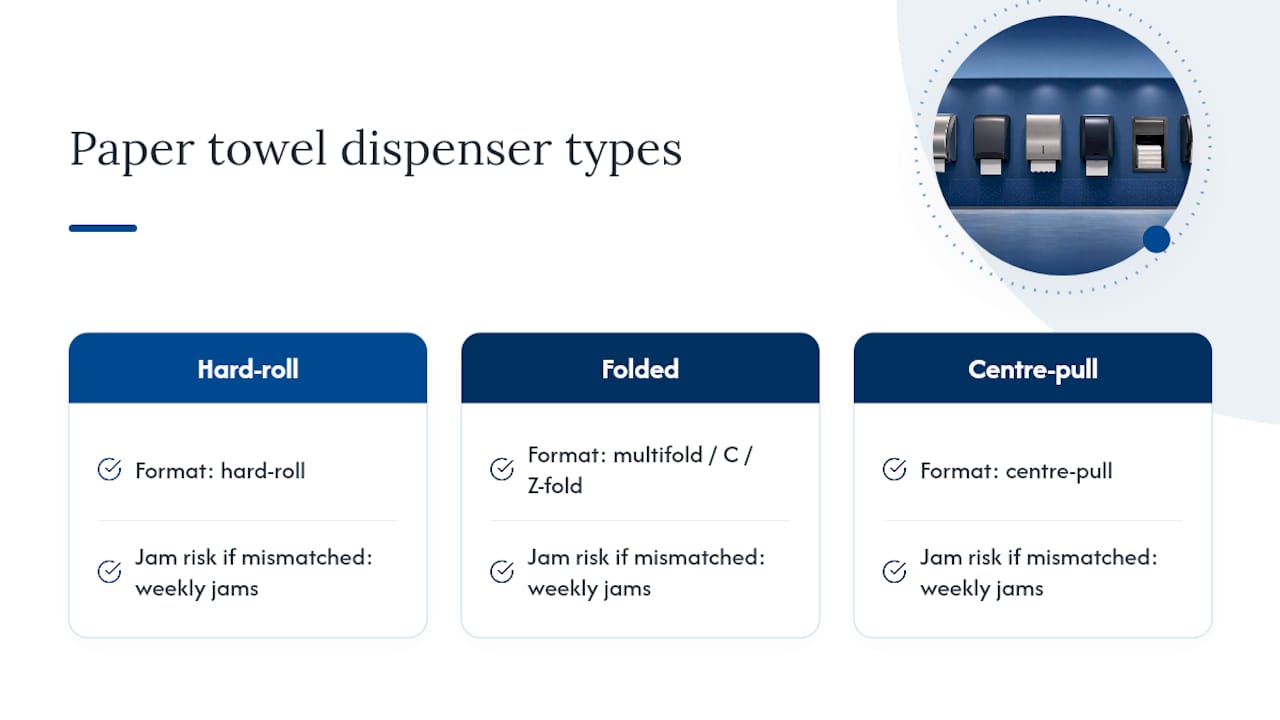
Paper towel dispensers split into three distinct hardware families: hard-roll, folded (multifold, C-fold, or Z-fold), and centre-pull. These aren’t interchangeable. Buy the wrong paper format for your dispenser and you’ll be clearing jams weekly, a problem the Commercial Restroom Supplies Guide flags as one of the most common facilities complaints.
Toilet tissue dispensers range from standard-roll single units to jumbo and mini-jumbo multi-roll cabinets, the latter suited to high-footfall public washrooms where staff can’t restock hourly.
Other categories matter depending on your site: hand sanitiser stations (often wall-mounted near entrances), period-care dispensers (increasingly a compliance expectation in UK commercial and public buildings), wipe dispensers for gym or kitchen-adjacent washrooms, and air freshener units for odour control in enclosed or low-ventilation rooms.
Match category to context: customer-facing retail washrooms lean towards touchless and higher-capacity units for perception and hygiene; staff-only or back-of-house spaces can run manual, lower-cost hardware without complaint.
How dispensers work: activation, refill and power choices
The mechanics behind a dispenser determine almost everything about its running cost, so it’s worth understanding the trade-offs before you specify anything.
Manual vs touchless is the first fork. Manual units cost less upfront and have fewer parts to fail, making them the practical choice for moderate footfall settings. Touchless (automatic) dispensers reduce contact points and standardise dosing, which matters in hygiene-sensitive settings like healthcare or food service, but they add batteries or wiring to your maintenance list.
Foam vs liquid soap isn’t just a texture preference. Foam’s soap saving becomes a real annual line-item difference once you’re running dozens of dispensers across a site.
Bulk-fill vs sealed cartridge refill systems trade cost against convenience. Sealed cartridges cut servicing time and lower contamination risk, but they run at a higher cost per wash and tie you to one supplier’s proprietary refills. Bulk-fill units cost less to run but need staff who won’t overfill or contaminate the reservoir during refills.
Battery vs hardwired power splits similarly. Battery units install anywhere without an electrician, but someone has to audit battery life on a schedule. Hardwired units remove that maintenance task entirely, though installation costs more upfront, a trade-off the KC Professional guide on automated dispensers sets out clearly for buyers weighing flexibility against long-term upkeep.
- Manual dispensers: lower cost, simpler servicing, best for moderate traffic
- Touchless dispensers: consistent dosing, fewer touchpoints, higher maintenance overhead
- Foam soap: less product used per wash, faster rinse
- Sealed cartridges: quicker refill swaps, higher per-wash cost, supplier lock-in
Matching dispenser selection to traffic, location and users
Footfall should drive every capacity decision, not floor area or aesthetics.
- Count peak-hour usage, not average daily footfall. A washroom that sees a lunchtime rush needs higher-capacity units even if its daily total looks modest.
- Apply a baseline ratio. A workable planning default is one tissue dispenser per stall, one soap dispenser per basin, and one towel dispenser or dryer per two basins in smaller washrooms, scaling up wherever queues form during peak periods.
- Choose format by area type. High-traffic public areas (transport hubs, retail, event venues) justify touchless, high-capacity units. Offices and back-of-house spaces can run manual dispensers with smaller refills.
- Check mounting height and reach. Accessible washrooms need dispensers mounted within reach ranges that meet UK accessibility standards, not just wherever looks tidy on the wall.
- Decide between towel dispensers and hand dryers. Both handle drying duty, but they carry different maintenance profiles worth comparing against your paper towel dispenser options and hand dryer choices before committing to one drying method sitewide.
Installation, servicing and five-year lifecycle costs
The purchase price of a dispenser tells you almost nothing about what it will actually cost you. Refills, batteries, labour, and waste disposal accumulate quietly over years, and hardware that looks cheap on day one can turn out to be the expensive option by year three.
Build your servicing checklist around three questions: can staff access the unit easily without special tools, are spare parts (batteries, pump heads, lock mechanisms) readily available, and does the refill format match what your cleaning contractor already stocks for other sites? Standardising refills across a building cuts down on the stockroom chaos of six different cartridge shapes.
- Refills: recurring cost, varies by bulk vs cartridge choice
- Batteries: budget for replacement and staff time to check them
- Labour: servicing time scales with dispenser count and access difficulty
- Waste disposal: cartridge and battery disposal has its own handling cost
Pro Tip: Run a quarterly spot-check on dose accuracy and battery levels rather than waiting for a complaint. A dispenser running dry or over-dosing soap for weeks before anyone notices costs more in wasted product and user frustration than the five minutes it takes to check.
Viewing dispensers as long-lived assets rather than one-off purchases changes the maths. A slightly pricier hardwired unit that removes battery management from your servicing rota often pays for itself against a cheaper battery-powered equivalent once you tally five years of maintenance visits.
Materials, mounting options and cleaning guidance
Stainless steel dispensers tolerate harsh cleaning chemicals and knocks better than ABS plastic, making them the sturdier choice for high-traffic public washrooms, though ABS units cost less and suit lower-abuse environments like offices.
Mounting options matter more than they first appear. Surface-mounted units are quicker to install and service; recessed units sit flush for a cleaner look but cost more to fit and are harder to swap later. Tamper-resistant or lockable dispensers are worth specifying anywhere the public has unsupervised access, particularly for soap and sanitiser units that are otherwise easy to remove or refill with the wrong product.
- Stainless steel: durable, chemical-resistant, higher upfront cost
- ABS plastic: lighter, cheaper, less resistant to impact and harsh cleaners
- Recessed mounting: cleaner finish, higher installation cost
- Lockable units: essential for vandal-prone or fully public washrooms
Wipe down dispenser exteriors daily and check reservoir seals weekly. This is a small habit that prevents the sticky, contaminated build-up that shortens the working life of both foam and liquid pump mechanisms.
Procurement checklist: spec items and tender questions
A tender document that’s vague about refill compatibility is how facilities teams end up locked into a single supplier without meaning to.
Specification fields to include for every dispenser line item:
- Activation method (manual or touchless) and expected duty cycle
- Refill type (bulk-fill or sealed cartridge) and dosing volume per use
- Capacity (refill size, number of uses before empty)
- Power source (battery type or hardwired) and expected battery life
- Finish and mounting method (surface or recessed, lockable or open)
- Warranty length and what it actually covers
Before signing, ask suppliers three questions: will refills from other manufacturers fit this dispenser, how long are spare parts guaranteed to be available, and what’s the typical lead time for replacement parts. At installation, test dose accuracy against the stated volume, check the mounting is fully secure, and confirm the first refill batch fits without forcing it. Cross-reference your full list against a washroom accessories procurement checklist before it goes out to tender.
A facilities manager’s honest take on dispenser selection
Most washroom dispenser decisions get made backwards. Someone picks the cheapest unit, then discovers eighteen months later that refills only come from one supplier at whatever price they choose to charge. The hardware was never the expensive part. The lock-in was.
The conventional wisdom says to buy on unit price and worry about running costs later. That’s exactly the wrong order. A £15 saving on a sealed-cartridge dispenser can cost you multiples of that over five years once you’re paying premium per-wash rates with no alternative supplier. High-quality mechanical manual units, unglamorous as they sound, often outperform battery-powered alternatives in sites where nobody has time to run a battery audit rota.
What tends to matter most on a repeat order isn’t the finish or the brand name stamped on the front. It’s whether the refill will still be available, and compatible, in three years’ time.
— Carl
How Simcodirect can help you choose the right dispensers
Once you’ve worked out which activation method, refill system, and capacity your washroom needs, sourcing the actual hardware shouldn’t be the hard part. There are suppliers stocking soap dispensers, paper towel systems, and washroom accessories built around the same compatibility and serviceability questions covered in this guide, with bulk pricing available for multi-site orders.
If you’re specifying touchless soap dispensers for a refurbishment, the Bobrick counter-mounted automatic soap dispenser is a solid reference point for dosing consistency and mounting flexibility. Comparing drying options at the same time? The UltraDry Pro 1 hand dryer is worth putting alongside your towel dispenser shortlist before you commit either way. Get in touch with Simcodirect’s commercial sales team for a bulk quote, or browse the full washroom accessories range to build your spec list today.
Sources
Manufacturer dosing and capacity tables vary by model, so verify exact figures against supplier spec sheets before finalising a tender, using guides like the Commercial Restroom Supplies Guide as a cross-reference.
- How to Choose a Commercial Soap Dispenser for Your Facility
- Commercial Restroom Supplies Guide
- How to Choose an Automated Paper Towel Dispenser for Commercial Restrooms
- Commercial Soap Dispensers: Manual vs Automatic Guide (2026)
FAQ
What are the different types of washroom dispensers?
The main categories are soap, paper towel, toilet tissue, hand sanitiser, period-care, wipes, and air freshener dispensers, each available in manual or touchless formats with bulk-fill or cartridge refill systems.
What are the different types of bathroom soap dispensers?
Soap dispensers split by mechanism (manual pump or touchless/automatic), by soap type (foam or liquid), and by refill system (bulk-fill or sealed cartridge), with mounting options including wall-mounted, counter-mounted, and free-standing units.
What are the different types of dispenser pumps?
Dispenser pumps are broadly manual (lever or push-operated) or automatic (sensor-activated), with foam pumps dispensing aerated soap and liquid pumps dispensing standard liquid soap, sanitiser, or lotion.
What’s the difference between roll, folded and centre-pull paper towel dispensers?
Roll dispensers hold continuous hard-roll paper, folded dispensers use pre-cut C-fold or multifold sheets, and centre-pull dispensers feed from the centre of a roll; each format requires matching hardware or the paper will jam.
Should I choose manual or automatic dispensers for a commercial washroom?
Manual dispensers suit moderate-footfall sites needing lower upfront cost and simpler servicing, while automatic dispensers are better justified in high-footfall or hygiene-sensitive areas despite their higher maintenance demands.