


Washroom Ventilation Requirements Explained for Compliance
Washroom ventilation requirements are defined by mandatory mechanical extraction rates, safety standards, and installation rules that prevent moisture damage and protect air quality. Under UK Building Regulations, specifically Approved Document F, mechanical ventilation is not optional. Bathrooms with a bath or shower require a minimum extract rate of 15 l/s intermittently, while separate WCs require at least 6 l/s. These figures are the legal floor, not a target. Property managers, contractors, and homeowners who understand these numbers avoid costly remediation, failed inspections, and persistent mold problems.
What are the standard washroom ventilation requirements?
Approved Document F sets the legal minimum airflow rates for all washrooms in England and Wales. These rates exist because bathrooms generate more moisture per square foot than almost any other room in a building. Without adequate extraction, that moisture saturates walls, ceilings, and joinery within months.
The two primary metrics are liters per second (l/s) and cubic feet per minute (CFM). Most UK specifications use l/s. One l/s equals roughly 2.12 CFM, so a 15 l/s bathroom fan moves about 32 CFM. That conversion matters when you are sourcing fans from international suppliers or reading older technical documents.
Minimum airflow rates by washroom type
| Washroom type | Intermittent extract rate | Continuous extract rate |
|---|---|---|
| Bathroom (bath or shower) | 15 l/s | 8 l/s |
| Separate WC | 6 l/s | — |
| Combined bathroom/WC | 15 l/s | 8 l/s |
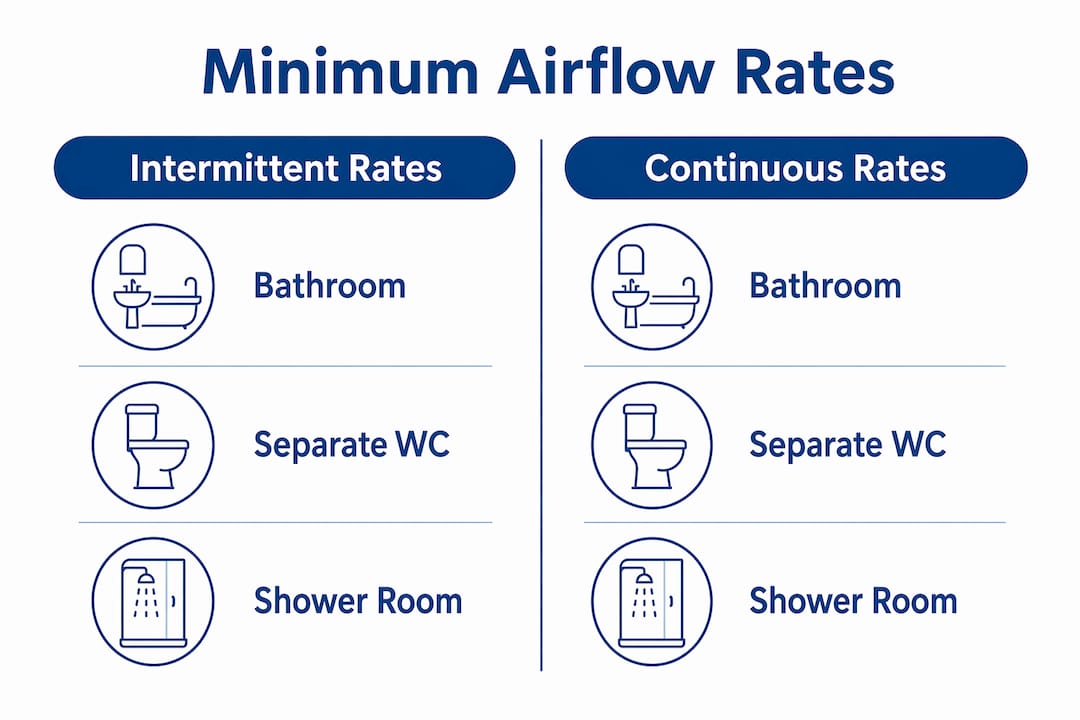
These rates represent the minimum at the outlet, not the fan’s rated capacity. That distinction is critical, and it shapes every equipment decision you make.
The rationale behind these specific numbers comes from moisture load modeling. A standard shower releases significant water vapor in a short time. At 15 l/s, a bathroom fan replaces the air volume roughly every two to three minutes during use. At 8 l/s continuous, the system maintains a steady negative pressure that prevents moisture from migrating into adjacent rooms.
Pro Tip: Convert l/s to air changes per hour (ACH) for your specific room volume to verify compliance. A small WC at 6 l/s may achieve 10+ ACH, while a large bathroom at 15 l/s might only reach 6 ACH. Both can be compliant, but knowing your ACH helps you defend the design during Building Control inspections.
How do installation factors affect ventilation performance?
Fan capacity on a spec sheet means nothing if the installation undermines it. Duct routing characteristics like length, bends, and duct type strongly influence real-world airflow. A fan rated at 20 l/s in lab conditions can deliver well under 15 l/s once it fights through a long, kinked duct run with a restrictive external grille.
Key installation variables that determine compliance
- Duct length and diameter. Longer ducts create more resistance. Use the largest practical duct diameter and keep runs as short as possible.
- Number of bends. Each 90-degree bend adds resistance equivalent to roughly 1–2 meters of straight duct. Use swept bends, not sharp elbows.
- Duct material. Flexible corrugated ducting creates far more friction than rigid smooth-bore pipe. Use rigid wherever possible, especially in long runs.
- External grille type. Louvered grilles restrict airflow significantly. A low-resistance grille can recover 10–15% of lost performance.
- IP rating. IP44-rated fans are the standard for bathroom zones. IP20 is technically acceptable outside defined wet zones but carries real risk during electrical inspections and in high-humidity environments.
Run-on timers are non-negotiable for intermittent systems. Intermittent fans must run for at least 15 minutes after the light is switched off to clear residual humidity. Skipping this step is one of the most common causes of mold complaints within the first year of occupancy. Humidity sensors offer a smarter alternative: they trigger the fan based on actual moisture levels rather than a fixed timer, which suits households with variable usage patterns.
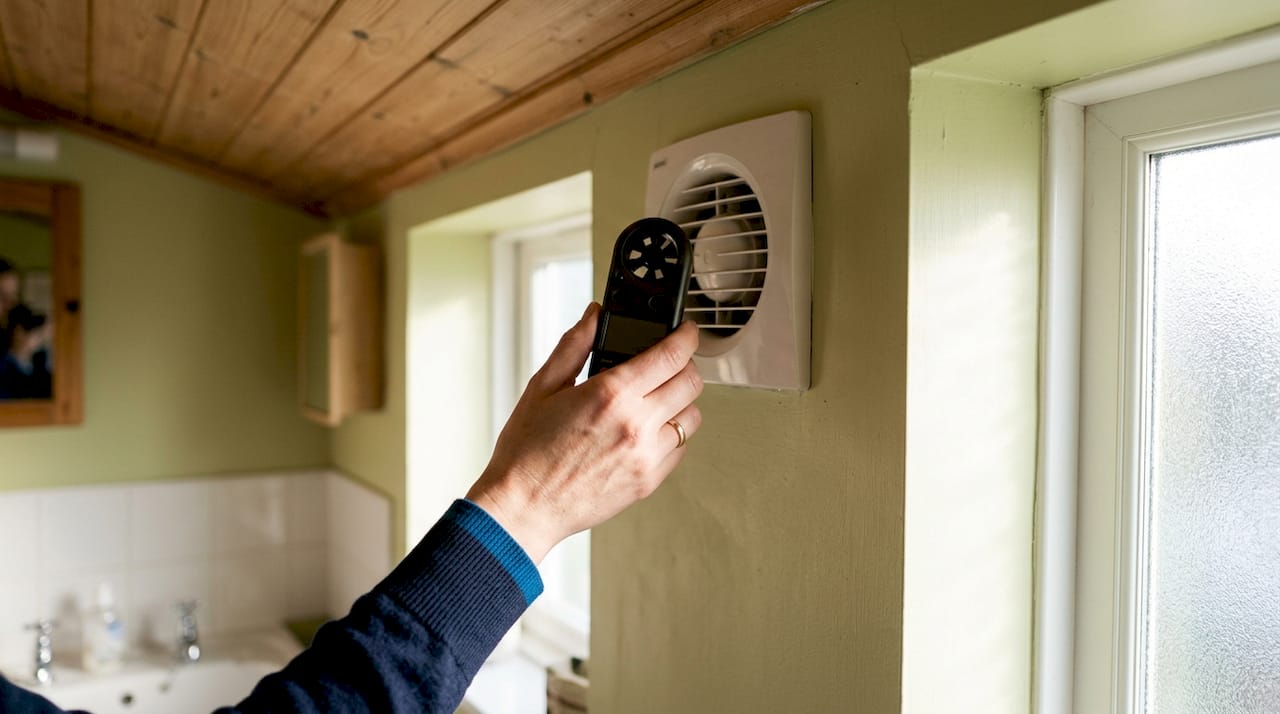
Commissioning the system by measuring airflow at the outlet and documenting results is a regulatory requirement under Approved Document F. Building Control expects this evidence at handover. Without it, you have no proof the system meets the 15 l/s or 6 l/s threshold, regardless of what the fan’s label says.
Pro Tip: Always over-specify fan capacity to account for real-world duct losses. Manufacturers’ nominal ratings are measured in ideal lab conditions. A fan rated at 22–25 l/s typically delivers 15 l/s in a standard domestic installation with a 3-meter duct run and one external grille.
What is the role of natural ventilation versus mechanical extraction?
Natural ventilation through openable windows provides rapid air changes but does not replace mandatory mechanical extraction. Openable windows cannot substitute for mechanical ventilation under Approved Document F. This surprises many homeowners who assume a large bathroom window solves the problem. It does not.
The core issue is reliability and directionality. A window depends on wind pressure, temperature differentials, and occupant behavior. A mechanical fan creates a consistent negative pressure that draws moist air directly to the outside before it can diffuse into the building fabric. That directional control is what prevents moisture from reaching cold surfaces where condensation forms.
Natural ventilation does play a supporting role in specific situations:
- Background ventilation. Trickle vents in window frames provide a small, continuous air supply that supports the extract fan’s performance by allowing replacement air to enter.
- Purge ventilation. Opening a window after a bath or shower accelerates initial moisture removal before the fan’s run-on timer takes over.
- Supplementary cooling. In summer, windows reduce the thermal load in bathrooms, which indirectly reduces moisture production from hot showers.
The practical implication for contractors is straightforward. Design the mechanical system to meet Approved Document F on its own. Treat windows and trickle vents as performance enhancers, not compliance substitutes. Property managers overseeing older properties with no mechanical extraction face a clear obligation: retrofitting a compliant fan is not optional under current regulations. Plumbing ventilation plays a similarly non-negotiable role in safe residential buildings, and the same principle applies to washroom air quality.
How does building airtightness change ventilation needs?
Modern energy-efficient construction has made washroom ventilation more complex. Increased building airtightness means simple intermittent fans may not perform adequately in new builds, because there is insufficient background air infiltration to support extraction.
Part L of the Building Regulations sets energy efficiency targets that push builders toward tighter envelopes. Part F sets indoor air quality targets that require adequate ventilation. These two requirements pull in opposite directions, and the resolution is whole-house mechanical ventilation.
- Mechanical Extract Ventilation (MEV). A central fan continuously extracts air from wet rooms including bathrooms, kitchens, and WCs. Individual room fans are replaced by a single, centrally located unit. MEV suits highly airtight new builds where intermittent fans would create pressure imbalances.
- Mechanical Ventilation with Heat Recovery (MVHR). The most energy-efficient option. MVHR extracts stale air and simultaneously supplies fresh filtered air, recovering up to 90% of the heat from the exhaust stream. This system meets both Part F and Part L requirements in a single installation.
- Intermittent fans with trickle vents. Still compliant in most existing dwellings and less airtight new builds. The fan handles wet room extraction; trickle vents in windows provide background ventilation for habitable rooms.
Pro Tip: For any new build or deep retrofit, check the dwelling’s air permeability test result before specifying fans. A result below 5 m³/(h·m²) at 50 Pa typically signals that MEV or MVHR is the right choice. Fitting a standard intermittent fan in a very airtight home can cause negative pressure problems that pull combustion gases from boilers and fires.
What practical steps ensure compliant washroom ventilation?
Compliance is a process, not a product purchase. Selecting the right fan is step one. Installing and commissioning it correctly is what actually determines whether you pass inspection and avoid callbacks.
- Match fan output to room type. Bathrooms need 15 l/s minimum at the outlet. Separate WCs need 6 l/s. Verify these figures after installation, not just on the spec sheet.
- Choose the correct IP rating. Use IP44 as your default for any bathroom installation. Reserve IP20 only for locations clearly outside defined wet zones, and document that decision.
- Minimize duct resistance. Use rigid smooth-bore ducting, keep runs under 3 meters where possible, and limit bends to two per run.
- Fit a run-on timer or humidity sensor. A 15-minute timer is the regulatory minimum for intermittent fans. A humidity sensor is a better long-term solution for properties with variable occupancy.
- Commission and document. Measure airflow at the outlet using an anemometer or flow hood. Record the result and retain it for Building Control and future property transactions.
- Schedule annual maintenance. Clean fan grilles and impellers every 12 months. Blocked fans can lose 30–40% of their rated airflow without any visible warning sign.
Preventing mold in duct systems requires the same discipline applied to HVAC duct maintenance. Moisture that accumulates inside poorly maintained ductwork becomes a contamination source that defeats the entire purpose of the ventilation system.
Key Takeaways
Compliant washroom ventilation requires meeting minimum airflow rates, correct IP ratings, run-on timers, and documented commissioning, all governed by Approved Document F.
| Point | Details |
|---|---|
| Minimum airflow rates | Bathrooms need 15 l/s; separate WCs need 6 l/s at the outlet, not just on the fan label. |
| Over-specify fan capacity | Real-world duct losses mean a fan rated 22–25 l/s typically delivers 15 l/s in practice. |
| IP44 is the safe default | IP44 protects against water ingress in wet zones and reduces risk during electrical inspections. |
| Run-on timers are mandatory | Intermittent fans must run 15 minutes post-use; humidity sensors offer a smarter alternative. |
| Commission and document | Measured airflow records are required by Building Control and protect you during property sales. |
What I’ve learned from watching ventilation jobs go wrong
The single most common mistake I see is treating fan selection as the whole job. A contractor specifies a compliant fan, installs it with 5 meters of flexible corrugated ducting and two sharp bends, and hands over a property that fails to meet 15 l/s at the outlet. The fan is fine. The installation is the problem.
The second mistake is skipping commissioning. Without a measured airflow result, you have no evidence of compliance. That gap surfaces at the worst possible moment: during a Building Control inspection, or when a property manager is trying to sell a flat and the buyer’s surveyor flags the ventilation as unverified. A five-minute measurement with an anemometer prevents both scenarios.
Noise is an underrated factor. A fan that runs at 45 dB or above will be switched off by occupants who find it intrusive. A silent fan that runs consistently does more for moisture control than a powerful fan that nobody uses. When I specify fans for residential properties, I prioritize models below 35 dB at the rated airflow. The compliance numbers matter, but occupant behavior determines real-world performance.
The shift toward MEV and MVHR in new builds is the right direction. Intermittent fans were designed for leaky buildings. Modern construction demands continuous, balanced ventilation. If you are specifying for a new build or a deep retrofit, the question is not whether to use a whole-house system. The question is which type fits the building’s airtightness level and energy target.
— Carl
Washroom accessories that complete a compliant, well-equipped space
A compliant ventilation system is the foundation of a functional washroom. The fixtures and accessories around it determine whether the space actually works for the people using it.

Simcodirect stocks a wide range of washroom essentials built for both residential and commercial environments. From hand dryers that handle high-traffic demand to quality toilet roll holders like the Bobrick Double Toilet Roll Holder in Brushed Satin, every product is selected for durability and compliance with commercial standards. Simcodirect offers fast delivery, a 30-day returns policy, and a catalog built around the needs of property managers and contractors who cannot afford downtime or returns. Browse the full washroom range at Simcodirect to find products that match your specification.
FAQ
What is the minimum ventilation rate for a bathroom?
The minimum intermittent extract rate for a bathroom with a bath or shower is 15 l/s under Approved Document F. A continuous ventilation alternative requires at least 8 l/s.
Do openable windows count as bathroom ventilation?
No. Openable windows do not satisfy the mechanical ventilation requirement under UK Building Regulations. A compliant extract fan is mandatory regardless of window size or position.
What IP rating does a bathroom fan need?
IP44 is the standard for bathroom zones. It provides protection from water ingress and reduces risk during electrical safety inspections. IP20 is only acceptable in locations clearly outside defined wet zones.
How long should a bathroom fan run after use?
An intermittent bathroom fan must run for at least 15 minutes after the light is switched off. A humidity sensor can replace a fixed timer and adjusts run time based on actual moisture levels.
When is a whole-house ventilation system required instead of a single fan?
Highly airtight new builds, typically those with an air permeability result below 5 m³/(h·m²) at 50 Pa, generally require MEV or MVHR rather than standard intermittent fans to meet both Part F and Part L requirements.