


What does BTU stand for? Your 2026 heating guide
BTU stands for British Thermal Unit, the standard measure of heat energy used across the UK heating and cooling industry. One BTU is defined as the energy needed to raise the temperature of one pound of water by one degree Fahrenheit. That single number underpins everything from radiator output ratings to air conditioning capacity. Understanding the BTU meaning gives you the power to size heating systems correctly, avoid wasted energy, and choose products that actually match your room’s needs.
What does BTU stand for in heating and cooling?
BTU stands for British Thermal Unit, and the full form dates back to the 19th century when engineers needed a consistent way to measure heat energy. The BTU definition is precise: it is the quantity of heat required to raise one pound of water by one degree Fahrenheit at sea level. That may sound abstract, but it translates directly into the numbers printed on every radiator and air conditioning unit sold in the UK.
In heating, BTU is expressed as BTU per hour (BTU/h), which describes the rate at which a radiator or boiler delivers heat. In cooling, the same unit describes how quickly an air conditioner removes heat from a room. The distinction between a single BTU (energy) and BTU/h (rate) matters because manufacturers always quote the rate, not a one-off energy value.
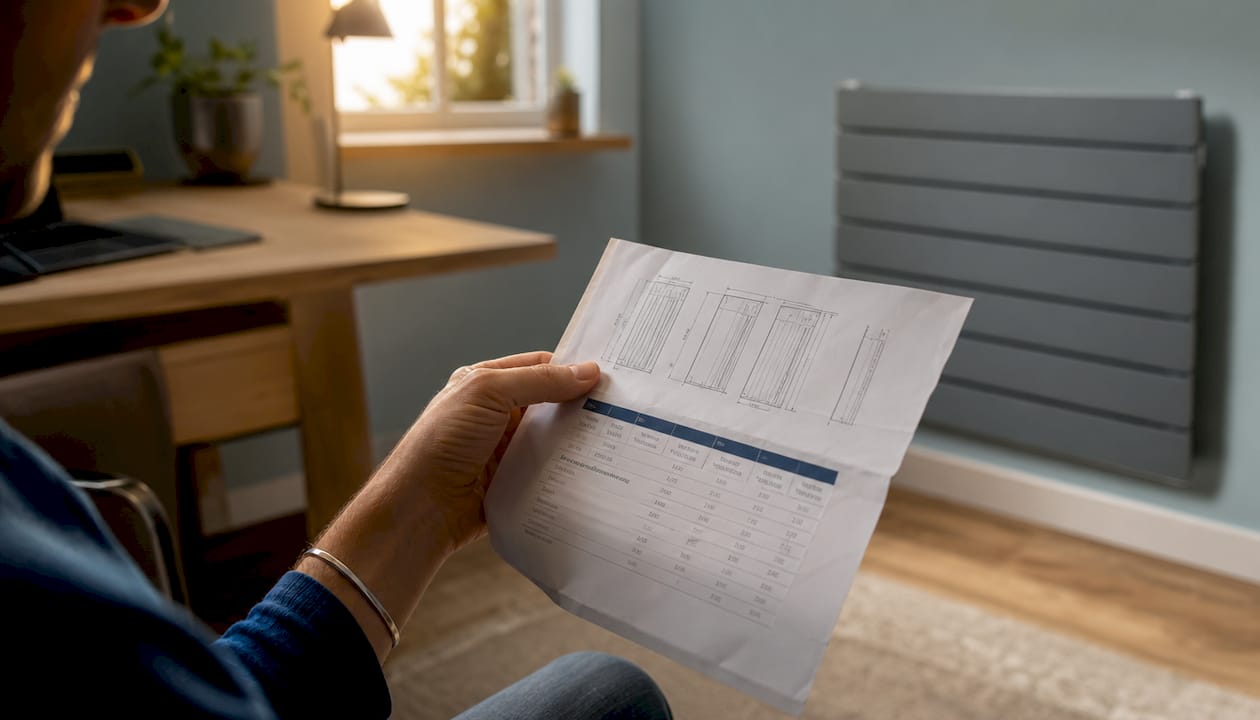
Radiators, electric panel heaters, and fan heaters all carry BTU/h ratings on their specification sheets. Air conditioning units use BTU/h to indicate cooling capacity. A higher BTU/h number means the unit moves more heat per hour, whether adding it to a room or extracting it.
Pro Tip: When comparing products, always check whether the figure quoted is BTU or BTU/h. A single BTU value without the “per hour” qualifier tells you nothing useful about a heater’s performance.
How is BTU used to measure heating and cooling capacity?
The BTU/h rating on a product tells you how much heat it can deliver or remove in one hour under standard test conditions. Getting that number right for your room is the foundation of good heating design.
Here is how BTU/h applies across common home heating and cooling scenarios:
- Radiators: A standard UK double panel radiator for a medium living room typically outputs between 4,000 and 8,000 BTU/h, depending on its size and flow temperature.
- Air conditioning: A small split unit for a bedroom commonly carries a 9,000 BTU/h cooling rating. Larger open-plan spaces may need 18,000 BTU/h or more.
- Electric panel heaters: A 1 kW panel heater delivers approximately 3,412 BTU/h, which suits a small, well-insulated room.
- Towel radiators: Bathroom towel rails typically output 1,500–3,500 BTU/h, enough to warm a compact bathroom and dry towels simultaneously.
- Fan heaters: These deliver heat quickly and are rated in both kW and BTU/h, making them easy to cross-reference with room heat loss figures.
A typical UK living room measuring 4x5x2.4 metres requires roughly 4,000–5,000 BTU/h under average insulation conditions. That figure rises sharply in poorly insulated or north-facing rooms. Matching the BTU/h output of your chosen product to the actual heat demand of the room prevents both underheating and unnecessary energy use.
How do you convert BTU to kilowatts?
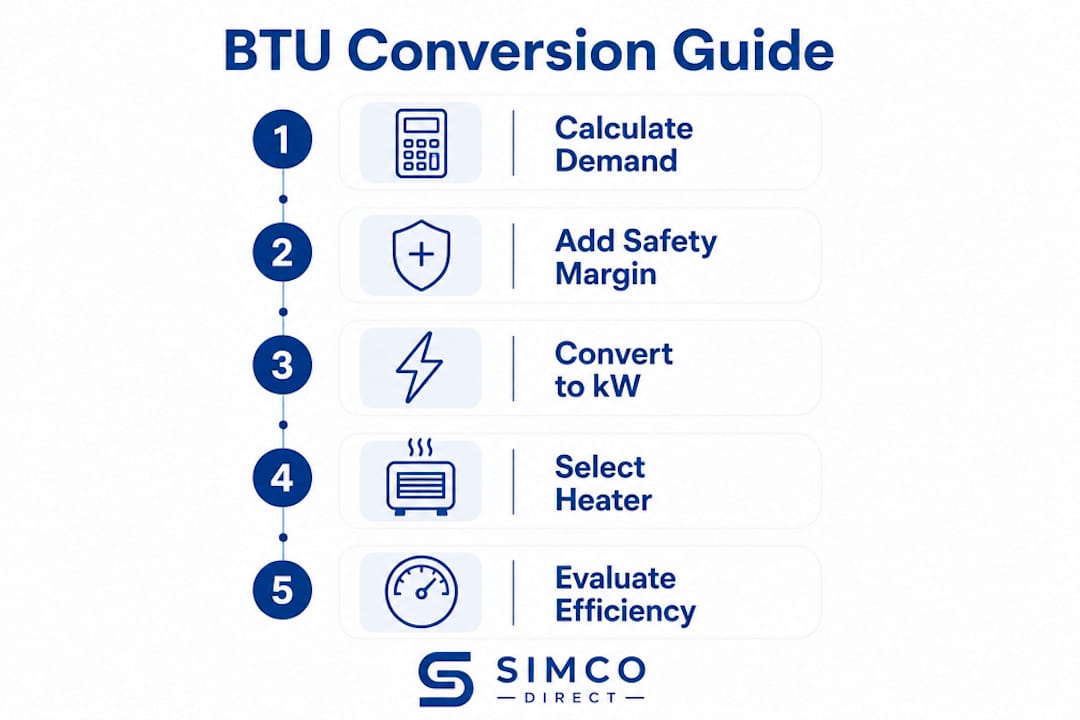
The UK heating industry uses both BTU/h and kilowatts (kW), and knowing how to move between them is genuinely useful when comparing products or sizing a boiler.
The standard conversion is straightforward: 1 kW equals 3,412 BTU/h. That relationship is fixed and universally accepted across British heating engineering.
Follow these steps to convert between the two units:
- Convert BTU/h to kW: Divide the BTU/h figure by 3,412. A radiator rated at 6,824 BTU/h outputs 2 kW.
- Convert kW to BTU/h: Multiply the kW figure by 3,412. A 3 kW electric heater delivers 10,236 BTU/h.
- Sum room demands: Add the BTU/h requirements of every room to find the total heat load for the property.
- Size the boiler: Convert the total BTU/h load to kW, then add a 20% capacity allowance. Boiler kW ratings represent heat output, not energy input, so this allowance covers domestic hot water demand and peak load periods.
- Check product specs: Cross-reference the calculated kW demand against the manufacturer’s rated output to confirm the product is correctly sized.
Boiler ratings in the UK refer to heat output in kW, not energy consumed. A combi boiler with a 24 kW central heating output and a 28 kW hot water output carries two separate figures for good reason. Confusing them leads to undersized systems.
Pro Tip: If a radiator’s specification sheet only lists kW, multiply by 3,412 to get BTU/h. This makes it easy to compare against heat loss calculations produced by heating engineers, which are often expressed in BTU/h.
What factors affect BTU requirements for a room?
A single BTU/h figure never tells the whole story. The actual heat demand of a room depends on several variables that interact with each other.
The core calculation uses the formula Q = U × A × ΔT, where U is the thermal transmittance of a building element (its U-value), A is the surface area, and ΔT is the temperature difference between inside and outside. Each building element — walls, windows, floor, roof — contributes its own heat loss figure, and these are summed to find the total BTU/h demand.
The key variables that push BTU requirements up or down include:
- Room size: Larger rooms lose more heat through their surfaces and need higher BTU/h output.
- Insulation quality: Solid brick walls have a much higher U-value than modern cavity walls with insulation. Solid brick versus cavity wall construction can change heat loss by a significant margin.
- Window glazing: Single-glazed windows lose heat far faster than double or triple glazing. A large single-glazed bay window can add hundreds of BTU/h to a room’s demand.
- Room orientation: North-facing rooms receive no direct solar gain and consistently need more heating than south-facing equivalents.
- Ventilation and room type: Living rooms demand higher output than bedrooms due to occupancy and comfort expectations. Bathrooms need adjustments for ventilation requirements.
- Flow temperature: Radiators tested under the BS EN 442 standard use a flow temperature of 75°C and a return of 65°C. Homes running heat pumps at 35–50°C see significantly reduced radiator output, requiring larger radiators to compensate.
| Variable | Effect on BTU requirement |
|---|---|
| Poor insulation | Increases demand by 10%–50% |
| Single glazing vs double glazing | Can add 15%–30% to window heat loss |
| Heat pump flow temperature (35–50°C) | Reduces radiator output versus BS EN 442 rated figures |
| North-facing orientation | Increases demand compared to south-facing rooms |
| Open-plan layout | Raises total BTU/h needed due to larger combined volume |
Heating engineers recommend adding a 15% safety margin to the calculated BTU/h requirement. That buffer prevents the system from running at maximum capacity during cold spells, which extends equipment life and reduces energy waste.
How do you calculate BTU for radiator and AC selection?
Calculating your BTU requirement before buying a radiator or air conditioning unit saves money and avoids the frustration of a system that cannot keep up in winter.
- Measure the room accurately. Record the length, width, and ceiling height in metres. Multiply all three to get the volume in cubic metres.
- Identify your insulation type. Note whether walls are solid brick, cavity, or insulated cavity. Check whether windows are single, double, or triple glazed. These details change the U-values used in the heat loss calculation.
- Apply the heat loss formula. Use Q = U × A × ΔT for each surface. Sum the results to get the total heat loss in watts, then convert to BTU/h by multiplying by 3.412.
- Adjust for room type. Living rooms and kitchens need higher comfort temperatures than bedrooms. A bedroom target of 18°C versus a living room target of 21°C changes the ΔT figure and therefore the BTU/h demand.
- Add the 15% safety margin. Multiply your total BTU/h figure by 1.15. This is the minimum output your radiator or heater must deliver.
- Convert to kW if needed. Divide the final BTU/h figure by 3,412 to get the kW output required. Match this against product specifications.
- Check manufacturer ratings at your flow temperature. If you run a heat pump or a low-temperature system, ask for the manufacturer’s output figure at your actual flow temperature, not the BS EN 442 standard test figure.
For air conditioning, the same BTU/h demand figure applies in reverse. The unit must remove at least that much heat per hour to maintain comfort. Add allowances for heat-generating appliances, south-facing glazing, and occupancy levels in rooms used by multiple people.
Pro Tip: Many online BTU calculators produce a rough estimate based on room volume alone. For accurate sizing, always input insulation type and glazing details. A well-insulated modern room can need 30%–40% less BTU/h than an equivalent uninsulated Victorian room of the same size.
Key takeaways
A BTU (British Thermal Unit) measures heat energy at a rate expressed in BTU/h, and matching that figure to your room’s actual heat loss is the only reliable way to size a heating or cooling system correctly.
| Point | Details |
|---|---|
| BTU full form | British Thermal Unit, measuring heat energy needed to raise one pound of water by one degree Fahrenheit. |
| Standard conversion | 1 kW equals 3,412 BTU/h; divide BTU/h by 3,412 to get kW output. |
| Room-specific demand | A typical UK living room needs 4,000–5,000 BTU/h, rising with poor insulation or north-facing orientation. |
| Flow temperature matters | Radiators rated at BS EN 442 conditions output less heat at heat pump flow temperatures; always check adjusted figures. |
| Safety margin | Add 15% to your calculated BTU/h requirement to prevent underheating during cold spells. |
Why most homeowners get BTU wrong
The single biggest mistake I see is treating the BTU/h figure on a radiator’s label as a fixed truth. It is not. That number was measured under BS EN 442 test conditions: flow at 75°C, return at 65°C, room at 20°C. Most modern UK homes, particularly those with heat pumps, run at flow temperatures of 35–50°C. At those temperatures, the same radiator can deliver a fraction of its rated output.
I have spoken with homeowners who upgraded to a heat pump, kept their existing radiators, and then wondered why the house felt cold. The radiators were not faulty. They were simply undersized for the new operating conditions. The BTU rating on the label had not changed, but the real-world output had dropped considerably.
The second mistake is ignoring building fabric. Solid brick walls lose heat at a fundamentally different rate than insulated cavity walls. Two rooms with identical dimensions can have BTU requirements that differ by 40% or more, purely because of construction type. A good heating engineer will always ask about wall construction before recommending a radiator size.
My advice is to treat BTU calculations as a starting point, not a final answer. Use the CIBSE Guide A methodology if you want rigorous results, or commission a proper heat loss survey for a new system. For straightforward replacements, use a detailed online calculator that asks for insulation and glazing data, apply the 15% safety margin, and check the manufacturer’s output at your actual flow temperature. That three-step approach catches the errors that a simple volume-based calculation misses entirely.
— Carl
Heating products with clear BTU and kW ratings from Simcodirect
Choosing the right heater is far easier when the product listing shows both BTU/h and kW output at realistic operating conditions.

Simcodirect stocks a range of electric heaters and radiators with transparent energy output specifications, including the Levante Slimline Tubular Heater and the Dimplex Thermo Tubular Heaters, both of which list clear kW ratings to help you match output to your calculated room demand. The range also includes panel radiators, towel radiators, and fan heaters, all with the specification detail you need to apply the BTU calculations covered in this guide. Simcodirect offers fast UK delivery and a 30-day returns policy, so if a product does not suit your space, returning it is straightforward.
FAQ
What does BTU stand for?
BTU stands for British Thermal Unit. It measures the amount of heat energy required to raise the temperature of one pound of water by one degree Fahrenheit.
What does BTU mean in texting?
In texting or informal online use, BTU is occasionally used as an abbreviation for “better than usual,” though this is informal slang. In any technical or home improvement context, BTU always refers to British Thermal Unit.
How is BTU calculated for a room?
Room BTU/h demand is calculated using the formula Q = U × A × ΔT, where U is the U-value of each surface, A is its area, and ΔT is the temperature difference between inside and outside. Sum the results for all surfaces, then add a 15% safety margin.
How many BTU do I need for a UK living room?
A typical UK living room measuring 4x5x2.4 metres requires approximately 4,000–5,000 BTU/h under average insulation conditions. Poor insulation or single glazing can increase this figure by 10%–50%.
What is the difference between BTU and kW?
BTU/h and kW both measure heat output rate. One kilowatt equals 3,412 BTU/h. UK boiler and radiator specifications often use kW, while air conditioning units commonly use BTU/h; the conversion between them is straightforward and fixed.